

What the Inflation Reduction Act Means for Your Energy Bills in 2026
Inflation reduction act benefits for california homeowners are more significant than most people realize — and in 2026, there is still real money on the table if you know where to look.
Here is a quick breakdown of the key benefits available right now:
| Benefit | What You Get |
|---|---|
| HEEHRA Heat Pump Rebate | Up to $8,000 for qualifying low-income households |
| HOMES Program | Whole-home efficiency rebates based on energy savings |
| Federal Solar Tax Credit | 30% of solar and battery installation costs (no cap) |
| Electrical Panel Upgrade | Up to $4,000 in rebates |
| Home Energy Audit | Up to $150 back on a professional audit |
| Heat Pump Water Heater | Rebates available through TECH Clean California |
| EV Fuel Savings | Average of $950 per year switching to electric |
California received a total of $590 million from the U.S. Department of Energy specifically for residential energy programs. That funding flows through three main programs — HEEHRA, HOMES, and CA-TREC — each designed to help homeowners like you cut energy costs and upgrade aging systems. Whether you are looking at a new heat pump, solar panels, better insulation, or an electrical panel upgrade, federal incentives can cover a meaningful portion of those costs.
The catch? These programs have rules, income thresholds, certified contractor requirements, and in some cases, waitlists. Knowing how to navigate them makes the difference between leaving money on the table and actually putting it in your pocket.
I'm Daniel Rodriguez, a licensed plumbing and HVAC professional with C36 and C20 credentials, and I've guided many Southern California homeowners through the process of understanding which upgrades qualify for inflation reduction act benefits for california homeowners and how to access them the right way. Let's walk through exactly what's available to you.
Understanding the Inflation Reduction Act Benefits for California Homeowners
The Inflation Reduction Act (IRA) is the most ambitious climate and energy legislation in U.S. history. For those of us living in the Greater Los Angeles area, Orange County, and the South Bay, it represents a massive opportunity to modernize our homes while fighting rising utility rates.
California was awarded a staggering $590 million from the U.S. Department of Energy to fund residential energy rebates. This money is split across three primary pillars:
- HEEHRA (Home Electrification and Appliance Rebates): Focused on point-of-sale rebates for specific electric appliances like heat pumps and stoves. This program received roughly $290 million.
- HOMES (Home Efficiency Rebates): A $291 million program that rewards homeowners for the total energy performance of their house. Instead of just looking at one appliance, it looks at the "whole home" savings.
- CA-TREC (Training for Residential Energy Contractors): A $10.3 million grant program ensuring that local technicians have the specialized training needed to install these high-tech, high-efficiency systems correctly.
By utilizing these programs, the DOE estimates that American households could save up to $1 billion on energy bills annually. In California, where cooling costs in the summer can skyrocket, these upgrades are more of a necessity than a luxury.
Maximizing HEEHRA and HOMES Rebates in Southern California
When we talk about the inflation reduction act benefits for california homeowners, the HEEHRA program is usually what gets people the most excited because it offers "point-of-sale" discounts. This means the money is taken right off the invoice at the time of purchase, rather than making you wait until tax season to get a check.
However, eligibility is strictly tied to your Area Median Income (AMI). Because the cost of living varies so much between a neighborhood in Beverly Hills and one in Santa Ana, the income limits are localized to your specific county.
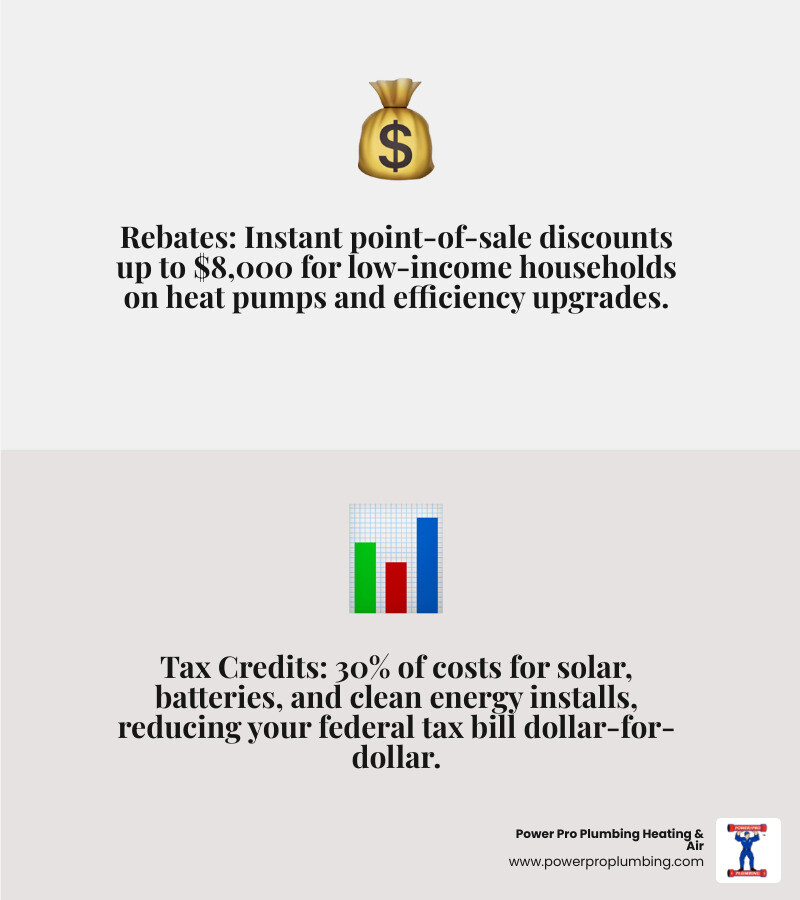
- Low-Income Households (<80% AMI): You may qualify for 100% of the project cost, up to specific caps. For example, you could receive up to $8,000 for a heat pump HVAC system.
- Moderate-Income Households (80%–150% AMI): You may qualify for 50% of the project cost, up to the same caps.
- Above 150% AMI: While you may not qualify for the HEEHRA rebates, you are still eligible for the federal tax credits, which we will cover below.
Current Status of Inflation Reduction Act Benefits for California Homeowners: Single-Family vs. Multifamily
As of April 2026, the landscape for these rebates has shifted. Because the demand was so high when the programs launched, the California Energy Commission (CEC) has had to manage the funds carefully.
Single-Family Homes: As of early 2026, the initial Phase I funding for HEEHRA single-family retrofits reached a "fully reserved" status. This means if you haven't applied yet, you will likely be placed on a waitlist. However, don't let that discourage you. A Phase II allocation of $152 million is in development, and the HOMES program (which targets whole-home savings) is rolling out "Pay for Performance" models that remain open to all income levels.
Multifamily Properties: If you own an apartment building or a duplex in areas like Long Beach or Glendale, there is great news. Multifamily rebates are currently active, providing up to $14,000 per unit for electrification upgrades. This is a massive win for property owners looking to increase property value while lowering overhead.
Eligible Upgrades and Inflation Reduction Act Benefits for California Homeowners
What exactly can you buy with this money? The list is extensive and covers the most energy-hungry parts of your home:
- Heat Pump HVAC Systems: Up to $8,000 in rebates. These systems handle both heating and cooling with incredible efficiency.
- Heat Pump Water Heaters: Up to $1,750 in rebates. Since water heating can account for up to 25% of your home's energy use, this is a top-tier upgrade.
- Electrical Panel Upgrades: Up to $4,000. Many older homes in Los Angeles need a panel "heavy up" to handle new electric appliances.
- Electric Wiring: Up to $2,500 to support your new equipment.
- Weatherization: Insulation, air sealing, and ventilation upgrades to keep that expensive conditioned air inside your home.
- Electric Stoves and Heat Pump Clothes Dryers: Smaller rebates are also available for these essential appliances.
Federal Tax Credits for Solar and Battery Storage
While rebates are great for immediate savings, the 30% Investment Tax Credit (ITC)—officially known as the Residential Clean Energy Property Credit—is the heavyweight champion of long-term savings.
Under the IRA, this 30% credit has been extended through 2032. Unlike the rebates, there is no maximum limit on the dollar amount you can claim. If you spend $30,000 on a massive solar array and battery setup, you can claim a $9,000 credit on your federal taxes.
One of the most important updates for 2026 is the inclusion of standalone battery storage. Previously, you had to install solar panels to get a tax credit for a battery. Now, if you just want a battery system (like a Tesla Powerwall) to protect your home in Burbank or Anaheim from grid outages, you can claim the 30% credit as long as the battery has a capacity of over 3 kWh.
Installing solar under the IRA is estimated to save homeowners roughly $300 per year on electricity, totaling about $9,000 over the life of the system. When paired with a battery, those savings can be even higher as you avoid "peak" utility rates during the evening.
Stacking Federal Credits with California Incentives
One of the best ways to maximize the inflation reduction act benefits for california homeowners is to "stack" federal money with our unique state programs. California has always been a leader in green energy, and we have several programs that work alongside the IRA:
| Program | What it Covers | How it Stacks |
|---|---|---|
| SGIP (Self-Generation Incentive Program) | Battery Storage | Provides an upfront rebate that can be combined with the 30% federal tax credit. |
| TECH Clean California | Heat Pumps & Water Heaters | Offers localized rebates (often $1,000+) that work in tandem with HEEHRA. |
| Equitable Building Decarbonization | Low-income retrofits | Direct-install programs that provide no-cost upgrades for qualifying households. |
| Property Tax Exclusion | Solar Installations | Prevents your property taxes from going up even though your home value increased due to solar. |
By combining these, it is possible for some low-income households to have nearly 100% of their electrification costs covered, while moderate-income families can often cut their net costs by more than half.
How to Safely Apply and Avoid Rebate Scams
With hundreds of millions of dollars flowing into the state, scammers have unfortunately come out of the woodwork. They often knock on doors in neighborhoods like Whittier or Torrance, claiming they can get you "free government money" if you provide your Social Security number or pay an upfront "processing fee."
To stay safe and ensure you actually receive your inflation reduction act benefits for california homeowners, follow these professional rules:
- Work ONLY with TECH-Certified Contractors: The HEEHRA and HOMES programs require that work be performed by contractors who are specifically trained and registered with TECH Clean California. We always recommend checking the "Switch Is On" contractor finder to verify a company's credentials.
- Verify the HEEHRA Badge: Authorized contractors will have a specific HEEHRA-trained badge. This ensures they know how to submit the reservation requests that lock in your funding.
- Income Verification First: You must complete the income verification process through the official state portal before the work begins. If a contractor says they can "figure it out later," walk away.
- No Upfront Fees for Rebates: There is never a fee to "apply" for these federal funds. If someone asks for a deposit just to fill out the paperwork, it is a scam.
- Get a Reservation Number: For HEEHRA rebates, your contractor must provide you with a reservation confirmation. This is your guarantee that the money is set aside for your project.
Frequently Asked Questions about California Energy Rebates
What is the difference between a tax credit and a rebate?
A rebate is like a coupon or cash back; it reduces the actual price you pay for the equipment. In many cases, these are applied at the point of sale. A tax credit reduces the amount of income tax you owe to the IRS. If you owe $5,000 in taxes and have a $2,000 credit, you only pay $3,000. These are "non-refundable," meaning if you don't owe taxes, you don't get a check for the difference (though some credits can be carried forward to future years).
Can I still get a rebate if the single-family fund is reserved?
Yes, but you have to be strategic. While the HEEHRA Phase I single-family funds are currently on a waitlist, the HOMES program is launching its "Pay for Performance" model. This program rewards you based on actual measured energy savings after the installation. Additionally, state-level programs like TECH Clean California often have their own separate funding pools that aren't tied to the federal waitlist.
How much can I save on my monthly utility bills?
While every home is different, the DOE estimates the average household saves about 20% on utility bills after proper weatherization and high-efficiency upgrades. Switching to a heat pump can save hundreds per year compared to old electric baseboard heat or propane. Furthermore, if you switch to an Electric Vehicle (EV) as part of your home energy plan, you could save an average of $950 a year on fuel costs alone.
Conclusion
Navigating the inflation reduction act benefits for california homeowners can feel like a full-time job, but the financial rewards are well worth the effort. From $8,000 heat pump rebates to the 30% solar tax credit, the tools to lower your carbon footprint and your monthly bills are finally within reach.
At Power Pro Plumbing Heating & Air, we are proud to serve the Los Angeles County, Orange County, and South Bay communities. As a Daikin Comfort Pro with over 28,000 online reviews, our licensed technicians are here to help you understand which high-efficiency systems are right for your specific home. We believe in building a more comfortable, energy-independent California, one home at a time.
Whether you're in Santa Monica, Irvine, or the San Gabriel Valley, we're here when you need us with the expertise to make these federal incentives work for you.