

Why Slow Drains Are a Common Problem in Los Angeles and Orange County Homes
What causes slow drains in Los Angeles and Orange County homes is one of the most frequent plumbing questions homeowners across the region ask — and for good reason. Southern California's unique combination of hard water, aging housing stock, and mature landscaping creates drain problems that go far beyond a simple hair clog.
Here is a quick look at the most common causes:
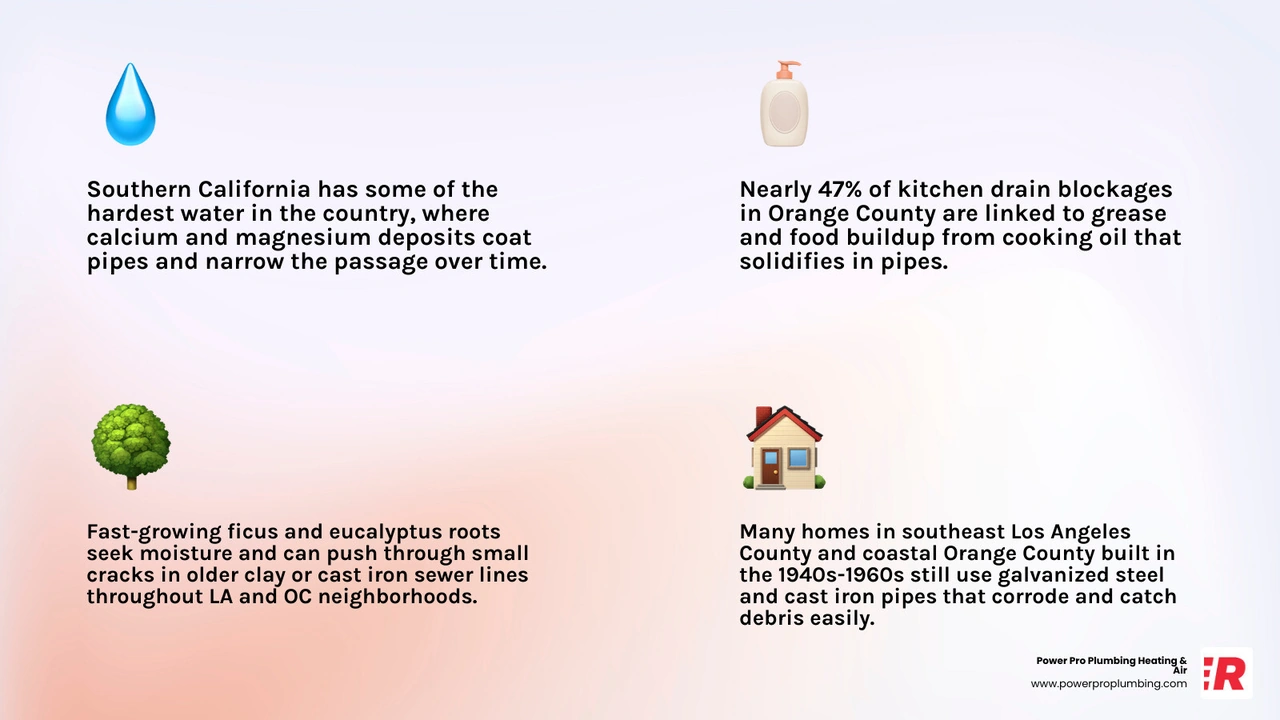
- Hard water mineral buildup — Southern California has some of the hardest water in the country. Calcium and magnesium deposits coat the inside of pipes over time, narrowing the passage and slowing flow.
- Grease and food waste — Cooking oil and grease solidify as they cool, sticking to pipe walls and trapping food particles. Nearly 47% of kitchen drain blockages in Orange County are linked to grease and food buildup.
- Hair and soap scum — Hair acts like a net inside bathroom drains, catching soap residue and body oils until water can barely pass through.
- Tree root intrusion — Fast-growing species like ficus and eucalyptus are common in LA and OC neighborhoods. Their roots seek out moisture and can push through even small cracks in older clay or cast iron sewer lines.
- Aging pipes — Many homes in southeast Los Angeles County and coastal Orange County were built in the 1940s through 1960s. Galvanized steel and cast iron pipes corrode over decades, creating rough interior surfaces that catch debris far more easily than smooth modern pipe materials.
- Flushing the wrong things — A 2023 survey found that 40% of Los Angeles residents admitted to flushing wipes, which do not break down in pipes and contribute directly to blockages.
A slow drain is rarely just a minor inconvenience. It is usually the first visible sign that something deeper is developing inside your plumbing system — and the longer it goes unaddressed, the worse it tends to get.
I'm Daniel Rodriguez, a second-generation tradesman with C36 and C20 licenses in plumbing and HVAC, and I've spent years working with homeowners across Greater Los Angeles and Orange County to diagnose exactly what causes slow drains in Los Angeles and Orange County homes before small problems become costly emergencies. Whether the culprit is hard water scale, root intrusion, or decades-old pipes, understanding the root cause is always the first step toward a lasting fix.
What Causes Slow Drains in Los Angeles and Orange County Homes?
When water lingers in your sink, shower, or tub, it is easy to assume a quick plunge will solve the problem. However, the plumbing systems in Southern California face a unique set of environmental and structural challenges. To understand why your drains are slowing down, we have to look at how different materials interact inside your pipes over time.
For most homes in areas like Long Beach, Anaheim, and Torrance, slow drains do not happen overnight. Instead, they are the result of a gradual narrowing process. Think of your drain pipes like the plumbing version of a highway: as debris builds up along the walls, the space available for water to flow gets smaller and smaller.
Understanding what is allowed down your plumbing is the first line of defense. There are certain everyday items that should never find their way into your plumbing system under any circumstances. If you want to protect your pipes, check out our guide on 3 Things You Should Never Put Down in the Drain to keep major blockages from forming.
What Causes Slow Drains in Los Angeles and Orange County Homes: The Impact of Hard Water
One of the biggest hidden culprits behind slow-moving drains in Southern California is our water chemistry. Hard water affects nearly 85% of U.S. homes, and the Greater Los Angeles and Orange County regions are major hotspots for high mineral content.
Hard water contains elevated concentrations of dissolved minerals, primarily calcium and magnesium. As this water flows through your plumbing system, these minerals naturally precipitate out and cling to the inner walls of your pipes. Over months and years, this creates a hard, chalky white substance known as limescale or mineral scale.
This mineral scale has two major impacts on your drainage system:
- Physical Narrowing: Just like plaque in an artery, limescale physically reduces the internal diameter of your pipes. A pipe that started with a two-inch opening can easily be restricted to less than an inch over a decade of hard water exposure.
- Rough Surfaces: Freshly installed pipes are smooth, allowing water and waste to slide through easily. Limescale, however, is incredibly rough and porous. It acts like sandpaper inside your drains, catching hair, soap scum, and food waste that would otherwise wash away cleanly.
This issue is particularly severe in coastal Orange County cities like Seal Beach, Huntington Beach, and Newport Beach. In these beachside communities, the mineral content in the municipal supply is exceptionally high. Homeowners in these areas often notice slow-draining bathroom sinks and showers long before they experience a complete blockage.
It is also worth noting that these same minerals settle heavily in your water heating system. If you are noticing sluggish performance or strange popping noises from your water heater alongside your slow drains, you may want to read our advice on Addressing Water Heater Sediment Buildup to protect your appliances from hard water damage.
Everyday Waste: What Causes Slow Drains in Los Angeles and Orange County Homes
While hard water sets the stage by roughening and narrowing your pipes, everyday household waste is what usually triggers the actual slowdown. In the kitchen and bathroom, different types of waste combine to form highly stubborn blockages.
Kitchen Drains: The Sticky Trap of Grease and Food
In the kitchen, the primary enemy is grease, fat, and cooking oil. When you pour warm grease down the sink, it looks like a harmless liquid. However, as soon as it hits the cooler pipes underground, it rapidly solidifies.
This hardened grease coats the bottom and sides of your drain lines, creating a sticky trap. When small food scraps, coffee grounds, pasta, or rice go down the drain, they get caught in the grease. Because starchy foods like pasta and rice expand when wet, they quickly swell and create a dense, doughy plug.
An estimated 47% of kitchen drain blockages in Orange County are directly related to grease and food buildup. This problem is especially common in older neighborhoods like Bellflower and parts of southeast Los Angeles County. Many homes here were constructed in the 1940s and 1950s without garbage disposals. Over the years, kitchens in these historic homes have struggled with food waste entering plumbing lines that were simply never designed to handle solid debris. To keep your kitchen running smoothly, check out our best practices on How to Keep Your Drain Lines Clear.
Bathroom Drains: Hair and Soap Scum
In your bathrooms, the primary cause of slow drains is a combination of hair and soap residue.
- Hair Netting: Human hair and pet fur do not break down in water. As they wash down the drain, they catch on rough pipe joints, rust, or mineral scale. Over time, they weave together to form a highly effective net.
- Sticky Soap Scum: Traditional bar soaps are made with natural fats and oils. When these fats mix with the calcium and magnesium in Southern California’s hard water, they react to form a sticky, insoluble substance known as soap scum.
This sticky scum coats the hair net, trapping toothpaste, shaving cream, skin flakes, and beauty products. What starts as a few loose strands of hair quickly grows into a thick, waterproof barrier that allows water to drain only at a agonizingly slow crawl.
Tree Roots and Aging Pipes in Historic Neighborhoods
While kitchen and bathroom clogs usually happen close to the fixture, some of the most severe slow drains are caused by issues deep underground. In older, established neighborhoods across Los Angeles and Orange County—such as Pasadena, historic parts of Santa Ana, and the Palos Verdes Peninsula—the combination of mature landscaping and aging infrastructure is a major recipe for plumbing trouble.
Many homes built between the 1920s and 1970s rely on original sewer lines made of clay, cast iron, or galvanized steel. While these materials were the industry standard at the time, they have distinct vulnerabilities as they age:
- Clay Pipes: Commonly used for main sewer lines in older homes, clay is highly susceptible to cracking as the soil shifts over decades. It also features numerous joint connections that can loosen, creating easy entry points for thirsty tree roots.
- Cast Iron and Galvanized Steel: These metal pipes naturally corrode from the inside out over fifty to eighty years. As they rust, the interior walls bubble and scale, catching hair and debris. Eventually, this corrosion can cause the pipe walls to collapse entirely.
Tree roots are naturally drawn to sewer lines because they carry a constant flow of water, oxygen, and warm nutrients. Fast-growing trees like ficus, eucalyptus, and mature palms have sprawling root systems that can travel dozens of feet in search of moisture. Even a hairline crack or a slightly loose joint in an old clay pipe is enough for a tiny root hair to wiggle inside. Once inside, the root feeds on the wastewater, expanding rapidly until it fills the pipe or breaks it completely.
In California, tree root intrusion is incredibly common, accounting for up to 50% of all sewer backups and overflows. If you suspect your plumbing is suffering from structural damage due to roots or age, it is critical to recognize the warning signs early. Read more about what to look for in our guide on 5 Warning Signs That Indicate Sewer Damage.
Early Warning Signs of Sewer Line Damage
A slow-draining sink or shower is annoying, but how do you know if the issue is a simple localized clog or a major sewer line failure? Main sewer line issues usually show themselves through very specific, system-wide symptoms:
- Multiple Slow Drains: If only your kitchen sink is slow, the clog is likely in that specific branch line. However, if your kitchen sink, guest bathroom shower, and master toilet are all draining slowly at the exact same time, the blockage is almost certainly in the main sewer line.
- Gurgling Sounds: When water struggles to pass a blockage in the main line, air bubbles get trapped and push backward. This causes a distinct gurgling or bubbling sound to come from your toilets, shower drains, or wet bars when you run a washing machine or empty a bathtub.
- Sewage Odors: A healthy plumbing system keeps sewer gases sealed away. If you notice a persistent, foul sewer smell in your yard, basement, or near your indoor drains, it indicates that wastewater is backing up or escaping through a broken pipe.
- Cross-Fixture Backups: If you flush your toilet and water starts rising up through your shower drain, or if running your washing machine causes your kitchen sink to overflow, your main line is backed up. The water has nowhere to go, so it reverses course and exits through the lowest open drains in your home.
Ignoring these early warning signs can lead to major water damage and costly cleanups. To understand how we catch these issues before they turn into emergencies, learn how Sewer Line Inspections Prevent Plumbing Issues.
Professional Solutions for Stubborn Clogs
When faced with a slow drain, many homeowners reach for a plunger or a plastic zip-it tool. While these can work for minor, shallow clogs near the sink basin, they rarely solve deep-seated or recurring drain issues.
To permanently restore your home's water flow, it helps to understand the difference between temporary drain clearing and professional drain cleaning.
- Drain Clearing (The Quick Fix): This involves using a basic hand plunger or a mechanical drain snake (or auger) to punch a hole through a blockage. While this allows water to start flowing again, it leaves the grease, hair, and mineral scale stuck to the pipe walls. The clog will almost always return within a few weeks or months.
- Drain Cleaning (The Permanent Restoration): This is a comprehensive, professional process designed to scrub the pipe walls completely clean, returning the pipe's interior to like-new condition.
| Feature | Temporary Drain Clearing (Plunging / Snaking) | Professional Drain Cleaning (Hydro Jetting) |
|---|---|---|
| Primary Goal | Punch a hole through an active blockage to restore basic flow | Scrub the entire pipe interior clean of grease, scale, and roots |
| Effectiveness | Short-term; leaves residue behind that traps new debris | Long-term; restores the full original diameter of the pipe |
| Root Removal | Can tear through some roots but leaves major root systems intact | Cuts roots flush with the pipe wall, delaying future intrusion |
| Best For | Simple, localized clogs (like a hair clump in a P-trap) | Recurring clogs, heavy grease, mineral scale, and main lines |
If you are ready to bring in the pros to clear your home's lines for good, you can learn more about our process by checking out What to Expect with Professional Drain Cleaning Service.
Advanced Techniques for Restoring Pipe Flow
To achieve true drain cleaning, professional plumbers use advanced technology designed to diagnose and clear pipes safely and effectively.
1. Sewer Camera Inspections
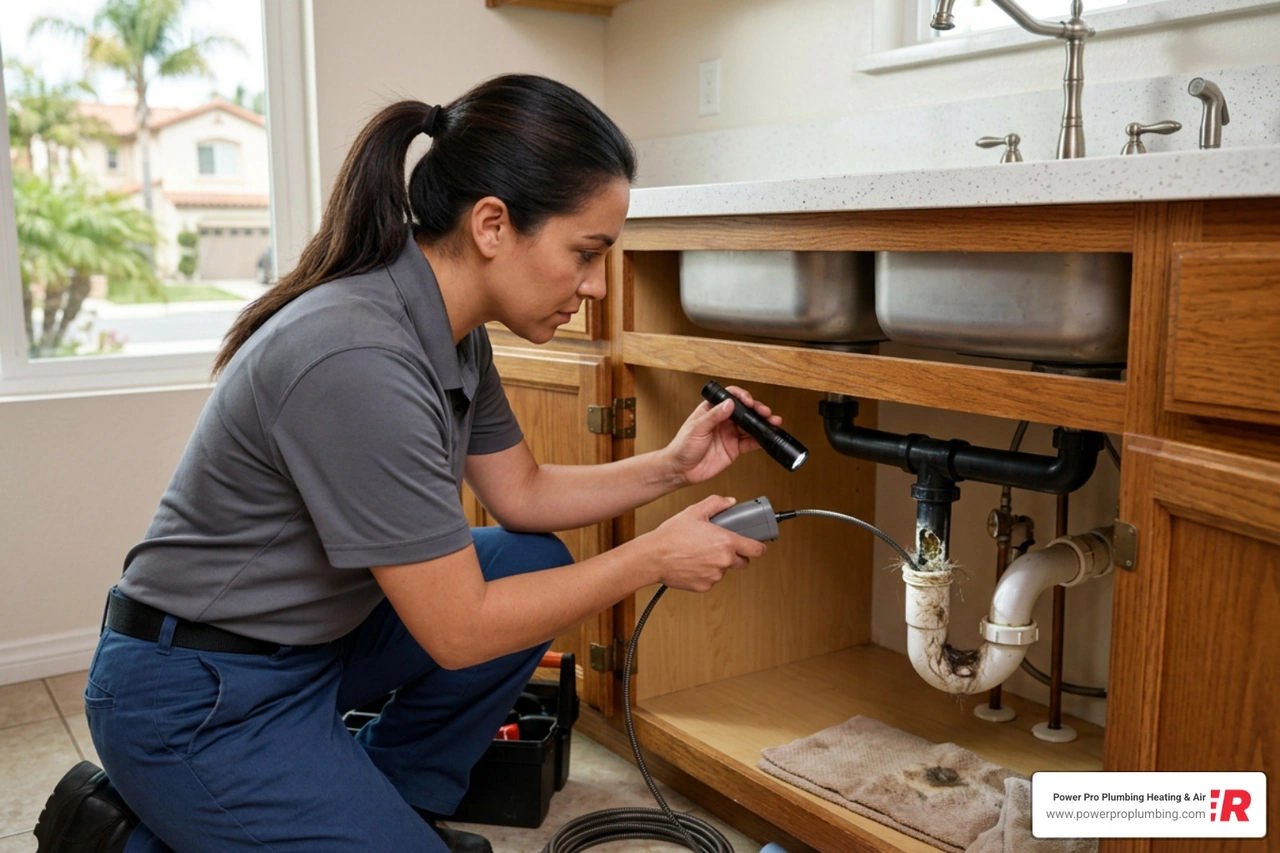
Before we perform any heavy-duty cleaning, we need to see exactly what is going on inside your pipes. We insert a high-definition, waterproof camera attached to a flexible fiber-optic cable into your cleanout. This allows us to inspect the interior of your sewer lines in real-time. We can pinpoint the exact location of root intrusions, locate collapsed sections of pipe, and identify whether your slow drains are caused by grease, mineral scale, or structural sagging.
2. Hydro Jetting
For stubborn clogs, heavy grease buildup, and thick mineral scale, hydro jetting is the gold standard. This method uses a specialized machine to pump highly pressurized water (often up to 4,000 PSI) through a multi-directional nozzle inserted into your pipes.
The high-pressure water acts like a pressure washer for your plumbing, slicing through tree roots, blasting away hardened grease, and scouring mineral scale off the pipe walls without damaging the pipe itself. To find out if this method is right for your home, take a look at our Hydro Jetting Clogged Drain Complete Guide and explore What Are the Advantages of Hydro Jetting for your home's long-term plumbing health.
Frequently Asked Questions About Southern California Drain Issues
Dealing with persistent drain issues can be incredibly frustrating. Here are some of the most common questions we hear from homeowners across Los Angeles and Orange County regarding how to handle slow-moving pipes. For even more detailed troubleshooting, you can read our guide on Solutions for Persistent Clogged Drains.
Can I use chemical drain cleaners on older pipes?
We strongly advise against using store-bought chemical drain cleaners, especially if you live in an older Southern California home with galvanized steel, cast iron, or clay pipes.
These chemical products rely on harsh, caustic ingredients (like sodium hydroxide or sulfuric acid) to dissolve clogs. When these chemicals sit in a slow-draining pipe, they generate intense chemical heat. In older metal pipes, this heat and acidity accelerate corrosion, eating away at the pipe walls and leading to pinhole leaks or complete pipe collapses. In plastic PVC pipes, the heat can warp the joints, causing hidden leaks behind walls or under your foundation.
Furthermore, chemical cleaners rarely solve the root cause of the issue. They might melt a tiny pathway through a clog, but they will not clear out thick mineral scale or tree roots. For a safer, eco-friendly alternative, try using a mixture of baking soda and hot water for minor kitchen buildup, or stick to manual plunging.
How often should I schedule professional drain cleaning?
For most standard homes, scheduling a professional drain cleaning once a year is an excellent preventive habit. However, your ideal schedule depends heavily on your location and the age of your property:
- Hard Water Areas: If you live in coastal Orange County cities like Seal Beach or Huntington Beach where hard water is severe, you may benefit from professional cleaning every six months to prevent mineral scale from narrowing your lines.
- Older Neighborhoods with Mature Trees: If your home has clay sewer lines and is surrounded by large trees, a camera inspection and light cleaning every six to twelve months will keep invasive roots from destroying your sewer main.
Investing in routine maintenance is always more cost-effective than dealing with an emergency sewer backup. To see how regular care saves you money and stress, read about the Benefits of Drain Cleaning Services.
When should I call a professional plumber for a slow drain?
While a slow bathroom sink can often wait a few days, you should call a professional plumber immediately if you experience any of the following:
- Multiple Slow Drains: If more than one fixture is draining slowly, it indicates a main sewer line issue that DIY methods cannot reach.
- Gurgling Toilets: If your toilet bubbles or gurgles when you run the sink or washing machine, air is trapped deep in your system by a developing backup.
- Persistent Sewer Odors: Foul smells indicate that sewer gases—or actual wastewater—are escaping your pipes.
- Water Backing Up: If water backs up into your shower when you flush the toilet or run the washing machine, your system is on the verge of a major overflow.
If you want to brush up on your plumbing knowledge before calling us, we have put together 6 Tricks About Drain Cleaning That You Must Know to help you make informed decisions.
Conclusion
At the end of the day, understanding what causes slow drains in Los Angeles and Orange County homes is the key to protecting your property and keeping your daily routine running smoothly. From the heavy mineral scale of coastal Orange County to the mature tree roots of historic Los Angeles neighborhoods, Southern California plumbing systems face unique environmental challenges that require smart, proactive care.
By adopting simple preventive habits—like keeping grease out of your kitchen sink, using drain strainers to catch bathroom hair, and skipping harsh chemical cleaners—you can significantly reduce the risk of sudden backups. However, when stubborn mineral scale, decades of grease, or invasive tree roots take hold, professional maintenance is the only way to truly restore your pipes.
At Power Pro Plumbing Heating & Air, we have spent years helping our neighbors across the Greater Los Angeles Area, Orange County, and the South Bay keep their plumbing systems in peak condition. With licensed technicians, same-day service availability, and a trusted reputation backed by over 28,573 online reviews, we are here to handle everything from routine maintenance to emergency sewer line repairs.
Do not let a slow drain turn into a major plumbing emergency. Contact us today or Schedule Professional Drain Cleaning Today to get your home's water flowing freely again!