

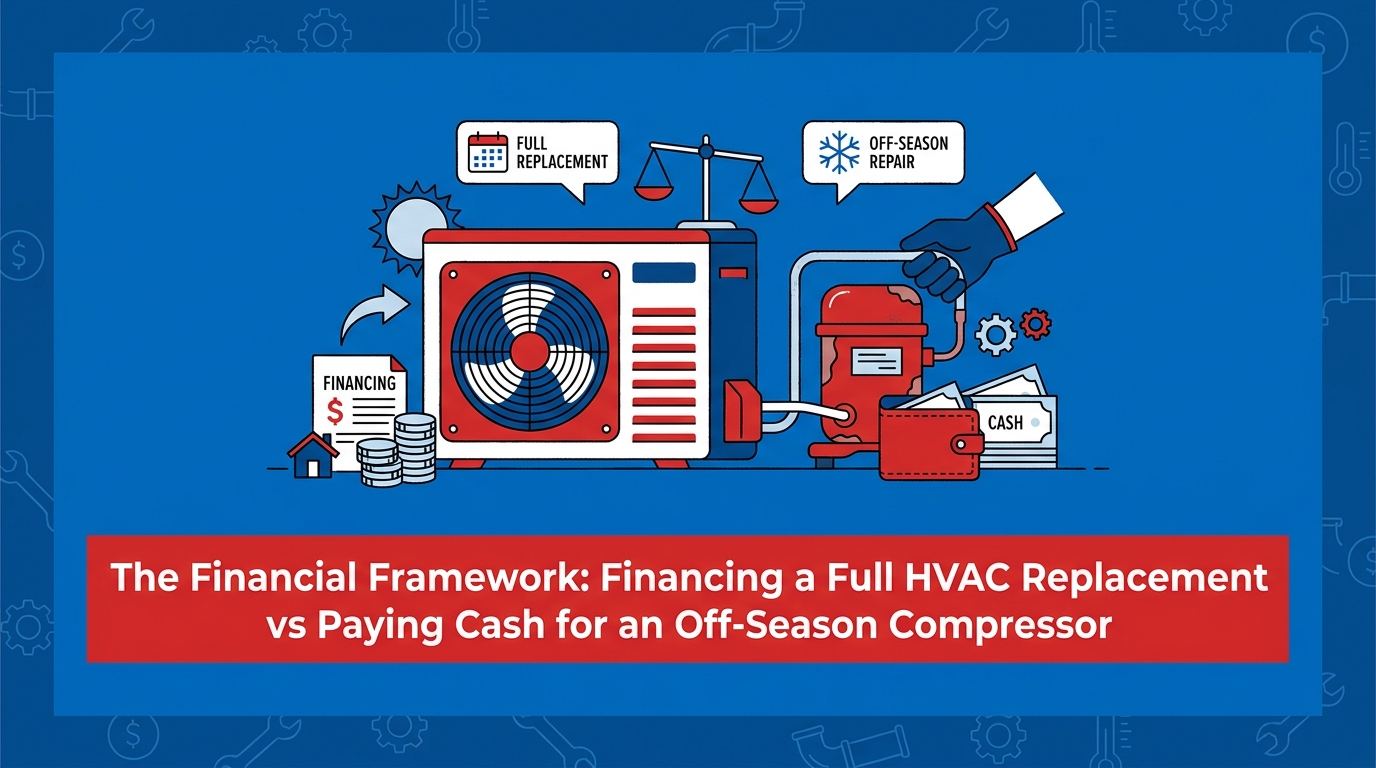
Is It Better to Patch an Aging AC or Upgrade the Whole System?
Are you trying to decide between financing a full HVAC replacement vs paying cash for an off-season compressor repair? It is incredibly frustrating when a major system component fails right as the hottest days of the year are finally ending. You expect your equipment to carry you through the finish line, but instead, you are left staring at a broken unit and a difficult financial decision.
At Power Pro Plumbing, Heating & Air, we see this scenario present a concrete problem for many Cerritos homeowners: do you sink a large lump sum of liquid cash into an aging, inefficient unit just to keep it limping along, or do you leverage modern financing to upgrade the entire system? Because this breakdown happened during the mild September transition, you have a unique advantage. The immediate, sweltering heat of peak summer has passed, removing the "emergency sweat" factor from your decision-making process. You have the luxury of time to evaluate your options without the pressure of a boiling house.
To make the best choice for your home and your wallet, you need a strategic financial framework. This means looking beyond the immediate fix and evaluating the long-term costs of running older air conditioning systems. By exploring flexible HVAC financing options, you can preserve your liquid cash while securing a reliable, energy-efficient system that will serve your home for years to come.
The Opportunity Cost of a Major Component Repair
When a compressor dies, it is rarely an isolated incident. The compressor is the heart of your cooling system, and its failure is often a symptom of broader, system-wide wear and tear. Paying cash out-of-pocket for a band-aid repair on an older system carries a significant opportunity cost.
Understanding the "5,000 Rule"
Industry professionals often use a baseline calculation known as the "5,000 rule" to help homeowners evaluate repairs. Here is how it works:
1. Determine the age: Find the exact age of your current cooling unit in years.
2. Estimate the repair: Take the quoted cost of the compressor replacement.
3. Multiply the two: Multiply the age by the repair cost.
4. Evaluate the result: If the resulting number exceeds 5,000, replacing the entire system is generally considered the more financially sound decision.
If your unit is 12 years old and requires a major, expensive component replacement, the math quickly points toward upgrading. However, the financial implications go beyond a simple calculation.
The Domino Effect of Aging Parts
Depleting your cash reserves on a single component ignores the reality of aging equipment. In our years of servicing Southern California HVAC systems, our team has seen this pattern often: when you install a brand-new compressor into a decade-old system, that new part must now work alongside an old blower motor, worn electrical contactors, and aging evaporator coils. The stress of operating with mismatched, degraded components can cause those older parts to fail shortly after your repair. You have spent a large sum of cash, but you are still vulnerable to future breakdowns.
Furthermore, out-of-pocket repairs on aging units offer very limited warranties. A replacement compressor might carry a one-year part warranty, but the rest of the system remains entirely unprotected. If the blower motor fails a month later, you are paying out of pocket again.
Most importantly, replacing a compressor does nothing to improve the overall efficiency of your existing system. An older unit in Cerritos and surrounding Southern California areas will continue to draw the same high amount of electricity it always has. When evaluating the choice between repairing vs replacing a blown AC compressor, you must factor in the ongoing penalty of high utility bills that a repair forces you to keep paying.
Why the Early Fall Off-Season is the Ideal Time to Upgrade
Timing plays a massive role in home improvement decisions. Experiencing a breakdown during the mild September transition is actually a strategic advantage that our installation crews highly recommend taking advantage of. Making major HVAC decisions during the mild transition months before winter heating demands begin puts you in the driver's seat.
The Luxury of Calm Decision-Making
Contrast the environment of early fall against a mid-summer breakdown. In July or August, a dead AC is a household emergency. Families often make panicked, rushed choices simply to get the cold air flowing again, sometimes settling for subpar equipment or draining their savings because they cannot afford to wait. In the fall, the weather is forgiving. You can take a few days to research equipment, compare efficiency ratings, and review financing terms without sacrificing your family's comfort.
Flexible Scheduling and System Integrity
Off-season scheduling often allows for much more flexible installation timelines. During peak summer, installation crews are booked weeks out. In the fall, you can often choose an installation date that perfectly fits your schedule. Installers have more breathing room to ensure every detail of your new system is calibrated perfectly.
Additionally, coastal-adjacent climates require reliable transitions from summer cooling to winter heating. The changing seasons mean your home will soon rely on the heating side of your HVAC setup. Evaluating the entire system now ensures both cooling and heating components are fully operational before temperatures drop. By taking advantage of this off-season window to replace the whole unit, you prevent a secondary, unexpected breakdown when you turn your furnace or heat pump on for the first time this winter.
Evaluating the Out-of-Pocket Compressor Fix
To make an informed decision, it helps to break down the realities of paying cash for a compressor replacement. While it might seem like the quickest path forward, it requires a balanced, objective view of what you are actually getting for your money.
Pros of a Cash Repair
• Short-term system extension: If the rest of the unit has been meticulously maintained and is in pristine condition, a new compressor might keep the current system running for a few more seasons.
• No new monthly obligations: Paying cash means you avoid taking on a new monthly payment structure, keeping your monthly debt-to-income ratio exactly where it is.
Cons of a Cash Repair
• Immediate cash drain: It drains your immediate liquid cash without guaranteeing the longevity of the blower motor, coils, or heat exchanger. That cash is gone, and the risk of future repairs remains high.
• Stagnant technology: You miss out on the incredible energy efficiency gains of modern technology. Your home will continue to cool at the efficiency standards of a decade ago.
• Mismatched wear: A powerful new compressor can sometimes over-stress older, weaker components in the system, accelerating their decline.
Before committing to a costly repair, you need a clear picture of your equipment's overall health. During a recent evaluation in our area, one of our Power Pro technicians provided a patient explanation of problems and probable solutions for a homeowner facing this exact dilemma. Our service manager also stepped in to review the system's history, ensuring the customer understood the true condition of their equipment before making a choice. That level of transparency is essential when weighing a major cash repair against a full upgrade.
The Strategic Advantage of Financing a Full Replacement
Our team frequently speaks with homeowners who view financing purely as a fallback option when they lack the cash for a repair. However, in our professional experience with modern home management, financing is a cash-flow preservation tool that makes a comprehensive system upgrade financially superior to a band-aid repair.
Transforming Lump Sums into Predictable Overhead
Financing transforms a large, unexpected lump-sum expense into a predictable, manageable monthly operational cost. Instead of wiping out your emergency savings to fix a broken compressor, you can keep that cash liquid for other investments or unexpected life events. By spreading the cost of a new system over several years, you maintain control over your household cash flow.
Access to Higher-Tier Technology
One of the biggest advantages of utilizing flexible payment plans is that it broadens your options. When paying strictly with cash, you might be forced to choose the most basic, entry-level replacement unit available. Financing allows you to upgrade to higher-tier, energy-efficient models—such as variable-speed heat pumps or high-SEER2 air conditioners—that you might not purchase with pure cash. These advanced systems provide superior humidity control, quieter operation, and significantly lower monthly energy consumption.
Comprehensive Peace of Mind
When you finance a full replacement during the mild September transition, you are also investing in peace of mind. Entirely new systems come with comprehensive manufacturer warranties that cover parts (and sometimes labor) for a decade or more. If a component fails three years from now, you are protected. You are no longer living with the underlying anxiety of wondering which aging part will break next. Financing is not just about paying for metal and wires; it is a strategic financial tool used to secure long-term home stability.
Factoring Long-Term Efficiency and Generic Incentives into Your Decision
When comparing the cost of a repair versus a replacement, you must factor in the monthly savings generated by new technology. A new system does not just cost money; it also saves money on a monthly basis, which helps offset the financed amount over time.
The Impact of Modern Efficiency Standards
HVAC technology has advanced rapidly over the last 15 to 20 years. Modern, high-efficiency systems significantly reduce monthly energy consumption compared to older units. Features like variable-speed compressors allow the system to run at lower capacities, maintaining a consistent temperature without the constant, energy-draining "on and off" cycling of older single-stage units. Homeowners in Cerritos and surrounding Southern California areas often notice a distinct drop in their monthly utility bills after upgrading.
This reduction in monthly utility costs can partially offset the monthly financing payment of a new system. If your new system saves you a measurable amount on electricity each month, the true "net cost" of your financing payment is lower than it appears on paper.
Leveraging Generic Incentives
Beyond monthly energy savings, upgrading to high-efficiency equipment often qualifies you for various generic incentives. Federal tax credits and local utility rebates may apply to qualifying high-efficiency heat pump and HVAC installations. These programs are designed to encourage homeowners to adopt greener, more efficient technologies.
While specific programs and amounts vary by location and tax year, these incentives can significantly improve the return on your investment. We always advise readers to verify current programs with their local utility provider or a qualified tax professional to ensure they maximize their available benefits.
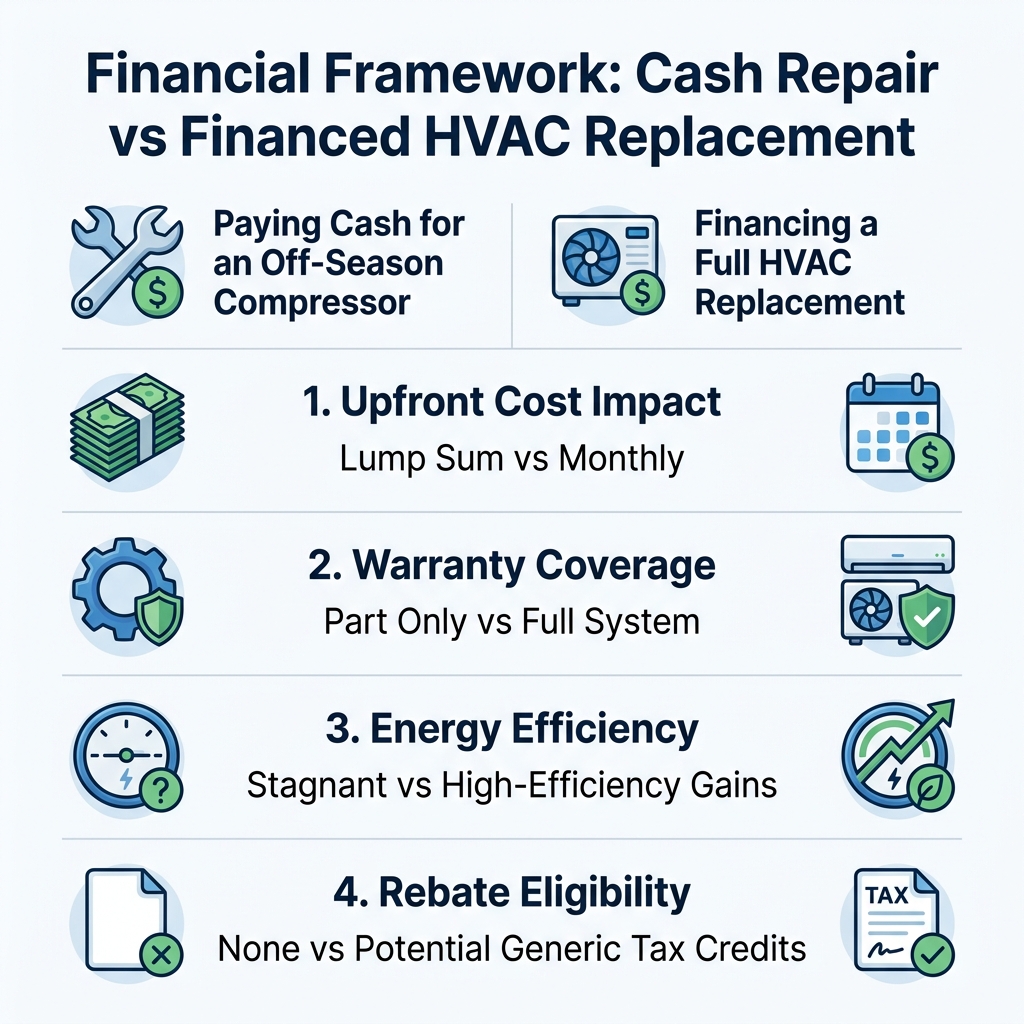
Side-by-Side Comparison: Cash Repair vs. Financed Replacement
To synthesize this decision, it helps to look at a clear comparative framework summarizing the financial and operational impacts of both choices. As one local homeowner noted when their heating system needed repair, having a professional who shows up on time, fixes the immediate issue, and explains the underlying problem clearly makes it much easier to weigh these options.
• Upfront Financial Impact — Out-of-Pocket Compressor Repair: Significant lump-sum cash drain from savings. — Financed Full System Replacement: Zero or low upfront cost; predictable monthly payments.
• Warranty Coverage — Out-of-Pocket Compressor Repair: Typically 1-year warranty on the compressor only. — Financed Full System Replacement: 10+ year comprehensive manufacturer warranty on the system.
• Energy Efficiency — Out-of-Pocket Compressor Repair: Stagnant; remains at the efficiency level of an aging unit. — Financed Full System Replacement: High-efficiency gains; lowers monthly utility consumption.
• Future Reliability — Out-of-Pocket Compressor Repair: High risk of other aging components failing soon. — Financed Full System Replacement: Maximum reliability; all new components working in harmony.
• Incentive Eligibility — Out-of-Pocket Compressor Repair: None. — Financed Full System Replacement: Potential eligibility for generic tax credits and rebates.
Choosing a full replacement offers long-term peace of mind, especially for homeowners looking to establish a reliable home infrastructure. Taking action during the mild September transition ensures you are prepared for the coming seasons without the stress of depleted savings. If you are ready to explore your options, the best first step is to schedule an HVAC evaluation to get a clear picture of your current system's health.

Frequently Asked Questions
Is it better to finance a new HVAC system or pay cash?
Financing is often the better strategic choice because it preserves your liquid cash for emergencies or other investments. Instead of draining your savings on a depreciating asset, financing allows you to spread the cost into predictable monthly payments. Furthermore, flexible payment plans often enable you to afford a higher-efficiency system that lowers your monthly utility bills.
Is replacing an AC compressor worth it on an older unit?
Replacing a compressor on an older unit is rarely worth the investment if the system is over 10 to 12 years old. The compressor is the most expensive part of the system, and putting a new one into an aging unit stresses other old components like the blower motor and coils. Using the "5,000 rule" (multiplying system age by repair cost) can help you mathematically determine when a replacement is the smarter move.
How long does a replaced AC compressor last?
While a brand-new compressor is built to last 10 to 15 years, its actual lifespan in a repaired system depends heavily on the condition of the surrounding parts. If the existing coils are dirty or the refrigerant lines have minor blockages, the new compressor will overwork and could fail prematurely. This is why full system replacements offer much better long-term reliability.
Can you finance an AC compressor repair?
Some contractors do offer financing for large repairs, but financing a single component on a dying system is generally not recommended. You end up making payments on a unit that remains inefficient and is still highly susceptible to further breakdowns. It is far more financially sound to apply that financing toward a completely new, fully warrantied system.
What efficiency standards should I look for in a new HVAC system to maximize long-term savings?
When upgrading, look for systems with high SEER2 (cooling) and HSPF2 (heating) ratings, as well as variable-speed technology. Variable-speed compressors adjust their output to match your home's exact needs, drastically reducing energy consumption compared to older single-stage units. Upgrading to these standards not only lowers your monthly utility bills but may also qualify you for generic energy rebates and tax credits.
Make the Smart Financial Choice for Your Home
Dealing with a major system failure is never easy, but approaching it with a strategic financial framework turns a stressful breakdown into an opportunity for an upgrade. By choosing to finance a full replacement during the off-season, you protect your liquid cash while securing long-term reliability and comfort. Reach out to our team at Power Pro Plumbing, Heating & Air today to evaluate your system and explore flexible financing plans that fit your budget.