

How Long Does a Central Air Conditioner Last in Greater Los Angeles?
The average lifespan of a central air conditioner in the greater los angeles area is shorter than most homeowners expect — and shorter than the national average. Here is a quick breakdown before we go deeper:
| Location | Typical AC Lifespan |
|---|---|
| Greater Los Angeles (overall) | 12-17 years |
| Coastal areas (Santa Monica, Venice, Long Beach) | 10-14 years |
| Mid-basin / inland LA neighborhoods | 12-16 years |
| San Fernando Valley / San Gabriel Valley | 10-15 years |
| National average (for comparison) | 15-20 years |
Key factors that determine where your system lands in that range:
- How consistently you schedule professional maintenance
- Which LA microclimate your home sits in (coastal, valley, or inland)
- Whether your system was correctly sized at installation
- How many cooling hours per year your unit runs
- Your home's exposure to salt air, dust, or Santa Ana wind events
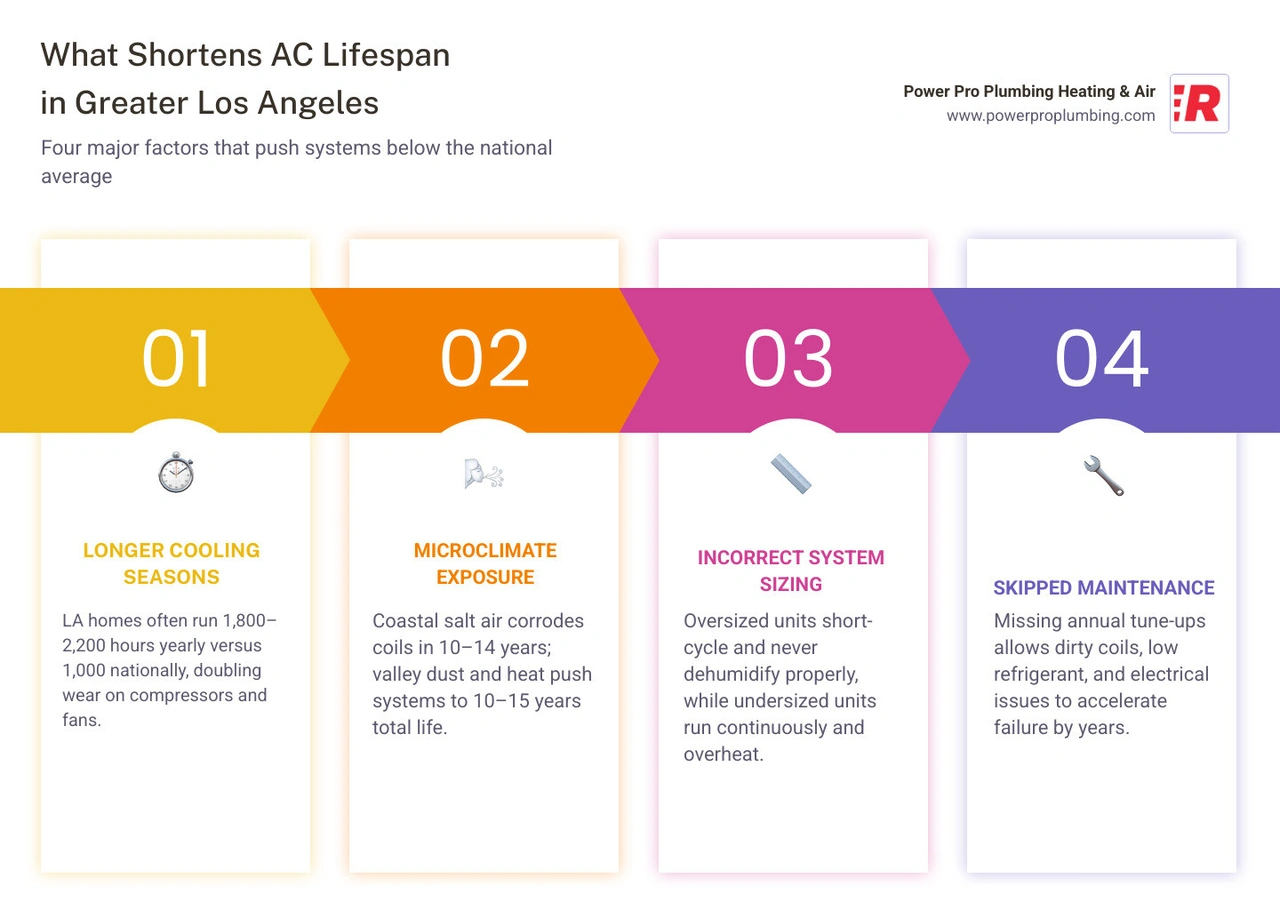
The gap between LA and the national average is not a minor footnote. A system that runs 2,000 hours per year wears out roughly twice as fast as one running 1,000 hours — and many Greater Los Angeles homes easily hit that higher number during long, hot cooling seasons that can stretch from April well into October.
Most homeowners are caught off guard when their system fails years ahead of schedule. The good news is that with the right information and the right habits, you can push your system toward the longer end of its realistic range — or at least plan your replacement before it becomes an emergency.
I'm Daniel Rodriguez, a second-generation tradesman with C20 HVAC and C36 plumbing licenses, and I have spent years working on and managing HVAC systems across Southern California — giving me knowledge of what truly determines the average lifespan of a central air conditioner in the greater los angeles area. In this guide, I'll walk you through everything you need to know to protect your investment and make smart decisions about your home's comfort system.
What is the Average Lifespan of a Central Air Conditioner in the Greater Los Angeles Area?
When manufacturers publish brochures, they love to highlight optimistic numbers. You will often see claims that a modern central air conditioning system will easily last 15 to 20 years, or even up to 25 years under "optimal conditions."
But let’s be honest: Southern California is rarely an "average" operating environment. In the Greater Los Angeles area, a realistic, real-world lifespan for a well-maintained central split-system air conditioner is typically 12 to 17 years.
If a system is neglected, that number can easily drop below 10 years. Conversely, high-quality, modern systems that receive consistent professional care can occasionally push past the 18-year mark, but they are the exception rather than the rule in our demanding climate.
To understand why this is the case, we have to look at how we use our systems. When you are planning for the future of your home's comfort, there are several vital factors to keep in mind, which we outline in our guide on 7 Things to Consider When Replacing Your AC.
Real-World Lifespan Expectations in Southern California
Different types of cooling systems experience different wear patterns under Southern California skies:
- Central Split Systems: These are the most common configurations in LA homes, consisting of an indoor evaporator coil (often paired with a gas furnace) and an outdoor condenser unit. In our region, these systems typically deliver 12 to 17 years of reliable service, depending heavily on the microclimate.
- Heat Pumps: Because they handle both heating and cooling, heat pumps run year-round. However, because LA winters are incredibly mild compared to the rest of the country, heat pumps do not suffer from the intense winter defrost cycles that wear them out in colder states. A well-maintained heat pump in LA can last a solid 12 to 18 years.
- Ductless Mini-Splits: These systems often utilize advanced inverter technology, which allows them to run at variable speeds rather than constantly cycling on and off. In older Los Angeles housing stock where ductwork is impractical, ductless mini-splits frequently achieve a service life of 15 to 20 years.
Why the Average Lifespan of a Central Air Conditioner in the Greater Los Angeles Area Diverges from National Averages
The primary culprit behind LA’s shortened AC lifespan is sheer run time. The national average central air conditioner runs for approximately 700 to 1,000 cooling hours per year.
In contrast, a system in the inland parts of Southern California (such as the San Gabriel Valley or the Inland Empire) routinely runs for 1,500 to 1,700 hours per year. If you move further out toward the desert areas, that number can skyrocket to 2,000 or even 2,400 hours annually.
A system running twice as many hours per year will naturally experience twice the mechanical wear. The constant thermal stress of our long cooling season—which often kicks off in April and refuses to quit until late October—means that motors, compressors, and electrical contacts age at an accelerated rate.
How Los Angeles Microclimates and Environmental Factors Affect AC Longevity
One of the most unique aspects of living in the Greater Los Angeles area is our microclimates. You can start your morning in the cool, damp marine layer of Santa Monica and drive thirty minutes inland to find the San Fernando Valley baking in triple-digit heat. These distinct environments place vastly different physical demands on your outdoor air conditioning equipment.
The table below illustrates how these regional environments directly impact the operational lifespan of your outdoor condenser unit:
| Microclimate Zone | Key Environmental Stressors | Average Expected Lifespan |
|---|---|---|
| Coastal Zones (e.g., Santa Monica, Long Beach) | High salt-air salinity, moisture, marine layer dampness | 10–14 Years (8–12 without protection) |
| Mid-Basin / Urban (e.g., Beverly Hills, Culver City) | Urban pollution, smog, light dust, moderate run times | 12–16 Years |
| Inland Valleys (e.g., San Fernando Valley, Pasadena) | Extreme summer heat waves, high dust, extended run times | 10–15 Years |
Coastal Zones vs. Inland Valleys
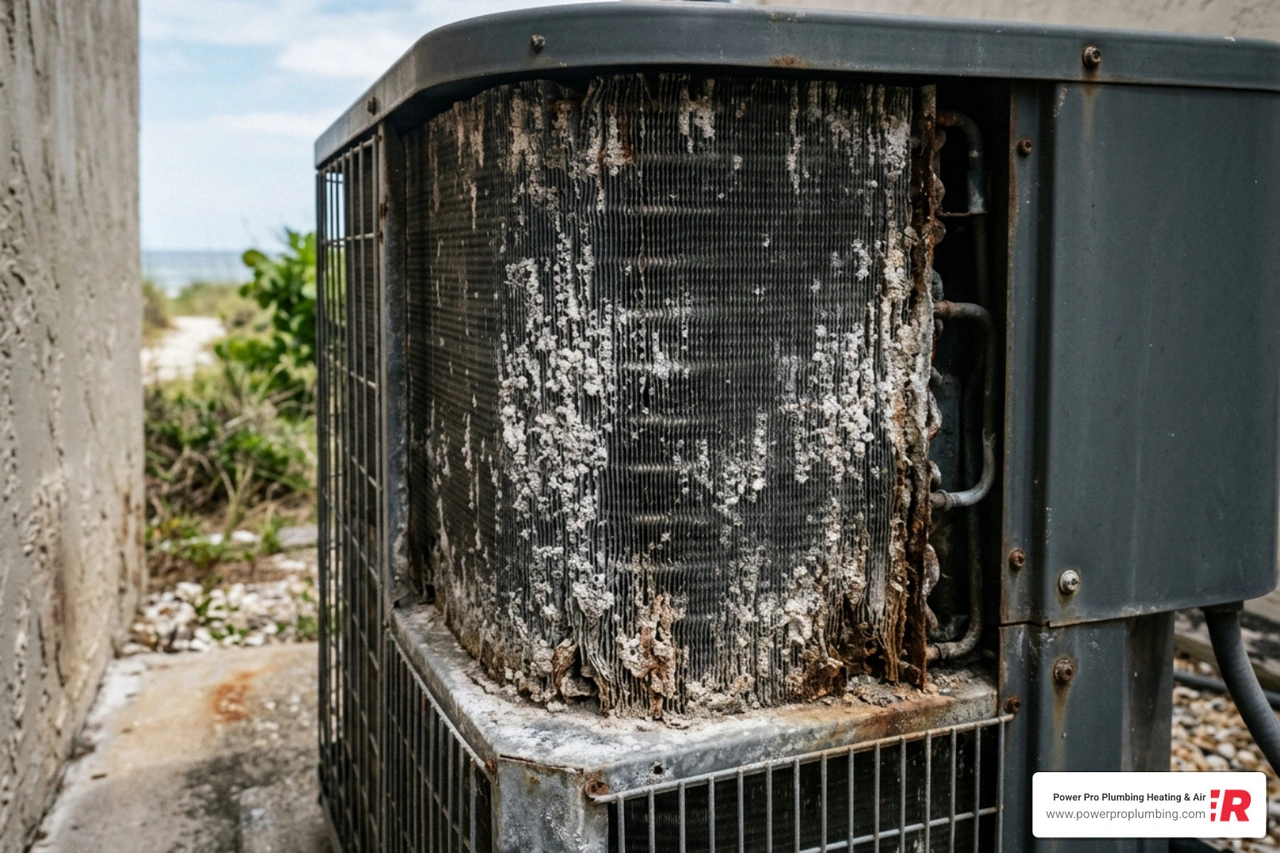
If you live within two miles of the Pacific Ocean in communities like Santa Monica, Venice, or Long Beach, your primary enemy is salt air corrosion. Salt-laden marine air is highly corrosive to the delicate aluminum fins and copper tubing of your outdoor condenser coil.
Without specialized coastal-grade protective coatings or frequent freshwater rinses, the salt air causes chemical pitting. This pitting degrades the metal, reduces heat transfer efficiency, and eventually causes pinpoint refrigerant leaks. It is not uncommon for coastal systems to suffer catastrophic coil failure in as little as 8 to 12 years.
Meanwhile, if your home is in the San Fernando Valley (such as Burbank or Glendale) or the San Gabriel Valley (such as Pasadena or Azusa), salt air isn't your issue—extreme heat and extended run times are. During July, August, and September, valley temperatures routinely climb past 100°F.
To maintain a comfortable 75°F indoors, your system must run almost continuously during the hottest parts of the day. This prolonged high-ambient operation puts immense thermal stress on the compressor motor and electrical capacitors, leading to premature mechanical breakdown.
Environmental Stressors Unique to the Southland
Beyond our temperature swings and ocean breezes, Southern California presents several other unique environmental challenges:
- Dust and Particulate Matter: The Santa Ana winds carry heavy loads of fine, alkaline dust from the deserts. This dust settles into the outdoor condenser coils, acting as an insulating blanket that prevents the system from releasing heat. It also clogs indoor air filters at an alarming rate, straining the indoor blower motor.
- Wildfire Smoke and Ash: Over the last decade, wildfire seasons have deposited fine particulate matter and corrosive ash across the LA basin. When an AC runs during a smoke event, these microscopic particles can coat the indoor evaporator coil and clog the outdoor unit, causing severe airflow restrictions and chemical wear on sensitive components.
- Intense UV Radiation: The relentless Southern California sun degrades plastic fan blades, wire insulation, and service valve covers on outdoor units, accelerating the physical deterioration of the system's exterior.
Key Indicators That Your Southern California AC is Nearing End of Life
No air conditioner lasts forever. Recognizing the early warning signs of a failing system can save you from a miserable weekend without cooling during a July heat wave. If your system is over a decade old, it is vital to keep an eye out for these indicators. If you notice any of these issues, you may want to review our checklist of 10 Signs Your AC Needs Repair Work.
Warning Signs of System Degradation
As central air conditioners age, their physical components gradually break down. Here are the most common signs that your system is reaching the end of its cost-effective service life:
- Skyrocketing Energy Bills: If your utility bills are climbing significantly compared to the same month in previous years, but your usage habits haven't changed, your system is losing its efficiency. As compressors and motors wear out, they require more electrical current to do the same amount of cooling.
- Inconsistent Cooling and High Humidity: A healthy AC is designed to both lower the temperature and remove moisture from the air. If your home feels muggy, or if some rooms remain warm while others are freezing, your system is struggling to complete its cooling cycles. You can read more about diagnosing these issues in our guide on 7 Signs for AC Repair.
- Frequent, Escalating Repairs: If you find yourself calling for service multiple times over two consecutive summers, those minor repair bills will quickly add up to the cost of a new, reliable system.
- Strange Noises: Squealing, grinding, or loud rattling noises from the outdoor unit often point to a failing compressor or a worn-out condenser fan motor.
The R-22 Freon Phase-Out Dilemma
One of the most critical factors for older air conditioners is the type of refrigerant they use. If your central air conditioner was installed before 2010, there is a very high probability that it operates on R-22 refrigerant (commonly known as Freon).
As of January 1, 2020, the U.S. Environmental Protection Agency (EPA) completely banned the production and import of R-22 due to its ozone-depleting properties.
While you are not legally required to stop using a working R-22 system, repairing one has become incredibly difficult and expensive. If an older R-22 system develops a refrigerant leak, sourcing reclaimed R-22 to recharge it is highly costly.
In almost every scenario, investing money into recharging an obsolete R-22 system is a temporary fix that delays an inevitable replacement. To understand why these refrigerant issues and electrical failures occur, take a look at the Top Causes of AC Unit Failure.
Repair vs. Replace: Making the Right Decision for Your LA Home
When your air conditioner breaks down on a hot afternoon, you are faced with a tough choice: do you patch it up with another repair, or do you invest in a complete system replacement? Making this decision under pressure is tough, but having a clear framework makes it much simpler. If you are trying to decide, our guide on the Time for AC Replacement can help clarify your options.
Applying the 50% and $5,000 Rules in Los Angeles
To take the emotion out of the decision, professional HVAC technicians use two classic rules of thumb:
- The 50% Rule: If the cost of a single repair exceeds 50% of the total value of a brand-new replacement system, you should always choose replacement. Putting major money into a system that still has old, worn-out motors and electrical components is rarely a wise long-term investment.
- The $5,000 Rule: This is a simple mathematical formula tailored to the age of your equipment.
$$\text{Age of the System (Years)} \times \text{Cost of the Repair} = \text{Score}$$
If your score is over $5,000, it is time to replace the unit. If it is under $5,000, a repair is generally reasonable.
Let's look at two real-world examples:
- Scenario A: Your 6-year-old air conditioner needs a new condenser fan motor. The repair quote is $600. $$\text{6 years} \times \$600 = \$3,600$$Since $3,600 is well below the $5,000 threshold, repairing the unit is the smart, cost-effective choice.
- Scenario B: Your 12-year-old system has a failed compressor. The repair quote is $1,800. $$\text{12 years} \times \$1,800 = \$21,600$$Because $21,600 vastly exceeds the $5,000 limit, repairing this aging system is highly likely to result in wasted money. Replacement is the far wiser long-term choice. For more tips on timing this transition, check out our article on the Perfect Time for AC Replacement.
Sizing, Installation, and Technology Upgrades
If you do decide to replace your system, the physical installation process is actually more important than the brand of equipment you buy. A poorly installed, incorrectly sized premium air conditioner will fail years before a budget-friendly system that was installed with precision.
- The Danger of Oversizing: Many homeowners assume that "bigger is always better" when it comes to AC. However, an oversized system will cool your home too quickly and shut off, a process known as short-cycling. This constant starting and stopping places immense wear on the compressor motor and prevents the system from running long enough to pull humidity out of the air.
- Manual J Load Calculation: To get the perfect fit, we always perform a Manual J load calculation. This industry-standard calculation takes into account your home's exact square footage, insulation levels, window orientation, and local climate to determine the precise cooling capacity (tonnage) your home requires.
- Variable-Speed Technology: Modern systems with variable-speed compressors can adjust their cooling output dynamically. Instead of blasting on at 100% capacity and shutting off, they run at lower, highly efficient speeds for longer periods. This reduces wear and tear, slashes energy usage, and keeps your indoor temperatures incredibly consistent.
If you are considering your options, you might want to compare a Central AC vs Ductless Mini Split Comparison or read our localized guide on AC Replacement Orange County.
Maintenance Strategies to Extend Your System's Life
The single most effective way to protect your air conditioner and push its lifespan toward that 17-to-18-year mark is consistent, proactive maintenance. Think of your AC like a car: if you never changed the oil or rotated the tires, you wouldn’t expect it to last past 50,000 miles.
If you want to know how to structure your upkeep, we break it down in our article: How Often Should I Get My AC Tune Up.
Proactive Steps to Extend the Average Lifespan of a Central Air Conditioner in the Greater Los Angeles Area
As a homeowner, there are several simple habits you can adopt to significantly reduce the daily strain on your cooling system:
- Change Air Filters Regularly: This is the easiest and most important task. A clogged air filter restricts airflow, forcing your indoor blower motor to work twice as hard to pull air through your home. In dusty inland areas or homes with pets, change your filters every 30 to 60 days. In milder coastal areas, every 90 days is usually sufficient.
- Keep the Outdoor Condenser Clear: Your outdoor unit needs room to breathe. Maintain at least a two-foot clearance around the unit, keeping it free of overgrown bushes, weeds, leaves, and trash.
- Rinse Coils Seasonally: If you live near the coast, gently rinse your outdoor condenser coils with a garden hose once a quarter to wash away salt deposits. If you live inland, a seasonal rinse before the summer heat hits will wash away insulating dust and dirt. Never use a pressure washer, as the high pressure will bend the delicate aluminum fins.
- Optimize Thermostat Settings: Avoid setting your thermostat to extremely low temperatures when you return home. An AC cools at the same rate regardless of how low you set the dial. Setting it to 78°F when you are home, and raising it a few degrees when you leave, prevents unnecessary system run time.
The Value of Professional Tune-Ups
While homeowner maintenance is vital, it cannot replace a comprehensive professional inspection. A licensed technician has the specialized tools to identify and resolve minor issues before they cascade into catastrophic system failures.
During a professional tune-up, we check refrigerant charge levels, inspect electrical contactors, test run capacitors, clean the condensate drain line, and calibrate your thermostat. Catching a weak capacitor during a spring inspection is a simple, affordable fix that prevents that capacitor from failing on a 100-degree Sunday, which would otherwise overheat and destroy your expensive compressor motor.
To learn more about what we do during these visits, read about the Benefits of AC Tune Up Services.
Frequently Asked Questions about Southern California AC Lifespan
How long does a central AC unit last in Los Angeles?
In the Greater Los Angeles area, a well-maintained central split-system air conditioner typically lasts between 12 and 17 years. This is slightly shorter than the national average of 15 to 20 years due to our extended cooling seasons, extreme summer heat waves in the inland valleys, and corrosive salt air along our coastal communities.
Does a heat pump last longer than a regular AC in Los Angeles?
Yes, in many cases it can. Because Southern California has incredibly mild winters, a heat pump does not have to work under the extreme, freezing conditions that wear out systems in other parts of the country. A high-quality, well-maintained heat pump in the LA area can easily achieve a service life of 12 to 18 years.
What is the best time of year to replace an AC in Los Angeles?
The ideal time to replace your air conditioner is during the off-peak months of late winter and early spring (February through April). During this window, HVAC contractors have their highest availability, scheduling is incredibly flexible, and you can get your new system installed and tested long before the first major summer heat wave hits.
Conclusion
Your home’s central air conditioner is one of the most significant investments you will make in your property's comfort and value. While the average lifespan of a central air conditioner in the greater los angeles area is shaped by our demanding microclimates, relentless summer heat, and coastal breezes, you hold the keys to its longevity. Through consistent filter changes, smart thermostat habits, and regular professional care, you can maximize your system's efficiency and keep your home cool for years to come.
At Power Pro Plumbing, Heating & Air, we have spent years keeping our neighbors comfortable across Los Angeles County, Orange County, and the South Bay. As a trusted Daikin Comfort Pro with thousands of positive online reviews, our licensed, highly trained technicians are here to help you get the absolute most out of your existing system—or guide you through a seamless, worry-free replacement when the time is right.
Whether you need a quick diagnostic check, an emergency repair, or a seasonal tune-up, we are here when you need us with fast, same-day service and honest, professional advice.
Ready to ensure your air conditioner is ready to handle the Southern California sun? Contact us today to schedule your seasonal tune-up or request a free estimate on our Professional Air Conditioning Services.