

Surviving Late-Summer Breakdowns: When Your Compressor Fails in August
With August late-summer cooling wear pushing your equipment to its absolute limits, suddenly having to choose between OEM vs Universal Aftermarket Compressors for Aging HVAC Systems is a stressful position for any homeowner. The heat is rising, the house is growing uncomfortable, and you need your air conditioning system running again as quickly as possible. A compressor failure is one of the most significant breakdowns an AC unit can experience, and how you respond dictates both your immediate comfort and your long-term budget.
When the system stops blowing cold air during peak heat, homeowners are immediately faced with a central dilemma: do you wait for an exact factory-match (OEM) part to be ordered and shipped, or do you install a readily available universal compressor to restore cooling today? As technicians who spend every summer diagnosing these exact failures, we know that the right answer depends entirely on the age of your unit, the status of your warranty, and the urgency of your situation.
The Immediate Stress of a Dead Compressor
The physical reality: A failed compressor means the system can no longer pump refrigerant through the lines. The indoor blower might still run, pushing warm, stagnant air through your vents, but the actual cooling process has stopped completely. In the middle of an August heat wave, indoor temperatures can climb into the upper 80s or 90s within a matter of hours.
The decision-making pressure: Homeowners often feel pressured to make a split-second decision to get the cold air flowing again. However, rushing into a repair without understanding your options can lead to overpaying for factory components that aren't strictly necessary. Our priority as technicians is to provide a transparent comparison that puts your budget and immediate comfort first, ensuring you understand exactly what goes into restoring your system without compromising safety or efficiency.
The Reality of Sourcing Parts for Out-of-Warranty Aging AC Units
The Problem: Central air conditioning systems endure massive thermal loads year after year. By the time a unit reaches the 10-to-12-year mark, the internal components have sustained significant wear and tear. When the compressor finally gives out on these older systems, homeowners discover a frustrating reality: the manufacturer's warranty has almost always expired.
The Cause: Manufacturers typically design their standard warranties to cover major components for 5 to 10 years. Once you cross that threshold, you are fully responsible for the cost of replacement parts. Furthermore, as models age out of active production, the original equipment manufacturer (OEM) stops producing large stockpiles of replacement parts for them. This creates a bottleneck in the supply chain, making factory-direct parts for out-of-warranty aging AC units harder to find and slower to ship.
How Age Changes the Repair Math
Investing in a premium factory part may not yield a sensible return if the rest of the system is nearing the end of its functional lifespan. If the condenser coils are deteriorating and the blower motor is showing signs of high amp draw, spending top dollar on an OEM compressor is like putting a brand-new, expensive engine into a vehicle with a rusting frame. The math simply doesn't support the investment.
The Solution: Because voiding a warranty is no longer a concern for these older models, you have much more flexibility in how you approach the repair. This opens the door to budget-friendly, highly reliable universal options. However, before making any decisions about parts, securing professional AC repair services is absolutely required. A thorough diagnostic must be performed to confirm that the compressor is actually dead—sometimes, a failed run capacitor, a burnt contactor, or a hard-start kit issue can mimic a dead compressor perfectly.
What Exactly is a Universal Aftermarket Compressor?
To make an informed choice, it helps to understand what the term "universal aftermarket" actually means in the HVAC industry. Many homeowners assume that "aftermarket" is a synonym for low quality, cheap materials, or knock-off manufacturing. In the world of HVAC compressors, this is a widespread myth that needs to be dispelled.
Defining the terms: A universal aftermarket compressor is a component designed to meet or exceed the exact electrical and mechanical specifications of the original part, but it is not branded with the specific AC manufacturer's label (such as Carrier, Trane, or Lennox). Instead, it is built to be compatible with a wide range of older systems across multiple brands.
The Truth About Tier-1 Manufacturers
Here is the reality of how air conditioners are built: most major AC brands do not manufacture their own compressors. They purchase them from massive, tier-1 global suppliers (like Copeland or Bristol) and install them inside their branded cabinets.
• Same assembly lines: Many universal aftermarket compressors are manufactured by the exact same tier-1 industry suppliers that produce the OEM parts.
• Quality standards: They undergo the same rigorous pressure testing, electrical load testing, and quality assurance protocols as the factory-branded units.
• The only difference: The primary difference is often just the sticker on the side of the metal casing and the distribution channel it flows through.
Because these parts are designed for broad compatibility rather than proprietary exclusivity, there is a robust, highly active supply chain for them. Across Cerritos CA and surrounding Southern California areas, local HVAC supply houses keep massive inventories of universal compressors in stock at all times. This local availability completely changes the timeline of a major repair.
Side-by-Side Comparison: OEM vs Universal Compressors
When evaluating how to repair out-of-warranty aging HVAC systems, comparing the two options directly helps clarify the best path forward. Each route has distinct characteristics regarding availability, compatibility, and the impact on your system's remaining lifespan.
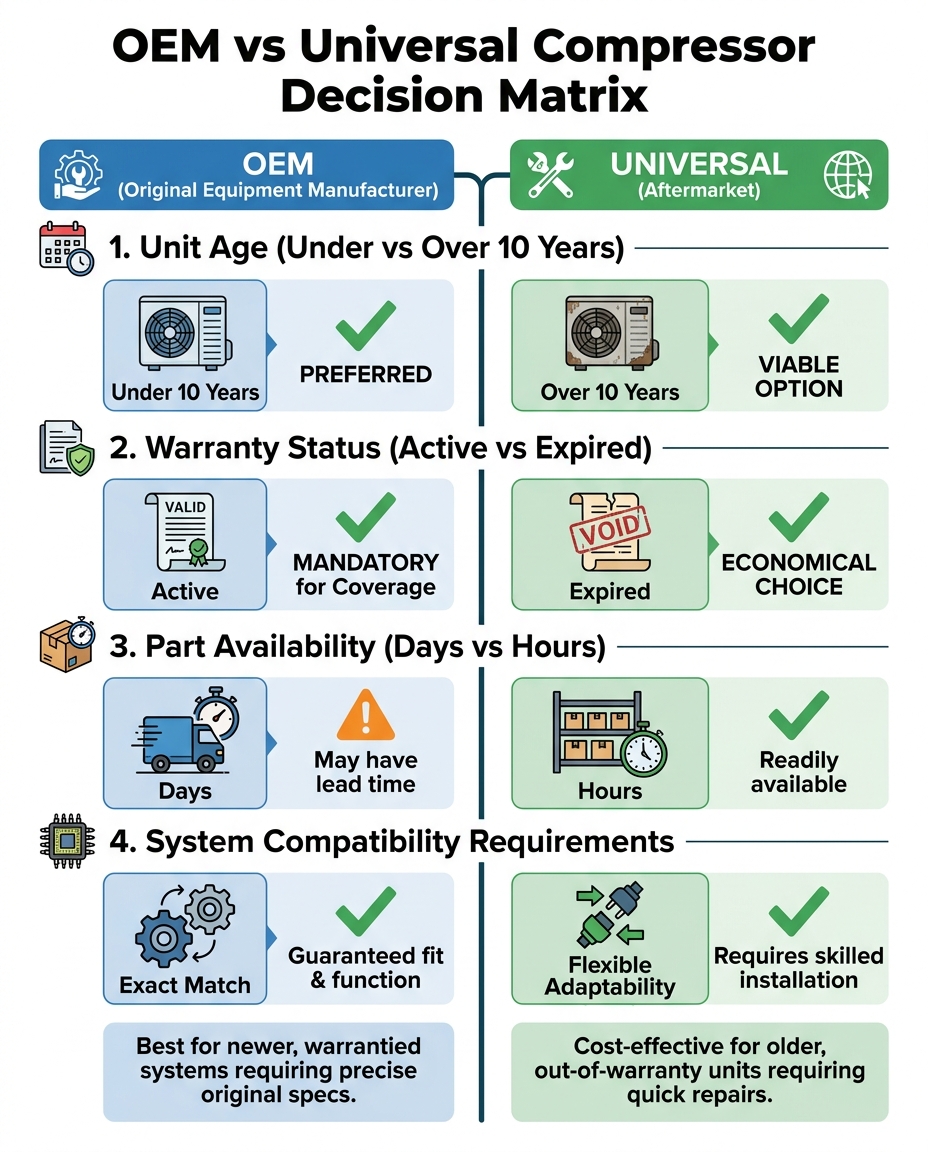
• Availability & Sourcing — OEM (Original Equipment Manufacturer): Often requires special ordering from a central regional warehouse; shipping delays are common during peak summer months. — Universal Aftermarket: Readily stocked at local supply houses; can typically be picked up by a technician the same day the failure occurs.
• Compatibility & Fit — OEM (Original Equipment Manufacturer): An exact, proprietary drop-in match. The mounting footprints and electrical connections align perfectly with the original cabinet. — Universal Aftermarket: Highly compatible, but requires a skilled technician to ensure proper mounting fit, piping alignment, and electrical matching.
• Warranty Implications — OEM (Original Equipment Manufacturer): Required if the system is still under the manufacturer's active warranty to avoid voiding the coverage agreement. — Universal Aftermarket: Ideal for out-of-warranty aging AC units where manufacturer coverage has already expired.
• Cost Profile — OEM (Original Equipment Manufacturer): Carries a premium price tag due to brand labeling and proprietary distribution channels. — Universal Aftermarket: Generally more budget-friendly, freeing up funds to cover the labor and refrigerant recovery costs.
• Ideal Use Case — OEM (Original Equipment Manufacturer): Newer systems under 10 years old, or high-end variable-speed communicating systems with proprietary electronics. — Universal Aftermarket: Standard single-stage or two-stage older units where fast cooling restoration is the absolute priority.

The Urgency Factor: Heat Waves and Part Availability
When evaluating repair options, homeowners often focus entirely on the hardware itself, forgetting that time is arguably the most critical factor in the equation. During August late-summer cooling wear, the logistics of ordering OEM parts become incredibly challenging. The intense Cerritos and Southern California summer heat waves don't just put stress on your local equipment—they put stress on the entire national supply chain.
The reality of peak season logistics: When thousands of units fail across the country in the same two-week window, factory warehouses deplete their inventories rapidly. Ordering an exact OEM match for a 12-year-old condenser during this peak timeframe can easily result in multi-day or even week-long shipping delays. For a household enduring triple-digit outdoor temperatures, waiting a week for a box to arrive on a delivery truck is physically and practically unfeasible.
Why Availability Often Wins
Contrast that delay with the alternative. When you schedule HVAC service with a team that understands how to cross-reference universal parts, the timeline shrinks dramatically. A technician can diagnose the dead compressor at 10:00 AM, drive to a local supply house in Southern California, pick up a perfectly matched universal aftermarket unit, and have your system blowing cold air again before the sun goes down.
When indoor temperatures reach dangerous levels, availability often becomes the deciding factor. The ability to restore a safe, comfortable environment immediately usually outweighs the desire to have a matching brand sticker hidden inside the outdoor cabinet.
Balancing the Investment: Parts, Labor, and Remaining Lifespan
Replacing a compressor is never just about buying a single part. It is a highly invasive, labor-intensive procedure that requires opening the sealed refrigeration circuit. To make an economically sound decision regarding out-of-warranty aging AC units, you have to look at the total scope of the work.
The hidden costs of the repair: The cost of the compressor itself is only one part of the equation. To perform the replacement safely and legally, a technician must safely recover the existing refrigerant, unbraze the old unit, braze the new unit into place, replace the filter drier, pressure test the system with nitrogen, pull a deep vacuum to remove moisture, and finally weigh in the exact factory charge of fresh refrigerant. The labor, specialized materials, and technical expertise required for this process represent a significant portion of the total investment.
Evaluating the Overall Health of the System
Before committing to this level of invasive repair, a professional will evaluate the overall health of the condenser coils and the indoor air handler. If the coils are heavily corroded or the indoor blower is failing, the labor vs parts cost for a compressor replacement might push the total repair bill uncomfortably close to the cost of a full system replacement.
This is exactly where universal parts shine. By saving substantially on the cost of the hardware itself, a universal compressor can make a repair financially viable. It keeps the total investment reasonable, allowing you to squeeze a few more years of life out of the aging unit without overcommitting funds that should ideally be saved for a future system upgrade.
A Technician's Transparent Assessment Framework
Our commitment to honest, transparent diagnostics means we prioritize your budget and the remaining lifespan of your unit over pushing expensive factory parts. We bring this exact same philosophy to every trade we handle. For example, when a customer faced an outdoor main water line leak last fall, our technician Rickey didn't just push the most extensive, disruptive overhaul right away; he assessed the situation, provided an immediate short-term solution to stop the damage, and clearly outlined a plan for a proper long-term fix. We apply that exact same transparent, options-based methodology to your AC.
When evaluating Cerritos CA and surrounding Southern California areas homes for compressor failures, here is what we look for when diagnosing the best path forward:
1. Verify the Failure: We extensively test the electrical components (capacitors, contactors, wiring) to ensure the compressor is truly mechanically or electrically failed, not just struggling due to a minor peripheral issue.
2. Check Warranty Status: We cross-reference the serial number with the manufacturer. If the unit is under warranty, we strongly advise OEM to protect your coverage.
3. Evaluate System Complexity: We assess the technology. Standard single-stage or two-stage units will safely accept a universal compressor. However, if the system features highly proprietary communicating electronics or a variable-speed inverter drive, we will honestly advise that an OEM part is strictly required.
4. Assess Remaining Lifespan: We inspect the condition of the coils, the reversing valve (if it's a heat pump), and the blower. If the system is on its last legs, we will provide a clear cost-benefit analysis of repair versus replacement.
5. Present Clear Options: We patiently explain all probable solutions, the compatibility rules, and the expected timelines for part delivery, allowing you to make an informed, pressure-free choice.
The ultimate goal is restoring your comfort reliably and safely. A trustworthy technician will never upsell the most expensive factory part if a high-quality universal alternative will do the exact same job for less.
Make the Right Call for Your Aging AC System
Dealing with a catastrophic breakdown during August late-summer cooling wear is stressful, but having a clear, technician-guided framework makes choosing between OEM and universal parts straightforward. By understanding the age of your equipment, the status of your warranty, and the logistical realities of supply chains during peak heat waves, you can confidently navigate the repair process.
Remember that fast, reliable cooling is the ultimate goal. If your older unit is struggling or has completely shut down, don't wait for the indoor temperatures to become unbearable. Reach out to a professional team for an honest assessment of your failed compressor, and let us provide the transparent options you need to get your home comfortable again.
Frequently Asked Questions
When should I choose an OEM compressor over a universal one?
You should choose an OEM compressor whenever your AC unit is still under the manufacturer's active warranty, or if you have a highly complex, variable-speed communicating system. Using factory parts ensures your warranty remains valid and guarantees that proprietary electronic components communicate correctly with the new hardware.
Are universal AC compressors reliable for older units?
Yes, universal aftermarket compressors are highly reliable for aging systems, provided they are sized and installed correctly. Many of these units are manufactured in the exact same facilities by the same tier-1 global suppliers that produce factory-branded parts, ensuring they meet rigorous industry standards for durability and performance.
How does part availability affect AC repair times?
Part availability dictates the entire timeline of a repair, especially during peak summer heat waves when supply chains are strained. While OEM parts often require special ordering and days of shipping time, universal parts are typically stocked at local supply houses, allowing technicians to restore your cooling on the same day.
Will an aftermarket compressor void my warranty?
Installing an aftermarket compressor will generally void an active manufacturer's warranty on the equipment. However, if your AC unit is over 10 to 12 years old, the original warranty has almost certainly expired already, meaning you can safely choose an aftermarket option without losing any coverage.
Can any HVAC technician install a universal aftermarket compressor?
While any licensed HVAC technician is legally permitted to perform the work, installing a universal part requires a higher level of specific expertise. The technician must know how to properly match the electrical load, adapt the mounting footprint, and ensure the piping aligns perfectly, making it critical to hire an experienced professional.
How long does a universal compressor typically last compared to OEM?
When properly installed, a high-quality universal compressor will generally last just as long as an OEM equivalent, often providing 10 to 15 years of reliable service. The true determining factor for lifespan is not the brand sticker, but the quality of the installation, proper refrigerant charging, and regular ongoing maintenance.