

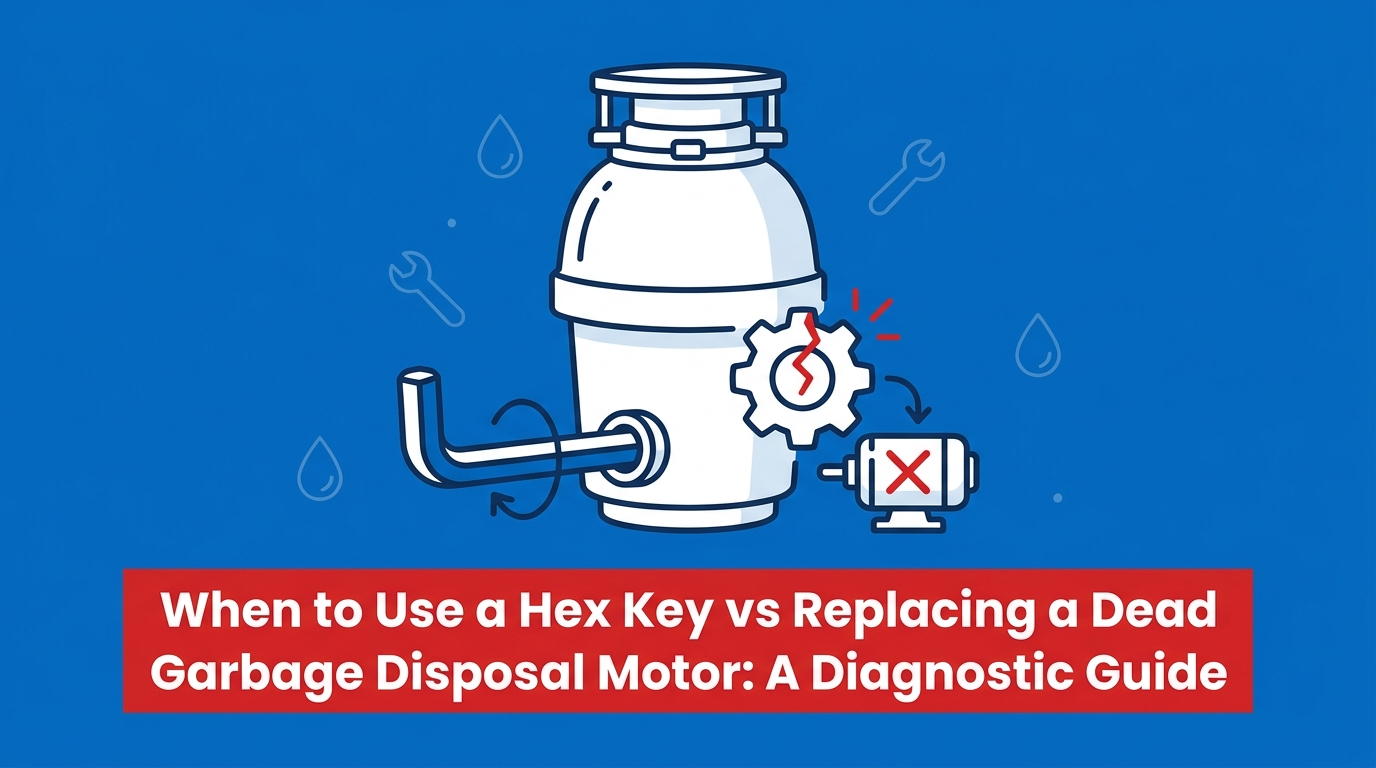
A Sudden Stop at the Sink: Diagnosing a Stuck Disposal
Your kitchen is in full swing with late-summer back-to-school kitchen usage, and suddenly, you need to know when to use a Hex Key vs replacing a dead garbage disposal motor. The sink stops draining, a strange noise fills the room, and your evening meal prep comes to a grinding halt. At Power Pro Plumbing, Heating & Air, our team knows firsthand that a sudden garbage disposal failure is incredibly frustrating, especially when your household is transitioning into a busy new routine and you rely heavily on your kitchen appliances to keep up.
For reliable diagnostics, explore our plumbing services or schedule plumbing repair services.
Before you panic and assume the entire unit is permanently broken, you need to understand the core decision point: determining whether the appliance is simply mechanically jammed or electrically dead. Many apparent failures are just simple, physical binds that you can safely resolve yourself with the right tool and a little patience. However, crossing the line from mechanical troubleshooting into electrical tampering is dangerous and unnecessary.
The diagnostic mindset: Approaching this problem requires a safe, step-by-step process. By relying on sensory cues like sound and smell, you can accurately diagnose the root cause of the sudden stop without ever needing to touch the internal wiring. This guide will walk you through exactly what to look for, what to listen for, and when it is time to put the tools down and call for professional backup.
Listening for the Hum: Identifying a Mechanical Jam
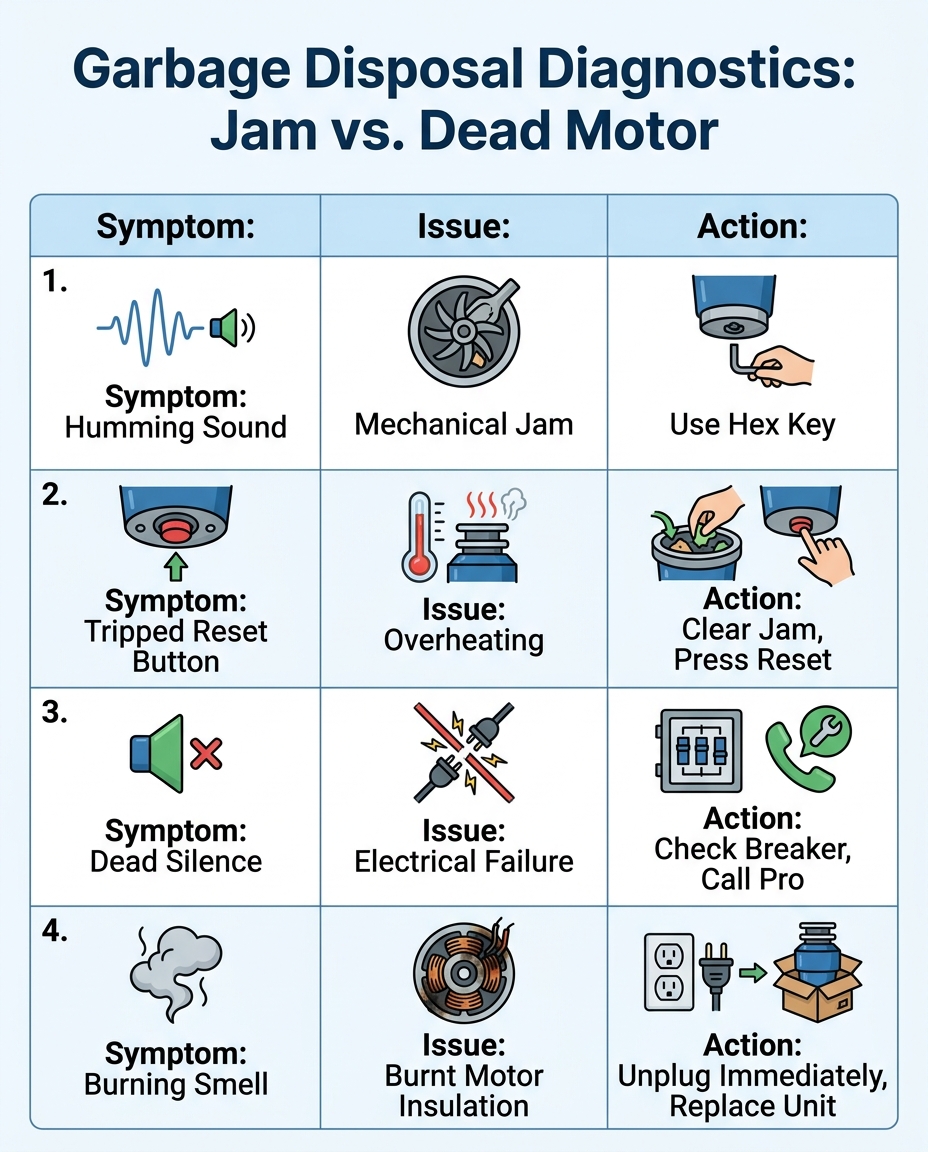
In our years of dispatching plumbers across Cerritos, we've found that the most common reason your sink appliance suddenly stops working is a physical obstruction. When you flip the wall switch and hear a distinct, low humming or buzzing sound, you are experiencing a mechanical jam. The motor is receiving electricity and attempting to spin, but the internal components are physically locked in place.
To understand why this happens, it helps to know how a standard under-sink continuous feed disposal operates. Inside the grinding chamber, there are no sharp blades like a blender. Instead, a flat metal plate called a flywheel spins rapidly. Attached to this flywheel are metal lugs called impellers. Centrifugal force pushes food waste outward against a stationary, cheese-grater-like shredder ring. When hard food scraps, fibrous vegetables, or stray utensils wedge between the spinning flywheel and the stationary ring, the entire mechanism binds up.
With year-round hosting and cooking in Cerritos, heavy usage makes mechanical jams from fibrous foods or bones a common occurrence. The system simply gets overwhelmed by the volume or density of the waste. If you find yourself constantly dealing with these blockages, you might want to look into the reasons you need garbage disposal repair to see if your unit is aging out of its useful life.
The Role of the Reset Button
If you leave a jammed unit turned on, the motor will continue to draw power as it struggles against the obstruction. Left unchecked, this would quickly cause the motor to overheat and catch fire. To prevent this, manufacturers build in a critical safety feature: the thermal overload protector.
• Locating the button: The thermal overload protector is connected to a small, usually red, reset button located on the very bottom of the canister under your sink.
• Why it trips: When the motor gets too hot from straining against a jam, this internal breaker trips automatically, cutting all electrical power to the unit. The red button will physically pop outward.
• The golden rule: Never press the reset button repeatedly without first clearing the underlying jam. If you force the unit to keep trying to run while it is physically locked, you will permanently damage the motor.
A humming unit that suddenly goes completely silent has likely just tripped this internal breaker. This is a protective feature doing its job perfectly, not a death sentence for your appliance.
Releasing the Bind: Safely Using a Hex Key
If you have identified that your unit is humming or has tripped its reset button due to a jam, you can usually free the mechanism manually. Standard garbage disposals typically use a 1/4-inch Allen wrench (also known as a hex key) for this exact purpose. Here is the safe, step-by-step process to release the bind.
1. Disconnect the power completely: This is the most critical safety step. Never attempt to clear a jam while the unit has power. Unplug the appliance from the wall outlet under the sink. If it is hardwired, go to your home's main electrical panel and flip the dedicated circuit breaker to the "off" position.
2. Locate the unjamming socket: Clear out the cleaning supplies under your sink and look at the very bottom center of the disposal canister. You will see a small, hexagonal hole. This socket connects directly to the bottom of the motor shaft.
3. Insert the hex key: Insert your 1/4-inch Allen wrench into this bottom socket. Ensure it is seated firmly.
4. Work the mechanism back and forth: Use the wrench as a lever to manually rotate the motor shaft. Turn it clockwise, then counterclockwise. You will likely feel significant resistance at first. Keep applying steady pressure back and forth until the obstruction breaks free and the wrench can complete a full, smooth rotation in both directions.
5. Extract the dislodged debris: Once the blades move freely, remove the wrench. Look down into the sink drain from above with a flashlight. Use long tongs or needle-nose pliers to grab and pull out whatever caused the jam. Never put your fingers down into the grinding chamber, even when the power is off.
6. Restore power and test: Once the chamber is clear, press the red reset button on the bottom of the unit if it had popped out. Plug the unit back in or flip the breaker back on. Run cold water into the sink and flip the wall switch to verify the unit spins smoothly.
Silence and Smoke: Recognizing a Burnt-Out Motor
While a hex key is a highly effective tool for a mechanical jam, it is completely useless if the appliance has suffered a catastrophic electrical failure. Establishing a strict safety boundary based on sensory cues will protect you from hazardous situations.
The sound of failure: Contrast the low, vibrating hum of a jam with the dead silence of a completely failed motor. If you flip the switch and hear absolutely nothing—and you have already verified that the unit is plugged in, the household circuit breaker is on, and the red reset button is pushed in—the motor itself is likely dead. The internal electrical pathways have failed, meaning the unit can no longer receive or process electricity.
The smell of melted insulation: The most critical warning sign of a dead unit is a persistent electrical burning smell coming from under the sink. This acrid, chemical odor is distinctly different from the smell of rotting food. When a motor strains too hard for too long, the intense heat melts the protective insulation surrounding the copper wire coils inside the motor casing. Once this insulation melts and the wires short out, the unit is irreparably damaged.
Strict safety warning: If you detect an electrical burning smell, unplug the unit immediately or turn off its circuit breaker. Do not attempt to turn it on again. Our technicians issue a firm safety warning against any DIY attempts to dismantle, open, or rewire the electrical components of a dead disposal. Water and compromised electricity are a lethal combination. A burnt-out motor cannot be repaired; the entire unit requires professional replacement.

What Causes Sudden Motor Stress?
Understanding why these appliances fail can help you prevent future emergencies. A pattern we see often is that sudden spikes in kitchen usage overwhelm aging disposal motors. During late-summer back-to-school kitchen usage, families tend to cook more frequently at home, process more heavy food scraps, and rush through cleanup. This abrupt change in routine puts immense strain on plumbing fixtures that may have been coasting through a quieter season.
There is also a strong relationship between a struggling sink appliance and broader kitchen drainage issues. When you force too much waste down the drain at once, you bypass the unit's ability to grind the food efficiently. Instead of creating a fine, water-suspended slurry, the unit pushes large, half-ground chunks into your plumbing. This rapidly leads to severe clogs deeper in the pipe network. If you notice water backing up into your sink or dishwasher, you may need professional drain and sewer services to clear the main line.
Proper continuous-feed habits:
• Use plenty of cold water: Always run a strong stream of cold water before you turn the unit on, while it is grinding, and for at least 15 seconds after you turn it off. Cold water keeps the motor cool and solidifies fats and greases so they can be chopped up rather than coating your pipes.
• Feed it gradually: Do not shove an entire plate of food scraps down the drain at once. Feed the waste in slowly to allow the impellers to keep up with the volume.
• Avoid fibrous and hard materials: Keep celery stalks, onion skins, corn husks, artichoke leaves, bones, and fruit pits out of the sink. These materials either wrap around the moving parts or bounce around the chamber without grinding down.
When to Stop Troubleshooting and Call a Professional
Knowing when to stop troubleshooting is just as important as knowing how to start. The definitive go/no-go threshold for calling an expert is clear: if the hex key absolutely will not turn the motor shaft despite steady pressure, if the red reset button refuses to stay pushed in, or if you detect any hint of an electrical burning smell, it is time for professional help.
Our team at Power Pro Plumbing emphasizes honest diagnostics—helping homeowners fix simple mechanical jams themselves with a hex key before paying for unnecessary motor replacements. If our plumbers come out to your home, we perform a thorough check without pushing upsells. In fact, a pattern we see often is homeowners assuming the unit is dead when it just needs a reset. One local homeowner recently experienced an unexpected plumbing issue that brought their kitchen to a standstill. Our technician arrived on time, quickly diagnosed the root cause, and resolved the problem efficiently, proving that the right expertise makes all the difference when you are stuck.
The value of having a licensed plumber evaluate the sink system goes beyond just swapping out a motor. A professional can verify if the issue is isolated to the appliance or if it is part of a larger, systemic drainage problem. They ensure the new unit is wired safely to code, that the plumbing traps are correctly aligned to prevent sewer gas leaks, and that the dishwasher drain connection is properly integrated. If you are tired of battling constant backups, having an expert fix your slow drain correctly the first time saves you immense frustration.
Frequently Asked Questions
How do I know if my garbage disposal motor is burnt out?
The most definitive sign of a burnt-out motor is a persistent electrical burning smell coming from the unit. Additionally, if the unit remains completely silent when switched on—even after verifying the power is connected and the reset button is engaged—the internal electrical components have likely failed. A burnt motor cannot be repaired and requires a full replacement.
Why is my garbage disposal humming but not spinning?
A humming sound indicates that the motor is receiving electricity but is physically prevented from spinning by a mechanical jam. Hard food scraps, bones, or foreign objects wedge between the spinning flywheel and the stationary shredder ring, locking the mechanism. You can typically resolve this by turning off the power and using a hex key in the bottom socket to manually break the jam free.
What does a dead garbage disposal sound like?
A completely dead unit makes absolutely no sound when you flip the switch. There is no humming, no buzzing, and no grinding noise. This dead silence means electricity is no longer flowing through the motor coils, usually due to melted internal wiring or a completely failed switch.
Can you fix a seized garbage disposal?
Yes, a seized or jammed unit can usually be fixed if the motor itself has not burned out. By disconnecting the power and inserting a 1/4-inch Allen wrench into the manual unjamming socket on the bottom of the canister, you can physically force the motor shaft to turn and release the obstruction. Once the debris is removed, the unit should function normally.
Should I press the reset button before or after using an Allen wrench?
You should press the reset button after you have used the Allen wrench to clear the physical jam. If you press the reset button while the unit is still jammed and try to run it, the motor will immediately overheat and trip the breaker again. Always ensure the blades spin freely manually before restoring power and resetting the unit.
How much does professional garbage disposal repair usually entail?
Professional repair entails a licensed plumber inspecting the electrical connections, the motor casing, and the surrounding drain pipes to diagnose the exact point of failure. If the issue is a deep clog or a damaged seal, they can repair the plumbing components. If the motor itself has failed electrically, the repair process shifts to safely disconnecting the old unit and installing a brand-new appliance.
Restoring Your Kitchen's Workflow
A sudden sink failure doesn't have to ruin your evening. By safely identifying the difference between a simple mechanical jam and a total electrical failure, you can take the right steps to resolve the issue. Whether you easily free the bind with a hex key or realize it's time for a professional replacement, a clear diagnostic approach provides the safe, definitive answers you need to get your kitchen running smoothly again.