


When Late-Summer Water Pressure Drops Point to a Bigger Problem
At Power Pro Plumbing, Heating & Air, we hear this story all too often as August rolls around: you turn on the shower after a long, hot day, and instead of a steady stream, you get a frustrating trickle. When you experience this kind of sudden pressure drop, it is natural to question the lifespan of galvanized steel pipes in 1970s Cerritos tract homes. Your air conditioning is already working overtime in the late-summer heat, and now your plumbing seems to be struggling to keep up. While peak end-of-season usage can cause temporary municipal supply fluctuations as everyone in the neighborhood runs their sprinklers and appliances at once, our team knows that persistent low pressure often signals a much deeper issue hiding behind your walls.
The reality is that original galvanized steel pipes in aging tract homes may have reached the terminal stage of internal corrosion. Before the situation escalates into a major leak, professional residential plumbing services are the necessary next step to accurately diagnose the root cause. Bringing in an expert for timely plumbing repair services can prevent catastrophic leaks, major water damage, and unexpected disruptions to your daily routine.
The Difference Between Municipal Fluctuations and Pipe Failure
It is easy to blame the city water supply when your taps lose their force. During the hottest months of the year, municipal water grids do experience heavy demand. However, these municipal drops are usually temporary, occurring only during peak hours like early morning or early evening. If your water pressure remains consistently low regardless of the time of day, the problem is likely localized to your property.
Key indicators that the issue is inside your home:
• Consistent low flow: The pressure does not recover during off-peak nighttime hours.
• Isolated fixture drops: The kitchen sink flows fine, but the master bathroom shower barely drips.
• Temperature-specific issues: The hot water pressure is significantly lower than the cold water pressure.
• Discolored water: The first few seconds of water flow appear brown, yellow, or rust-tinted.
When these symptoms appear together, they point directly to the internal degradation of your home's water supply lines. Understanding the timeline of these materials is the first step toward finding a permanent solution.
The 50-Year Clock on 1970s Cerritos Tract Homes
Our team frequently works in the older Cerritos neighborhoods developed during the housing boom of the 1970s, which means we know your home is operating on a very specific mathematical timeline. The plumbing industry standard lifespan for galvanized steel pipes is typically 40 to 50 years. Simple math reveals that homes built in the 1970s are currently operating well past their intended plumbing lifecycle. These systems are effectively living on borrowed time, and the signs of failure are becoming impossible to ignore.
The Hidden Reality Behind the Walls
One of the most deceptive aspects of galvanized plumbing is that the exterior of the pipes often looks perfectly fine. If you inspect an exposed pipe in your garage or attic, the grey metal might appear solid and intact. However, the true degradation happens on the inside, where homeowners cannot see it. Our technicians at Power Pro Plumbing, Heating & Air frequently see that original plumbing systems in older Cerritos neighborhoods have completely deteriorated internally while maintaining a pristine exterior.
Our deep local expertise and familiarity with the original plumbing systems built into Cerritos tract homes during the 1970s housing boom means we know exactly what to look for. We understand the specific routing, materials, and wear patterns unique to these properties. When a homeowner calls us about low water pressure, we already know the likely culprit based on the year the home was built.
Comparing Plumbing Material Lifespans
• Galvanized Steel — Expected Lifespan: 40 - 50 years — Common Failure Mode: Internal rusting and severe occlusion
• Copper (Type L) — Expected Lifespan: 50+ years — Common Failure Mode: Pinhole leaks from acidic water or friction
• PEX (Cross-linked Polyethylene) — Expected Lifespan: 40 - 50+ years — Common Failure Mode: UV degradation if exposed to sunlight
• CPVC — Expected Lifespan: 30 - 50 years — Common Failure Mode: Becoming brittle and cracking over time
As the table shows, galvanized steel has reached the end of its reliable service life for any home built before 1980. The question is no longer if these pipes will fail, but exactly how and when.
Inside-Out Rusting: The Hidden Danger of Galvanized Steel
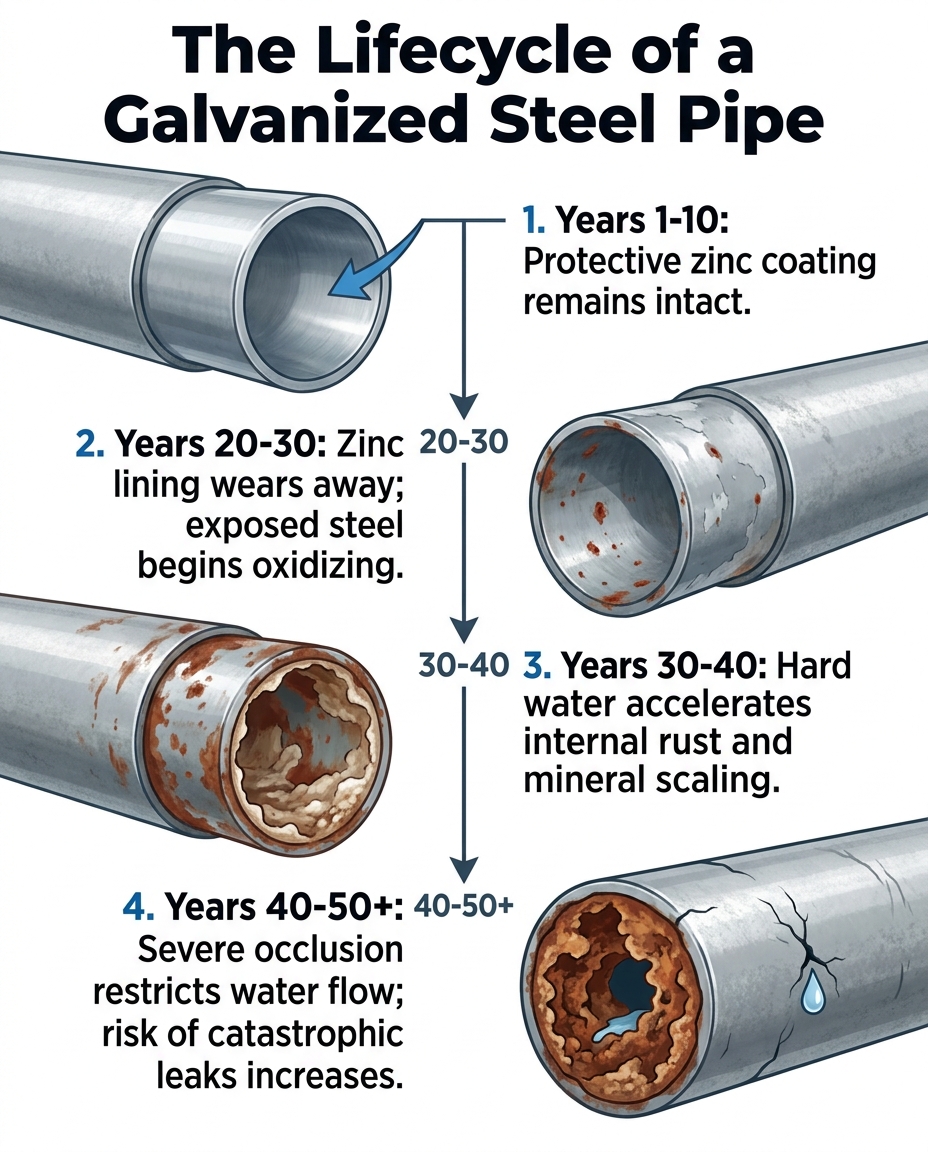
To understand why your water pressure is dropping, you have to understand the science of galvanized pipe corrosion. Galvanized pipes are simply steel pipes that have been dipped in a protective zinc coating. This zinc lining is designed to prevent the water inside the pipe from touching the raw steel. However, decades of continuous use, friction, and water flow eventually wear this protective lining away.
The Process of Internal Oxidation
The Problem: Once the zinc lining is compromised, the raw steel is exposed directly to oxygen and running water. This creates the perfect environment for oxidation, commonly known as rust. Unlike a rusty bumper on a car that flakes off, the rust inside a plumbing pipe has nowhere to go. It builds up along the interior walls of the pipe.
The Cause: This internal rust creates a condition called occlusion. Occlusion means the blockages are effectively shrinking the internal diameter of the pipe. A pipe that originally had a one-inch diameter for water to flow through might be reduced to the size of a drinking straw. This restricted pathway makes it physically impossible for the pipe to deliver the volume of water your fixtures demand.
The Solution: Severe pressure drops are the primary warning sign of this inside-out rusting before catastrophic leaks occur. When the structural integrity of the steel is compromised by rust, the pipe walls become paper-thin. Eventually, the pressure of the water will break through the rusted steel, causing a hidden leak behind your drywall. Recognizing the pressure drop as a symptom of occlusion allows you to address the problem proactively, replacing the compromised sections before they burst.

How Southern California Hard Water Accelerates Pipe Failure
The 50-year lifespan of galvanized steel is an industry average, but regional climate and environmental factors play a massive role in how quickly plumbing degrades. In our years of servicing Cerritos homes, our team has seen firsthand how our notoriously hard Southern California water makes the 50-year lifespan a hard limit rather than a casual suggestion for older properties.
The Chemistry of Mineral Scaling
Southern California's municipal water supply contains high levels of dissolved minerals, primarily calcium and magnesium. When this hard water flows through your pipes, it leaves microscopic mineral deposits behind. In a brand-new pipe with a smooth interior, these minerals have a harder time sticking. But in an aging galvanized pipe where the zinc has worn away and rust has started to form, the rough, jagged surface of the oxidation acts like a magnet for hard water minerals.
How hard water compounds the damage:
• Accelerated buildup: Calcium and magnesium bind to the rust, creating a thick, concrete-like scale inside the pipe.
• Increased friction: The rougher the interior becomes, the more turbulence is created in the water flow, which strips away any remaining zinc even faster.
• Chemical reactions: The presence of certain dissolved minerals can accelerate the galvanic corrosion of the steel itself.
This mineral scaling acts as a powerful catalyst, compounding the internal rusting typical of 1970s plumbing and speeding up the occlusion process. It is a vicious cycle: the rust catches the minerals, the minerals create more surface area for rust, and the pipe closes up much faster than it would in a region with naturally soft water. Regulatory plumbing standards acknowledge that hard water environments require more frequent monitoring of aging metal supply lines.
Secondary Plumbing Casualties: Protecting Your Home's Fixtures
When galvanized pipes begin to fail, the damage rarely stays confined to the pipes themselves. The rust, mineral scale, and debris from deteriorating supply lines do not just stay in the walls—they flow directly into your expensive appliances and plumbing fixtures. This creates a chain reaction of secondary plumbing casualties throughout your home.
The Domino Effect on Water Heaters and Appliances
Think about the path water takes through your house. Before it reaches your showerhead, it often passes through your water heater. As the internal pipe rust flakes off, this heavy sediment is carried by the water current and deposited directly into the bottom of your water heater tank.
Over time, this sediment builds up into a thick layer of sludge at the base of the tank. For gas water heaters, this sludge acts as an insulator between the burner at the bottom and the water above it, forcing the unit to burn more fuel and work twice as hard to heat the water. This significantly reduces the unit's efficiency and drastically shortens its lifespan. If you are noticing rust-tinted water, it is a clear indicator that your fixtures and water heaters are already being compromised. Our plumbers often find that addressing the root pipe issue is essential to protect your investment in modern plumbing fixtures, and may require professional water heater services in Cerritos to flush the accumulated sediment and restore your system's performance.
Other fixtures at risk from pipe debris include:
• Washing machines: Sediment clogs the fine mesh intake screens, causing the machine to fill very slowly.
• Dishwashers: Rust particles can damage the internal pump and leave orange stains on your glassware.
• Faucets and showerheads: Small pieces of scale get trapped in the aerators, destroying the spray pattern and reducing flow to a trickle.
What to Expect from a Professional Plumbing Inspection
Diagnosing internal pipe corrosion requires specialized tools, professional knowledge, and a systematic approach. It is not something that can be determined by simply looking at the pipes under the sink. A professional plumbing inspection is designed to assess the true health of your 1970s plumbing system without relying on guesswork or pushing unnecessary services.
The Diagnostic Process
When you schedule an inspection for low water pressure, a licensed technician will follow a strict diagnostic protocol to isolate the issue.
1. Initial Flow Assessment: The technician will test multiple fixtures simultaneously to map out where the pressure drops are most severe.
2. Comprehensive Pressure Test: Using a specialized gauge attached to your main water line or hose bib, the technician will measure the static incoming municipal pressure versus the dynamic working pressure inside the home.
3. Leak Check and Visual Inspection: The technician will carefully inspect exposed piping in the garage, attic, or crawlspace for signs of external corrosion, weeping joints, or galvanic reactions where different metals meet.
4. Isolating Clogs vs. Supply Issues: Professionals know how to differentiate between localized issues—like a clogged aerator or a backup requiring drain and sewer services—and systemic supply line occlusion caused by rusted galvanized pipes.
The goal is always to provide an honest, transparent assessment that gives homeowners clear options rather than using pressure tactics. Whether our crew is performing a complex whole-home pressure test or handling a straightforward late-summer fixture upgrade before the back-to-school rush—like a recent visit where a Cerritos customer needed a toilet replacement and appreciated how our technician kept the area spotless, sealed the new fixture perfectly, and explained every single step of the process—that exact same level of clear communication applies to diagnosing failing pipes. Because the true condition of the pipes is hidden inside the walls, relying on professional diagnostic tools is the only safe way to proceed.
Transitioning Away from Galvanized Pipes in Cerritos
Once a professional confirms that your original galvanized steel pipes have reached the end of their lifespan, the next logical step is planning for a whole-home repipe. While the prospect of replacing your home's plumbing may seem daunting, it is a one-time upgrade that fundamentally transforms how your home operates and protects it from catastrophic water damage.
Modern Solutions for Aging Tract Homes
Today's plumbing industry has moved far beyond galvanized steel. Modern, corrosion-resistant materials are now the standard replacements, offering decades of reliable, clean water delivery.
Copper Piping: Copper has been a premium standard for decades. It is highly durable, naturally resists bacterial growth, and is unaffected by UV light. However, it can be susceptible to pinhole leaks if the local water chemistry is highly acidic. PEX (Cross-linked Polyethylene): PEX is a flexible, highly durable plastic tubing that has revolutionized residential plumbing. It expands slightly, making it highly resistant to bursting, and it does not corrode, rust, or accumulate mineral scale the way metal pipes do. Its flexibility also means it can often be routed through walls with significantly less drywall damage than rigid pipes.
The long-term benefits of repiping include fully restored water pressure, cleaner water free of rust particles, and the peace of mind that comes from knowing your walls aren't hiding a ticking time bomb. Furthermore, upgrading your home's plumbing systems can sometimes qualify for general energy rebates or utility incentive programs, especially if the repiping is tied to high-efficiency appliance upgrades. We always advise homeowners to check with their local utilities or a tax professional to see what current programs might apply.
Ultimately, a whole-home repipe is a complex, code-compliant process that requires precise calculations for flow rates, proper venting, and secure structural routing. It is never a DIY project. It must be handled by licensed professionals, like our dedicated team at Power Pro Plumbing, Heating & Air, who understand local building codes and the specific architectural nuances of 1970s tract homes.
Frequently Asked Questions
How long do galvanized steel pipes last in Southern California?
Galvanized steel pipes typically have a lifespan of 40 to 50 years. In Southern California, the notoriously hard water can accelerate internal scaling and corrosion, often pushing pipes toward the shorter end of that lifespan. If your home was built in the 1970s, your original pipes have likely exceeded their intended service life.
What happens when galvanized pipes rust on the inside?
When the protective zinc lining wears away, the exposed steel reacts with water and oxygen to create rust. This rust builds up on the interior walls of the pipe, a process called occlusion, which shrinks the pipe's diameter. Eventually, this restricts water flow severely and weakens the pipe walls until they leak or burst.
Why is my home water pressure suddenly so low in the late summer?
While peak late-summer usage can cause temporary drops in municipal water pressure due to heavy neighborhood demand, persistent low pressure usually indicates an internal problem. In older homes, this is frequently a sign that galvanized pipes have rusted internally and can no longer deliver the necessary volume of water.
How do I know if my galvanized pipes are bad?
The most common signs of failing galvanized pipes include a significant drop in water pressure, especially when multiple fixtures are running. You may also notice rust-tinted or brown water when you first turn on the tap, recurring leaks, and sediment clogging the aerators on your faucets.
Should I replace all the galvanized pipes in my 1970s home?
Yes, replacing all original galvanized pipes is highly recommended for homes built in the 1970s. Because these pipes degrade from the inside out, patching one small leak does not solve the systemic rusting throughout the rest of the house. A whole-home repipe is the only permanent solution to restore pressure and prevent major water damage.
Can hard water cause my water pipes to clog?
Yes, hard water contains high levels of dissolved calcium and magnesium that can cling to the inside of your pipes. In older galvanized pipes where rust has already formed, these minerals attach to the rough oxidized surface, rapidly accelerating the buildup of scale and clogging the pipe much faster than soft water would.
Secure Your Home's Plumbing Future Today
Dealing with the terminal lifespan of galvanized steel pipes in 1970s Cerritos tract homes does not have to be a guessing game. If late-summer pressure drops are making your daily routine a frustration, it is time for a professional diagnosis from a team that knows your neighborhood. Reach out to Power Pro Plumbing, Heating & Air for expert plumbing repair services today to get a localized, accurate assessment of your plumbing materials, confirm exactly why your pressure is dropping, and explore your professional repiping options with total peace of mind.