


Is Central Air or a Mini Split Right for Your Southern California Home?
Central air vs mini split for southern california homes is one of the most common HVAC questions homeowners across Los Angeles County and Orange County face — especially when an old system gives out during a heat wave or a home addition suddenly needs cooling. The short answer: both systems work well in SoCal, but the right choice depends on your home's existing ductwork, your layout, and how you use your space.
Here's a quick breakdown to help you decide:
| Factor | Central Air | Mini Split |
|---|---|---|
| Existing ductwork | Ideal if ducts are in good shape | Best if no ducts exist |
| Home type | Newer tract homes, large open layouts | Older homes, additions, ADUs, garages |
| Zoning control | Single thermostat (or costly add-ons) | Built-in room-by-room control |
| Energy efficiency | 15–22 SEER2; loses 20–30% through ducts | 20–35+ SEER2; no duct losses |
| Installation disruption | Low (with ducts), high (without) | Minimal — requires only a small wall opening |
| Heating capability | Needs separate furnace | Built-in heat pump covers SoCal winters |
| Best for | Whole-home uniform cooling | Targeted zones, retrofits, problem rooms |
Southern California's mix of hot inland summers, mild coastal winters, older housing stock, and some of the highest electricity rates in the country makes this decision more nuanced than it might seem elsewhere. Duct systems running through sun-baked attics can bleed away 20 to 30 percent of the cool air you're paying for — a real problem in places like the Inland Empire, the San Gabriel Valley, and inland Orange County. Meanwhile, many pre-1980 homes in areas like Long Beach, Fullerton, and Santa Ana were never built with ductwork at all, making a traditional central AC install a far more complicated and costly project.
I'm Daniel Rodriguez, a second-generation tradesman with C20 HVAC licensure and years of hands-on experience helping Southern California homeowners navigate exactly this kind of decision — weighing the practical realities of central air vs mini split for southern california homes against each family's budget, comfort goals, and home layout. Read on for a full breakdown of costs, efficiency, rebates, and which system fits your specific situation.
Central Air vs Mini Split for Southern California Homes
When we look at the mechanics of keeping a home in the South Bay or the San Fernando Valley cool, both systems rely on the same basic science: a refrigerant cycle that moves heat from inside your house to the outside. However, the delivery methods are worlds apart.
A central air system is often what we call a "split system." It features a large outdoor condenser unit and an indoor evaporator coil, usually tucked away in a closet or attic. The "magic" happens through a network of ducts that pull air from your rooms, cool it down, and push it back out through vents. If you want to dive deeper into how these are set up, you can check out the Ins and Outs of Central AC Installation.
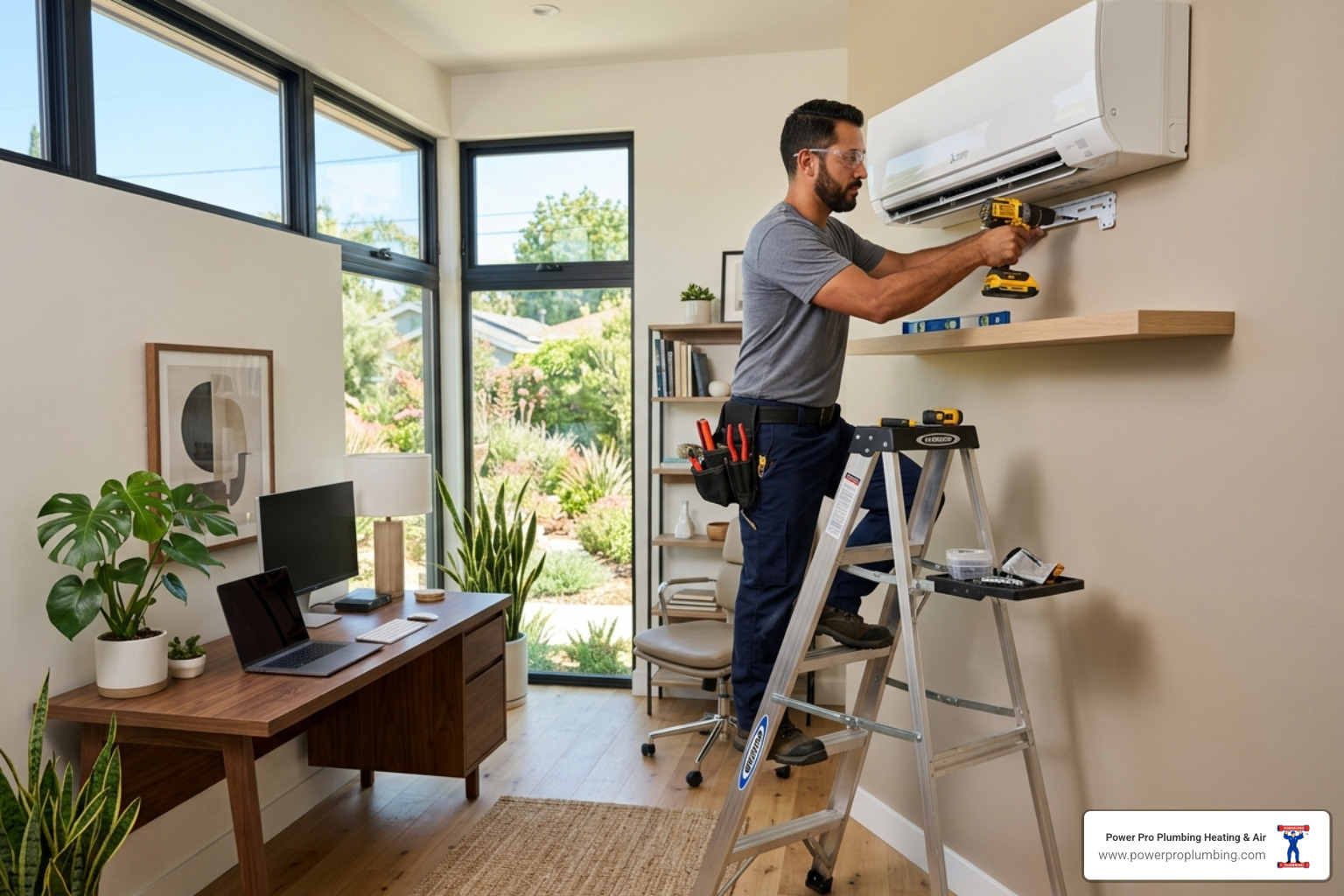
On the flip side, Ductless Mini Split Systems skip the ductwork entirely. Instead of one giant fan pushing air through the whole house, you have small, sleek indoor air handlers mounted directly on the walls or recessed into the ceiling of specific rooms. These are connected to the outdoor unit by thin refrigerant lines and electrical wiring that only require a small three-inch hole in the wall.
Understanding Central Air vs Mini Split for Southern California Homes
For many families in Santa Clarita or Anaheim, central air is the "invisible" winner. You don't see any equipment in your living areas—just small vents in the floor or ceiling. It provides uniform, whole-home cooling controlled by a single thermostat. It’s the traditional choice for newer tract homes where the infrastructure is already in place.
However, there are plenty of Common Myths about AC Installation that suggest central air is always the best or only option. In reality, the "one-size-fits-all" approach of a single thermostat can lead to the classic SoCal struggle: the upstairs is a sauna while the downstairs is a refrigerator. Mini splits solve this by giving every room its own "brain," allowing for precise comfort where you actually spend your time.
Why is energy efficiency so important for homes in Los Angeles and Orange County?
In April 2026, energy efficiency isn't just a buzzword; it's a financial necessity. With local utility rates climbing, how your system handles the heat directly impacts your monthly overhead. The industry uses SEER2 (Seasonal Energy Efficiency Ratio 2) to measure this. While California requires a minimum of 15.2 SEER2 for new central units, mini splits often soar much higher.
One of the biggest culprits of high bills in Southern California is "duct loss." In many homes in Pasadena or Whittier, ductwork runs through attics that can reach 140°F in the summer. Research shows that typical duct systems lose 20–30% of their cooling energy through leaks and poor insulation before the air even hits your living room. Mini splits eliminate this loss entirely because there are no ducts to leak.
Furthermore, mini splits utilize inverter technology. Think of it like a dimmer switch for your AC. Instead of a standard central unit that blasts at 100% and then shuts off (the "all or nothing" approach), an inverter-driven mini split slows down or speeds up to maintain a perfect temperature. This leads to incredible Efficiency with Ductless Mini Splits.
| System Type | Typical SEER2 Range | Potential Energy Savings |
|---|---|---|
| Standard Central AC | 15.2 – 18 | Base Efficiency |
| High-Efficiency Central AC | 19 – 22 | 15–20% Savings |
| Standard Mini Split | 20 – 25 | 30% Savings |
| Premium Mini Split | 26 – 35+ | 40–50% Savings |
When is a ductless system the better choice for my home's layout?
We often see mini splits as the "problem solvers" for Southern California's diverse architecture. If you live in a historic Craftsman bungalow in Riverside or a mid-century home in Silver Lake that never had AC, installing ducts would mean tearing into beautiful lath-and-plaster walls or dropping ceilings—a nightmare for aesthetics and your wallet.
A Ductless AC Installation is far less invasive. It's also the go-to for modern lifestyle changes, such as:
- Garage Conversions & ADUs: Perfect for turning a detached garage into a legal living space or rental unit.
- Room Additions: Adding a sunroom or a new master suite? Don't stress your existing central AC; give the new space its own dedicated system.
- The "Hot Room": We all have that one bedroom over the garage that never gets cool. A single-zone mini split fixes this instantly.
For many Ductless AC Installations for California Homes, the flexibility to scale the system room-by-room is a game changer. You can start with the master bedroom and living room, then add more zones later as your budget allows.
Choosing Central Air vs Mini Split for Southern California Homes
When making the final call, consider these three "lifestyle" factors:
- Zoning Needs: If your family fights over the thermostat, mini splits are the "peacekeepers." Each person can set their own temperature.
- Noise Levels: Mini splits are remarkably quiet. Most indoor units operate at 19–26 decibels—literally softer than a whisper. Central AC isn't necessarily "loud," but you will hear the "whoosh" of air and the thud of the blower motor starting up.
- Aesthetics: This is the one area where central air usually wins. If you hate the look of a unit on your wall, you might prefer the hidden vents of a central system. However, modern Daikin Ductless options include floor-mounted units and ceiling cassettes that are much more discreet.
Can I combine central air with mini splits for better comfort?
You don't always have to choose one or the other! We frequently recommend a "hybrid" approach for larger multi-story homes in areas like Irvine or Manhattan Beach.
Many homeowners keep their existing central air for the main floor and common areas but install Mini Splits for the upstairs bedrooms. This allows you to turn off the massive central system at night and only cool the rooms where people are sleeping. Since most mini splits are also heat pumps, they provide incredibly efficient heating for our mild SoCal winters, often allowing you to keep the gas furnace off entirely during those chilly January nights.
Frequently Asked Questions about SoCal HVAC Upgrades
Can mini splits effectively heat my home during a Southern California winter?
Absolutely. Modern mini splits are heat pumps, which means they can reverse their cycle to pull heat from the outside air and move it indoors. They are incredibly efficient in our climate because they move heat rather than generate it. In places like Torrance or Huntington Beach, where it rarely drops below freezing, a mini split can easily replace an old, inefficient gas furnace.
How much noise do these systems make compared to traditional vents?
As mentioned, mini splits are the champions of quiet. While a central AC vent might produce 30–40 decibels of "air noise," a mini split air handler is nearly silent. This makes them ideal for home offices, recording studios, or bedrooms where you want a peaceful sleep environment.
How long does the installation process take for each system?
If your home already has good ductwork, a central AC replacement can often be done in a single day. However, if you need new ducts, that can take a week or more and involve significant construction. A whole-home mini split system (3–4 zones) typically takes 1–2 days. A single-zone unit for a garage or home office can often be installed in just 4–6 hours with minimal disruption to your daily life.
Conclusion: Finding the Right Cooling Partner in Los Angeles
Deciding between central air vs mini split for southern california homes doesn't have to be a headache. Whether you are in a vintage apartment in West Hollywood, a sprawling estate in Rancho Palos Verdes, or a busy family home in Santa Ana, the goal is the same: reliable, affordable comfort.
At Power Pro Plumbing Heating & Air, we take pride in being a Daikin Comfort Pro. We’ve seen every type of home layout across Los Angeles County, Orange County, and the South Bay. We understand the local climate challenges—from the salt air in Santa Monica to the dry heat in San Bernardino. Our team is here to provide an honest assessment of your home’s infrastructure and help you find the system that fits your lifestyle.
If you’re ready to upgrade your comfort or just want a second opinion on your current setup, we’re here when you need us. Explore more about our Ductless Mini Splits Los Angeles CA or get More info about ductless services to see how we can make your home the coolest on the block.