


I'm looking to upgrade my home's cooling. How does a mini split vs central ac cost comparison look for LA homeowners?
: Mini Split vs. Central AC in Los Angeles and Orange County
A mini split vs central ac cost comparison comes down to more than just the sticker price on installation day — and if you're a homeowner in the Greater Los Angeles or Orange County area trying to decide between the two, here's the short answer:
| Factor | Mini Split | Central AC |
|---|---|---|
| Best for homes without ducts | Yes | No — adds significant cost |
| Best for homes with existing ducts | Competitive | Yes — lower upfront cost |
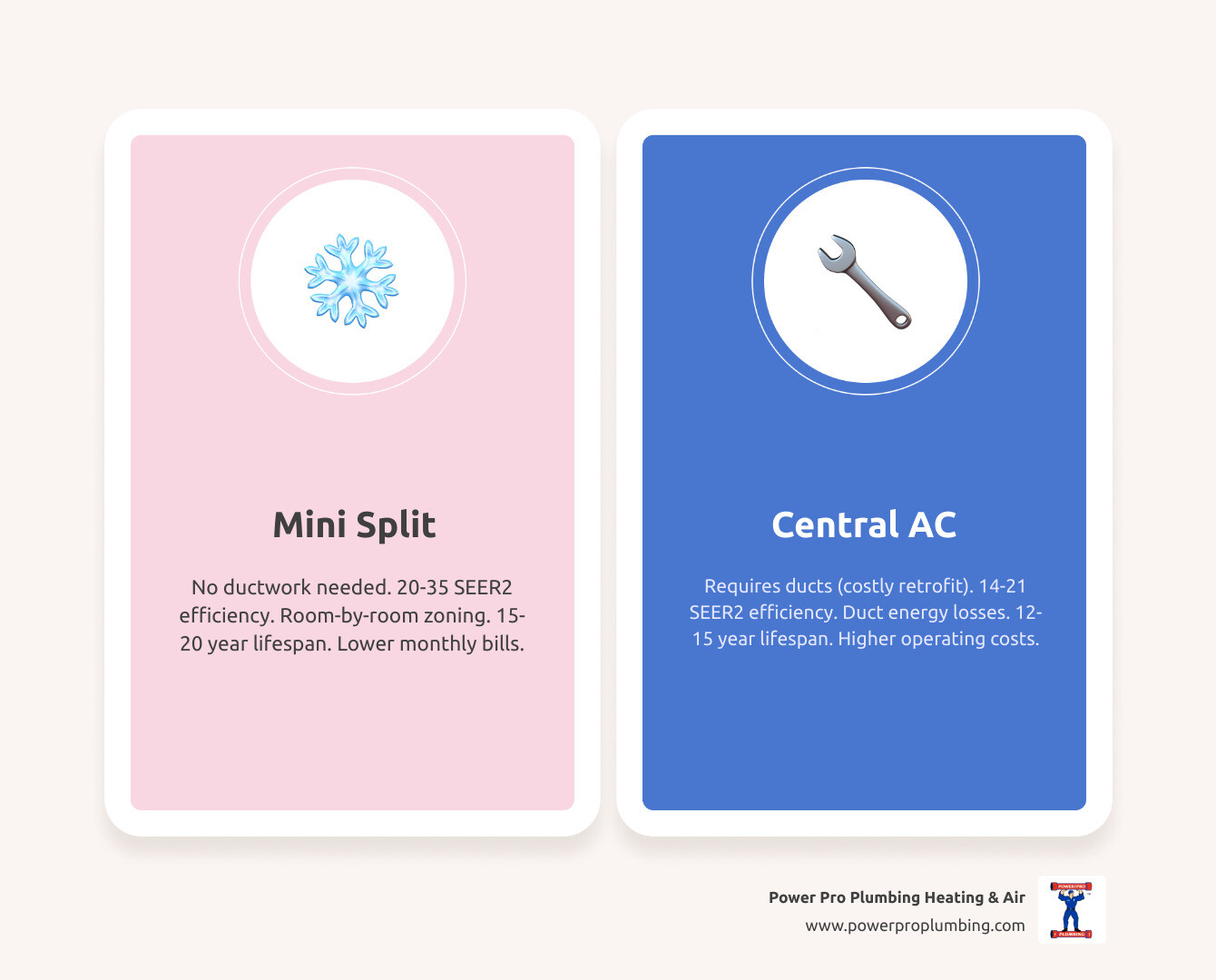
| Energy efficiency (SEER2) | 20–35 | 14–21 |
| Monthly operating costs | Lower | Higher (duct losses add up) |
| Zoning capability | Built-in, room by room | Limited without upgrades |
| Typical lifespan | 15–20 years | 12–15 years |
| Long-term total cost of ownership | Comparable to lower | Comparable to higher (especially without ducts) |
Bottom line: If your home already has solid, well-sealed ductwork, central AC can be the more straightforward and cost-effective upfront choice. If you don't have ducts — or your existing ducts are old and leaky — a mini split system will almost always save you more money over time.
Now, here's the longer story, because the right answer really does depend on your specific home.
Picture this: your central AC finally gives out on a 95-degree afternoon in Anaheim. You call for a replacement quote and suddenly find yourself wondering — is this the right time to make the switch to mini splits? It's a question we hear from homeowners across Los Angeles County, Orange County, and the South Bay all the time. The answer isn't one-size-fits-all, and anyone who tells you otherwise isn't giving you the full picture.
Ductwork is the single biggest variable in this decision. Homes built before central air became standard often lack ducts entirely, and retrofitting them into existing walls, floors, and ceilings can be a major — and expensive — undertaking. On the other hand, a home with modern, well-maintained ductwork is already set up for a straightforward central AC swap. Add in the real-world energy losses that come from ducts running through hot Southern California attics, and the efficiency gap between the two systems becomes very real, very fast.
I'm Daniel Rodriguez, a second-generation tradesman holding both C36 and C20 licenses, and I've helped countless LA and Orange County homeowners work through exactly this kind of mini split vs central ac cost comparison firsthand. That hands-on experience — from crawl spaces to attics — is what I bring to breaking this down clearly for you.
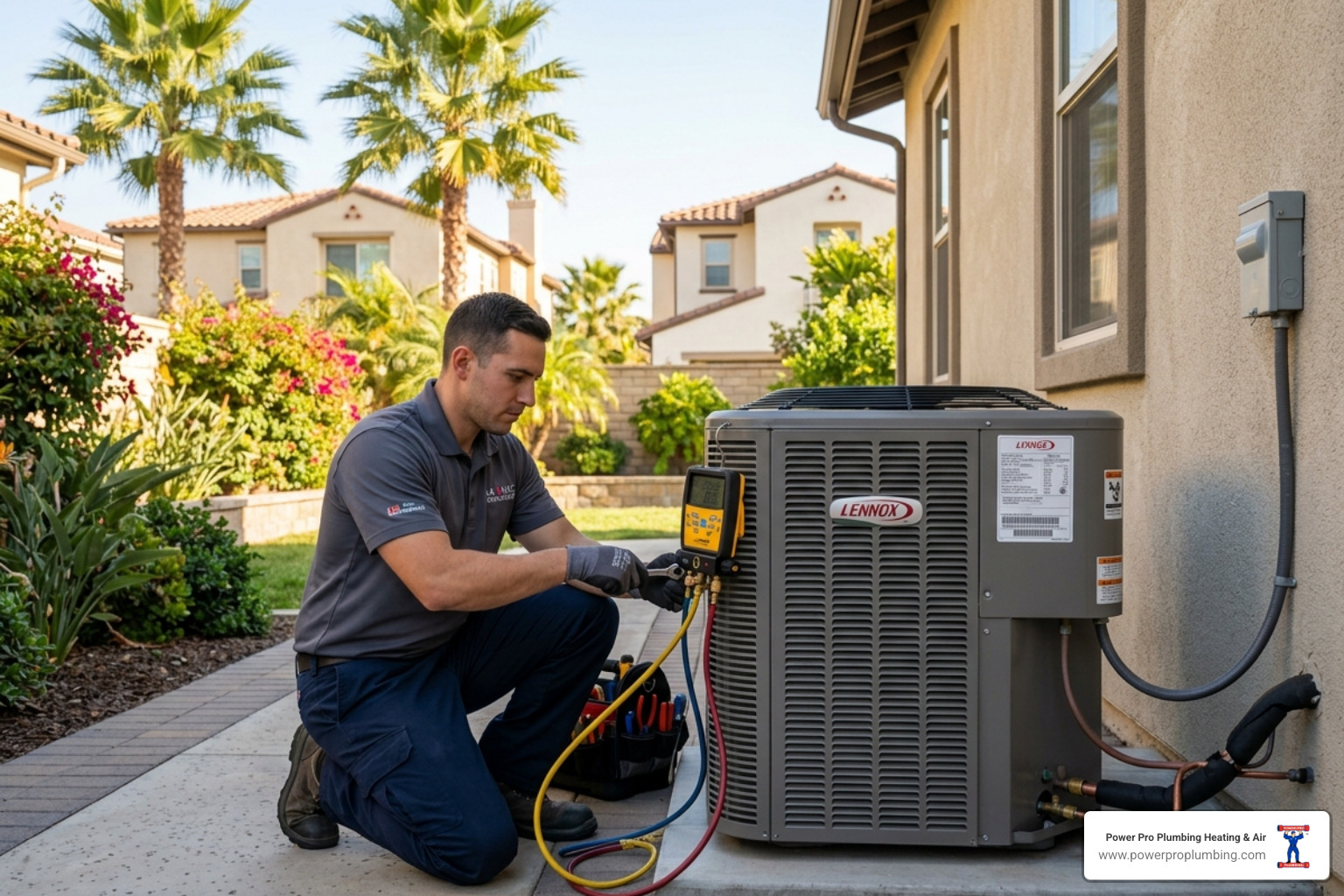
When we sit down with families in Beverly Hills or South Pasadena to discuss a new Air Conditioning system, the first thing we look at is the "skeleton" of the home. The upfront investment is heavily dictated by whether we are working with what’s already there or starting from scratch.
For a traditional central AC system, the installation is relatively simple if your home has existing, functional ductwork. However, if those ducts are old, undersized, or leaky, they can add thousands to the project. In many older Los Angeles homes, we find that the existing ducts are actually the bottleneck, wasting energy and preventing the new unit from working correctly.
Ductless Mini Split Systems take a different approach. Because they don't rely on a network of hidden tubes, the installation is much less invasive. We only need to drill a small three-inch hole to connect the indoor air handler to the outdoor condenser. While a multi-zone mini split system (one that cools several rooms) often carries a higher equipment price tag than a standard central unit, you aren't paying for the "ductwork tax"—the labor and material costs of tearing into your walls to run sheet metal or flex ducts.
Does a mini split vs central ac cost comparison favor ductless for monthly bills?
If you want to win the battle against Southern California Edison’s rising rates, efficiency is your best friend. In April 2026, energy rates are a top concern for everyone from Santa Monica to Irvine. This is where mini splits often take the lead.
Most Daikin Inverter Air Conditioners use variable-speed technology. Unlike traditional central AC units that are either "all on" or "all off," an inverter system adjusts its speed to match the exact cooling needs of the room. It’s like the difference between a car that only has two settings—park and 100 mph—versus one that can cruise smoothly at 35 mph.
| Feature | Central AC (Standard) | Mini Split (Inverter) |
|---|---|---|
| Duct Energy Loss | 20% to 30% waste | 0% (Ductless) |
| SEER2 Rating | Typically 14–18 | Typically 20–30+ |
| Cooling Delivery | Forced through ducts | Direct to the room |
| Compressor Type | Single or Two-Stage | Variable-Speed (Inverter) |
Research shows that ducts in a typical hot attic can lose up to 30% of the conditioned air before it ever reaches your living room. By eliminating ducts, mini splits ensure that every penny you spend on electricity actually cools your skin.
How zoning capability reduces energy waste
One of the biggest reasons homeowners in Ductless Mini-Split Systems South Pasadena CA choose ductless is the ability to stop cooling empty rooms.
Central AC is a "whole-home" solution. If you’re sleeping in the master bedroom, you’re still paying to cool the kitchen, the guest room, and the dining room. With a mini split, you have room-by-room control. You can set the living room to 74 degrees during the day and turn it off entirely at night while your bedroom stays a crisp 68. This strategic use of "zoning" can slash summer electric bills by 20% to 40% compared to a central system that forces air everywhere at once.
Which system is more cost-effective for older homes and additions in Orange County?
In areas like Ductless Mini-Split Systems Fullerton CA and Ductless Mini-Split Systems Tustin CA, we see many beautiful historic homes that were built long before air conditioning was a standard feature. For these homeowners, the mini split vs central ac cost comparison isn't just about the equipment—it's about preserving the home's integrity.
Mini split vs central ac cost comparison for homes without existing ducts
If your home doesn't have ducts, central AC becomes a massive project. You’re looking at significant costs just to build "bulkheads" or drop ceilings to hide the ductwork. This often involves tearing into lath-and-plaster walls, which is both messy and expensive.
The Role of Ductwork in AC System Replacement is often underestimated. In a home without ducts, a mini split is almost always the more cost-effective choice. It avoids the thousands of dollars in construction costs associated with a Ductless AC Installation. Instead of a week of demolition and drywall repair, a mini split can often be installed in a single day, keeping your home’s character intact while providing modern comfort.
Cooling solutions for garages and ADUs
With the rise of Accessory Dwelling Units (ADUs) in Cerritos and across LA County, mini splits have become the go-to solution. If you’re converting a garage into a home office or a "granny flat," extending your main home's central AC is often impractical and can even be against local building codes if the systems aren't sized correctly.
A Ductless AC Installation Cerritos CA allows an ADU to have its own independent climate control. This is ideal for rental units or guest spaces where the occupants might have different temperature preferences than the main house. It also ensures that if you're only using the garage for a few hours a day, you aren't straining your main home's HVAC system to keep it cool.
What are the long-term savings and 2026 tax incentives for new HVAC systems?
When we look at the total cost of ownership over a 10-to-15-year period, the math often tilts in favor of high-efficiency systems. While the initial price of a multi-zone Mini Splits setup might seem higher, the combination of lower monthly bills and longer equipment life changes the equation. You can find more details in our Ductless Mini Splits Ultimate Guide.
Federal tax credits and California rebates in 2026
As of April 2026, there are significant financial incentives available for homeowners in Ductless Mini-Split Systems Irvine CA and surrounding areas.
- Federal Tax Credits: Under the current energy guidelines, homeowners can claim a 30% tax credit (up to $2,000 annually) for installing qualified heat pump systems, which include most mini splits.
- HEEHRA Rebates: For income-qualified households in California, the High-Efficiency Electric Home Rebate Act (HEEHRA) can provide point-of-sale rebates that significantly lower the upfront cost of a heat pump.
- Utility Incentives: Local providers like Southern California Edison (SCE) often offer additional rebates for switching from older, less efficient units to high-SEER2 systems.
These incentives can effectively bridge the price gap between a standard central AC and a premium ductless system, making the higher-efficiency option much more accessible.
Maintenance and repair differences over ten years
Maintenance is a key part of any mini split vs central ac cost comparison. In Ductless Mini-Split Systems Lakewood CA, we recommend annual professional tune-ups for both systems to maximize their 15-to-20-year lifespan.
Central AC maintenance usually involves changing one or two large filters every few months and having a technician check the ductwork for leaks every few years. Mini splits require you to be a bit more "hands-on." Each indoor unit has its own small filter that should be rinsed out every few weeks. However, because there are no ducts, you never have to worry about the cost of professional duct cleaning or sealing, which can save you hundreds of dollars over the decade.
How do comfort factors like noise and air quality affect my investment?
Cost isn't just about dollars and cents; it’s also about the "cost" to your comfort. A system that keeps you up at night with a loud hum or aggravates your allergies has a hidden price tag.
Improving indoor air quality in the South Bay
Living in areas like Ductless Mini-Split Systems West Carson CA or Ductless Mini-Split Systems Lomita CA means dealing with urban dust and pollen.
Central AC systems use a single filter at the return air vent. While effective, the air then travels through ducts that can accumulate dust, mold, and pet dander over time. Ductless systems deliver air directly. Many Daikin Ductless units feature multi-stage filtration that can trap smaller particles and even neutralize odors right at the source. For families with asthma or severe allergies, this direct filtration can be a major selling point.
Operational noise and neighborhood considerations
In the tight-knit neighborhoods of Ductless Mini-Split Systems Marina del Rey CA, outdoor noise matters. You don't want your AC to be the reason your neighbor can't enjoy their patio.
Mini split outdoor units are famously quiet, often operating at decibel levels comparable to a quiet conversation. Inside, the air handlers are even quieter—some as low as 19 decibels. This is significantly quieter than the "whoosh" of air coming through a central AC vent. If you’re a light sleeper or have a home recording studio, the silence of a mini split is an investment in your peace of mind.
For larger properties where a central system is still preferred, we often recommend Daikin Package Units which are engineered for high performance with reduced noise profiles compared to older models.
Frequently Asked Questions about Home Cooling Costs
Can I add more zones to a mini split system later?
Yes, provided your outdoor condenser unit has the capacity. Many multi-zone condensers are designed to handle between two and five indoor units. If you start with two units today, you can often add a third for a home office later, as long as the initial system was planned with that expansion in mind.
Do mini splits provide efficient heating during California winters?
Absolutely. Mini splits are heat pumps, meaning they can reverse the cooling process to pull heat from the outside air and bring it indoors. They are incredibly efficient for our moderate Southern California winters, often performing better and costing less to run than a traditional gas furnace.
How much does existing ductwork impact the choice of a central AC system?
It is the deciding factor. If your ducts are in great shape, central AC is usually the most affordable way to get whole-home cooling. However, if a professional inspection reveals that your ducts are falling apart or were poorly designed, the cost to repair them might make a mini split system the more logical financial choice.
Conclusion: Finding the Best Cooling Solution for Your Family
The mini split vs central ac cost comparison doesn't have a "right" answer until we look at your specific home. At Power Pro Plumbing Heating & Air, we’ve spent years serving the Greater Los Angeles and Orange County communities, from the hills of San Marino to the beaches of Newport.
We pride ourselves on being honest, local experts. As a Daikin Comfort Pro, we have the specialized training to install high-efficiency Ductless Mini Split Systems that stand the test of time. Our licensed technicians treat every home like their own, ensuring that whether you choose central air or ductless, your system is sized perfectly for your needs.
Don't guess when it comes to your comfort and your wallet. Whether you're in the South Bay, the San Gabriel Valley, or North Orange County, we're here to help you weigh the pros and cons. We offer same-day service and a "we're here when you need us" attitude that has earned us over 28,000 reviews from your neighbors.
Ready to see which system makes the most sense for your home? Give us a call today. We’ll help you find a cooling solution that keeps your family comfortable and your energy bills in check for years to come.