

Why Hard Water Is Such a Common Problem in LA and Orange County
What is hard water and how hard is the water in Los Angeles and Orange County? Hard water is water that contains high concentrations of dissolved minerals — primarily calcium and magnesium — and across most of LA and Orange County, it ranges from moderately hard to very hard. Here's a quick summary:
Hard water at a glance for LA and Orange County:
- What is hard water? Water with elevated calcium and magnesium levels, measured in grains per gallon (GPG) or parts per million (PPM)
- Los Angeles average hardness: ~177.7 PPM / 10.4 GPG (ranges from 8.6 GPG in Western LA to 16.3 GPG in Eastern LA and the Harbor area)
- Orange County average hardness: 10–15 GPG / 171–257 PPM (ranges from 8 GPG in coastal cities to 19 GPG in inland cities)
- Classification: Any reading above 7 GPG (120 PPM) is considered hard — most of SoCal clears that bar easily
- Hardest cities in the area: Fullerton (333 PPM / 19.5 GPG), Glendale (358.6 PPM / 21 GPG), Hermosa Beach and Redondo Beach (508 PPM / 29.7 GPG)
If you've noticed white crusty buildup around your faucets, spots on your glasses after the dishwasher runs, or skin that feels dry after a shower, you're already living with the effects of hard water. You're far from alone — nearly 90% of American households deal with hard water, and Southern California is one of the more affected regions in the country, thanks largely to water sourced from the mineral-rich Colorado River and local groundwater basins.
This guide walks you through everything you need to know: what hard water actually is, how hard the water is where you live, what it does to your home and health, and what you can do about it.
I'm Daniel Rodriguez, a licensed plumber (C36) with years of hands-on experience helping homeowners across Los Angeles and Orange County deal with exactly these kinds of water quality challenges — including the plumbing damage that comes from living in an area where what is hard water and how hard is the water in Los Angeles and Orange County is a question that genuinely affects your pipes, appliances, and daily comfort. In the sections ahead, we'll break it all down clearly so you know exactly where you stand.
What Is Hard Water and How Is It Measured?
At its most basic scientific level, hard water is water that has accumulated a high concentration of dissolved minerals. As rainwater falls, it is naturally soft. However, as it filters down through the soil and percolates through rock layers underground, it acts as a solvent. It dissolves and collects minerals from surrounding deposits of limestone, chalk, gypsum, and clay.
The primary culprits behind hard water are calcium and magnesium ions. While other minerals like iron, manganese, and brass can sometimes play a minor role, calcium carbonate ($CaCO_3$) is the standard compound used to measure and classify water hardness.
To help homeowners understand where their water falls, water quality organizations use standard classification scales. Hardness is typically grouped into four main categories:
| Hardness Classification | Parts Per Million (PPM) / mg/L | Grains Per Gallon (GPG) |
|---|---|---|
| Soft | 0 – 60 | 0 – 3.5 |
| Moderately Hard | 61 – 120 | 3.5 – 7.0 |
| Hard | 121 – 180 | 7.0 – 10.5 |
| Very Hard | More than 180 | More than 10.5 |
When water crosses the threshold of 7 GPG (or 120 PPM), it is officially classified as "hard." At this point, homeowners typically begin noticing scale buildup on plumbing fixtures, spotty dishes, and a distinct lack of rich soap lather in the shower.
Understanding GPG vs PPM
If you look at a municipal water quality report or a home testing kit, you will see water hardness measured in one of two units:
- Parts Per Million (PPM) / Milligrams per Liter (mg/L): This is the standard scientific measurement. It represents the weight of dissolved calcium carbonate minerals in a specific volume of water. One PPM means there is one milligram of calcium carbonate dissolved in one liter of water.
- Grains Per Gallon (GPG): This is the unit most commonly used by the plumbing and water treatment industry. A "grain" is an ancient unit of weight originally based on a single grain of wheat (about 64.8 milligrams). One GPG represents one grain of calcium carbonate dissolved in one gallon of water.
To convert PPM to GPG, you simply divide the PPM figure by 17.1. For example, if your city's water report shows a hardness level of 171 PPM, you divide 171 by 17.1 to get 10 GPG.
According to United States Geological Survey (USGS) standards, anything exceeding 180 PPM (10.5 GPG) is considered "very hard." As you will see, many neighborhoods in Los Angeles and Orange County blow past this "very hard" threshold on a regular basis.
What Is Hard Water and How Hard Is the Water in Los Angeles and Orange County?
To understand what is hard water and how hard is the water in Los Angeles and Orange County, we have to look directly at where our local water comes from. Southern California does not rely on a single water source. Instead, our water is a blend of several sources:
- The Colorado River Aqueduct: This water travels hundreds of miles across desert limestone beds, picking up massive amounts of minerals along the way. It is notoriously high in calcium and magnesium.
- The State Water Project: Sourced from Northern California’s Sierra Nevada snowmelt, this water starts off incredibly soft but picks up minerals as it flows south through the Sacramento-San Joaquin Delta and various aqueducts.
- Local Groundwater Basins: Many cities in LA and Orange County pump water from local underground wells. Because this water sits in deep underground aquifers surrounded by rock and soil, it has ample time to dissolve local mineral deposits, making it highly concentrated.
Because of this complex blending process, the water hardness in your home can change depending on the season, local drought conditions (which force cities to rely more heavily on groundwater wells), and how your local water district mixes these sources. This constant exposure to mineral-rich water is why local homeowners often experience premature appliance failure and plumbing issues. To learn more about this, read our detailed article on How Hard Water Affects Your Plumbing and Appliances.
Analyzing what is hard water and how hard is the water in los angeles and orange county neighborhoods
In Los Angeles County, water hardness is highly localized. The Los Angeles Department of Water and Power (LADWP) distributes water across a vast network, and the mineral content varies dramatically depending on your neighborhood's primary water source:
- San Fernando Valley & Western LA (e.g., Beverly Hills, Culver City, Santa Monica): These areas average roughly 8.6 GPG (147 PPM), though it can range from 5.4 to 16.1 GPG depending on the exact blend. While this is still classified as hard water, it is often the softest water you will find in the basin.
- Silver Lake, Downtown, & South LA: These central neighborhoods experience moderately hard to hard water, averaging 9.8 GPG (167 PPM).
- Eastern Los Angeles & the Harbor Area (e.g., Lomita, San Pedro): These neighborhoods experience some of the hardest water in the city, averaging 16.3 GPG (279 PPM). This water is firmly in the "very hard" category.
- Glendale & Burbank: Because these municipal utilities rely heavily on local groundwater blending, their hardness levels are incredibly high. Glendale averages 21 GPG (358.6 PPM), while Burbank sits around 16.7 GPG (285 PPM).
- The South Bay (Hermosa Beach & Redondo Beach): If you live along the coast in Hermosa Beach or Redondo Beach, you are dealing with some of the hardest water in California, often measuring a whopping 29.7 GPG (508 PPM).
Evaluating what is hard water and how hard is the water in los angeles and orange county cities
Crossing over into Orange County, the story remains much the same. The Orange County Water District (OCWD) manages a massive groundwater basin that supplies about 77% of the water to 19 municipal water agencies and districts. The remaining water is imported from the Colorado River and Northern California.
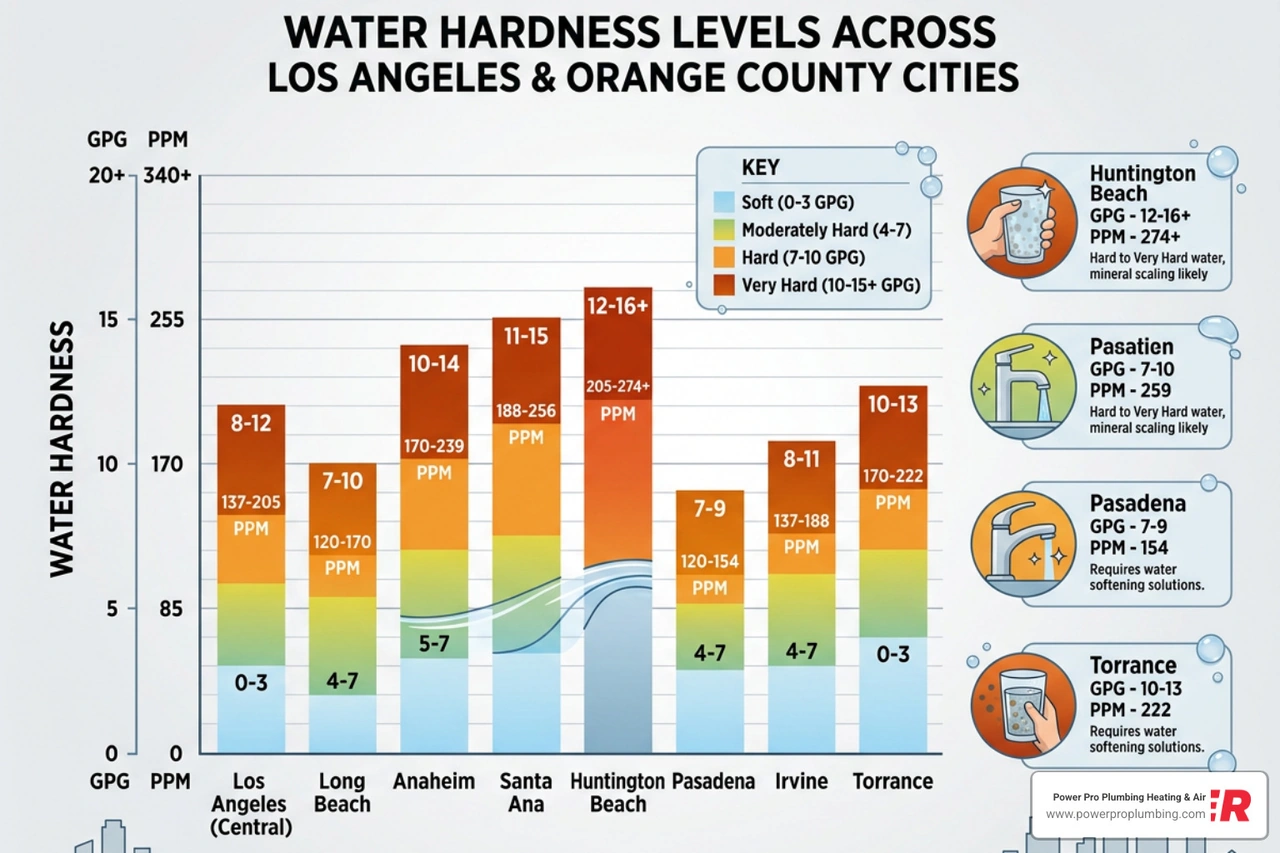
On average, Orange County water hardness ranges from 10 to 15 GPG (171–257 PPM), meaning the entire county is dealing with hard to very hard water. However, the specific city you live in dictates just how severe the issue is:
- Fullerton: Sits at the top of the list with a very high average of 19.5 GPG (333 PPM).
- Orange: Averages 17 GPG (290.7 PPM) due to its heavy reliance on local groundwater wells.
- Anaheim: Experiences an average water hardness of 16.4 GPG (279.5 PPM).
- Santa Ana: Averages 14.2 GPG (242 PPM).
- Irvine: Averages 13.5 GPG (231 PPM).
- Huntington Beach: Experiences average hardness levels in the 10 to 15 GPG range.
- Coastal Communities (e.g., Newport Beach, Laguna Beach): These coastal areas typically enjoy slightly softer water (often on the lower end of the 8 to 10 GPG range) because they consume a higher ratio of imported surface water rather than groundwater. However, this is still well above the 7 GPG threshold, meaning scale and spotting are still daily realities.
The Impact of Hard Water on Your Home and Health
While hard water is not a health hazard, it acts as a constant, quiet tax on your household budget, your plumbing system, and your physical comfort. The minerals dissolved in your water do not stay dissolved forever. When hard water is heated, or when it evaporates, it leaves behind solid calcium carbonate deposits known as limescale.
Over time, this chalky, white residue builds up inside your pipes, coats the heating elements of your appliances, and ruins the aesthetic of your kitchen and bathroom fixtures.
Additionally, hard water reacts chemically with soap. Instead of creating a rich, cleansing lather, the calcium and magnesium ions bind with the soap molecules to form an insoluble, sticky precipitate known as soap scum. This film clings to your shower walls, your dishes, your clothes, and even your skin and hair.
Effects on Plumbing and Appliances
For homeowners, the most expensive consequences of hard water occur out of sight, deep within your home's infrastructure:
- Reduced Appliance Lifespan: According to studies by the Water Quality Research Foundation (WQRF), hard water can shorten the lifespan of major water-using appliances — like washing machines, dishwashers, and water heaters — by 30% to 50%. Heating elements coated in scale have to work twice as hard to heat water, leading to rapid burnout.
- Water Heater Efficiency Loss: As hard water is heated in your tank, calcium sediment settles to the bottom. This layer of sediment acts as an insulator, forcing your water heater to consume significantly more energy to heat the water. It can also cause the tank bottom to overheat and fail prematurely.
- Clogged Pipes and Low Water Pressure: Over years of exposure, limescale accumulates inside your copper or galvanized steel pipes, narrowing the pathway for water. This restricts water flow, clogs faucet aerators, and causes a frustrating drop in water pressure.
- Bacterial Growth: Limescale creates a rough, porous surface inside your plumbing. This texture provides an ideal anchor point for biofilms and harmful bacteria, such as Legionella, to take root and multiply.
To prevent these issues from taking over your home, many local families choose to install whole-house filtration and treatment systems. If you want to explore how these systems protect your plumbing, take a look at our guide on How Water Filtration Improves Your Water Quality.
Effects on Skin, Hair, and Laundry
The mineral film left behind by hard water is equally tough on your body and your fabrics:
- Dry, Itchy Skin: Soap scum does not wash away easily. It leaves an invisible film on your skin that clogs pores and strips away natural, protective oils. This leads to persistent dryness, itching, and irritation.
- Eczema and Atopic Dermatitis: Medical studies have linked hard water areas to higher rates of atopic dermatitis (eczema), particularly in infants and young children. The mineral residue irritates sensitive skin barriers, triggering flare-ups.
- Dull, Flat Hair: Hard water makes it incredibly difficult to thoroughly rinse shampoo and conditioner out of your hair. The resulting buildup weighs hair down, leaving it feeling straw-like, frizzy, and difficult to style.
- Stiff, Faded Laundry: When washed in hard water, clothing fibers trap mineral deposits and soap scum. Your clothes will emerge from the wash feeling stiff, scratchy, and rough. Over time, these minerals break down fabric fibers, causing colors to fade and clothes to wear out faster.
How to Test and Solve Hard Water Issues in Southern California
If you suspect you have hard water, there are several simple ways to confirm your exact hardness levels:
- The DIY Soap Test: Fill a clean, clear plastic bottle one-third full with tap water. Add a few drops of liquid dish soap and shake the bottle vigorously. If the bottle quickly fills with a thick layer of suds and the water underneath remains clear, your water is relatively soft. If you get very few bubbles, a cloudy layer of water, and a greasy film on the surface, you have hard water.
- At-Home Test Strips: You can purchase inexpensive water testing kits online or at home improvement stores. These kits include paper strips that change color when dipped in water, allowing you to match the color to a chart to find your GPG or PPM level.
- Check Your Municipal Report: Every public water utility in LA and Orange County is required to publish an annual Consumer Confidence Report (CCR). You can look up your city's report online to find their official testing averages.
- Professional Water Testing: For the most accurate results, you can have a professional water specialist test your water. This is highly recommended if you are trying to size a water treatment system, as it measures exact hardness alongside pH, total dissolved solids (TDS), and other potential contaminants.
Once you know how hard your water is, you can choose from several highly effective treatment solutions:
- Traditional Salt-Based Water Softeners: This is the gold standard for hard water treatment. Using a process called ion exchange, these systems route hard water through a resin bed filled with sodium ions. The resin acts like a magnet, capturing the calcium and magnesium ions and releasing a tiny, harmless amount of sodium in their place. This completely removes the hard minerals, giving you truly soft water.
- Salt-Free Water Conditioners: If you do not want to use salt, a water conditioner is an excellent alternative. Rather than removing the minerals, these systems use physical media to alter the chemical structure of calcium and magnesium, preventing them from binding to surfaces and forming scale. While they do not technically "soften" the water (soap lathering and skin feel remain similar), they do an outstanding job of protecting your pipes and appliances from limescale.
- Reverse Osmosis (RO) Systems: If you want pristine, mineral-free water for drinking and cooking, a point-of-use reverse osmosis system is the perfect solution. These systems force water through a semi-permeable membrane that filters out up to 99% of dissolved solids, including calcium, magnesium, heavy metals, and chlorine.
Choosing the right system for your home depends on your water hardness, household size, and specific goals. To help you navigate this decision, we have put together two essential resources: Three Important Reasons to Have a Water Filtration System and How to Choose the Right Water Treatment System.
Frequently Asked Questions about SoCal Water Hardness
Is hard water in Los Angeles and Orange County safe to drink?
Yes, the tap water provided by LADWP, the Orange County Water District, and other local municipal utilities is completely safe to drink. It meets or exceeds all state and federal drinking water standards.
In fact, drinking hard water can actually have minor health benefits. The World Health Organization (WHO) notes that drinking water rich in calcium and magnesium can contribute positively to your daily dietary intake of these essential minerals. Some medical studies have even suggested a weak link between drinking hard water and lower rates of cardiovascular disease.
However, many people find the taste and mouthfeel of mineral-heavy water unpleasant, which is why they choose to filter their drinking water.
Will a water softener increase my water bill?
A traditional water softener does require a small amount of water to regenerate (clean) its resin tank, which usually happens once or twice a week. While this does use some water, the overall impact on your utility bill is very minimal.
In fact, a water softener will actually save you money in the long run. By preventing scale buildup, your water heater will operate much more efficiently, lowering your monthly gas or electric bill. You will also save money by using up to 75% less soap, shampoo, and laundry detergent, and you won't have to replace expensive appliances prematurely.
How often should I flush my water heater in LA or OC?
Because the water in Los Angeles and Orange County is so hard, we strongly recommend flushing your water heater at least once a year.
If you live in an area with exceptionally hard water, such as Glendale, Fullerton, or the South Bay, flushing it every six months is even better. Regularly draining the sediment out of your water heater tank prevents the calcium from hardening into a thick crust, protecting your heating elements and significantly extending the lifespan of your unit.
Conclusion
Living in Southern California means enjoying beautiful beaches, incredible weather, and vibrant communities — but it also means dealing with some of the hardest water in the nation. Knowing what is hard water and how hard is the water in Los Angeles and Orange County is the first step toward protecting your home, your appliances, and your family's comfort from the silent damage of mineral buildup.
At Power Pro Plumbing Heating & Air, we have spent years helping homeowners across the Greater Los Angeles Area, Orange County, and the South Bay find the perfect solutions for their water quality issues. Whether you are dealing with low water pressure, a water heater that needs a thorough flush, or you are ready to install a professional-grade whole-house water softener, our team of licensed, friendly technicians is here to help. We pride ourselves on our outstanding reputation — backed by over 28,573 online reviews — and our commitment to providing fast, reliable, same-day service.
Don't let hard water take a toll on your home's plumbing. Protect your home from mineral damage by addressing water heater sediment buildup today! Give us a call or schedule an appointment online, and let our family take care of yours.