

The 6:30 AM Shower Rush: Is Your Plumbing Ready for Fall?
Flushing your tankless water heater before the back-to-school morning rush is the single most effective way to prevent cold showers and low water pressure this fall. Here at Power Pro Plumbing, Heating & Air, we see this exact scenario play out every late August. The relaxed, staggered schedules of summer are about to vanish, and soon, your household will shift back to a highly synchronized morning routine, placing a massive, sudden demand on your home's hot water system.
During the summer months, family members tend to shower at different times of the day. Your water heater barely breaks a sweat. However, once the school year begins, our team typically sees demand spike dramatically. Between 6:00 AM and 7:30 AM, multiple showers, bathroom sinks, and perhaps a dishwasher are all running at the exact same time. If you want to ensure your system can handle this peak demand, you need proactive professional plumbing services to get your equipment ready for the transition.
The sudden pressure drop: Many homeowners only discover their tankless system is struggling on the first day of school. Someone turns on the kitchen sink while two showers are running, and suddenly, the water pressure drops to a trickle, or the temperature fluctuates wildly. This frustrating scenario is a direct result of neglected maintenance. Tankless units require proactive care to handle peak demand, especially in areas with challenging water conditions.
Understanding how scale buildup directly impacts your daily routine is the first step toward a stress-free morning. When you know what is happening inside that metal box on your wall, you can take the right steps to keep the hot water flowing perfectly, no matter how chaotic the late August back-to-school transition gets.
How Simultaneous Showers Expose Tankless Flow Restriction
When our technicians arrive at a home struggling with morning water pressure, we always look at the mechanical reality of how these systems operate under stress. Tankless water heaters provide continuous hot water, but they have a hard limit on their maximum flow rate capacity. They are designed to heat water on demand as it passes through a heat exchanger.
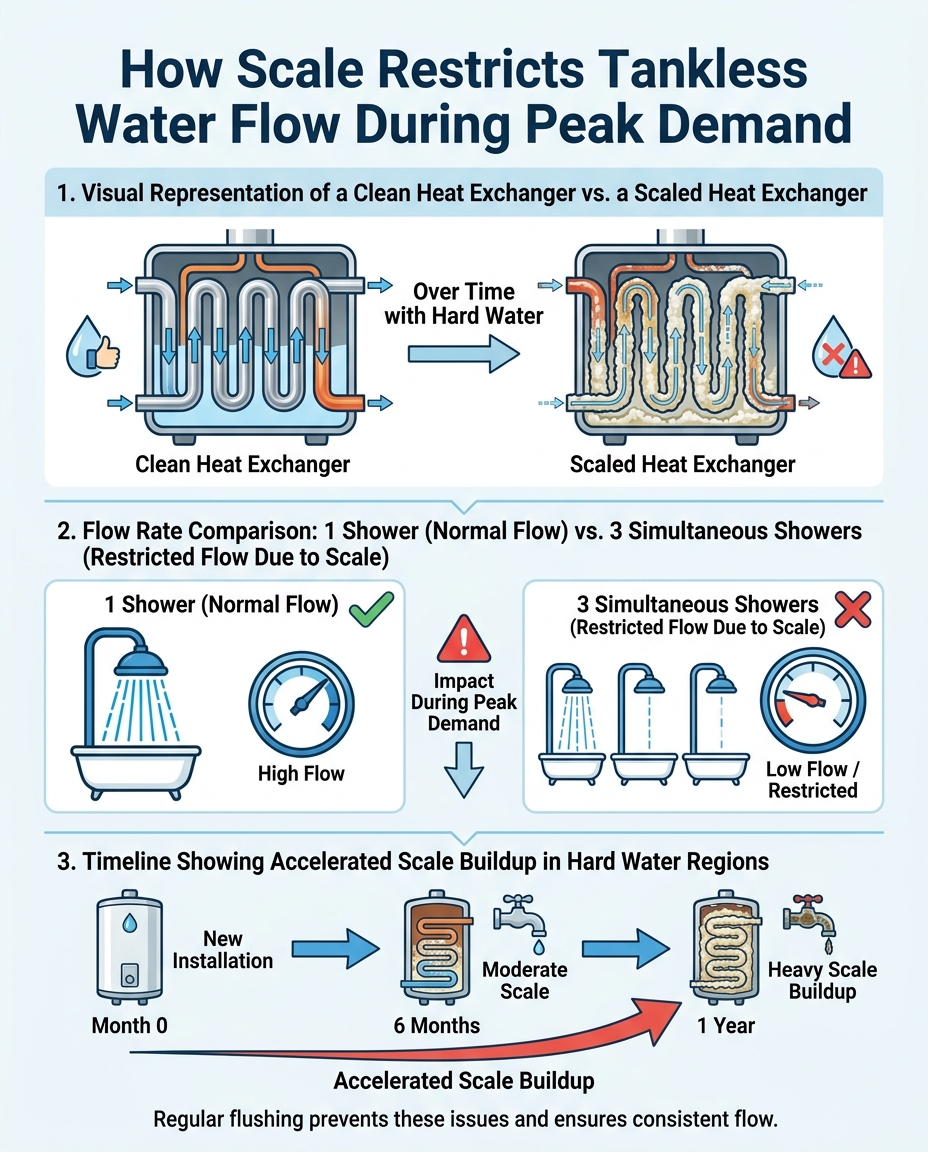
If that heat exchanger is compromised by mineral buildup, the system faces a critical problem. The unit's internal computer recognizes that it cannot heat the water fast enough to meet your requested temperature at the current flow rate. To compensate, the system deliberately restricts the water flow. It slows the water down so it spends more time inside the heat exchanger, ensuring the water reaches the set temperature before it exits the unit. This is why our experts emphasize routine tankless water heater maintenance to keep the internal components completely clean and functioning at full capacity.
This flow restriction connects directly to the experience of a sudden drop in water pressure. When a second shower or a bathroom sink is turned on, the system simply cannot keep up with the volume while maintaining the heat. It throttles the output, leaving you shivering under a weak stream of water. This mechanical limitation remains hidden during the low-demand summer months but becomes glaringly obvious during peak seasonal usage spikes.
The Myth of 'Running Out' of Hot Water
Most homeowners assume their system is "running out" of hot water, much like a traditional tank water heater does when it empties. That is a common misconception our team clears up almost daily. A tankless unit never actually runs out of hot water, because it does not store water. Instead, it throttles the flow.
The system's programming always prioritizes temperature over pressure. It will sacrifice your water pressure to guarantee the water remains hot. If your system were perfectly clean, it could handle the volume and the temperature simultaneously. The restriction is a protective measure, signaling that the system is working harder than it should have to.
• Summer Staggered (1 Shower) — System Load: Low / Moderate — Impact on Scaled Unit: Unnoticeable. System easily meets temperature and pressure demands.
• Back-to-School (2 Showers + Sink) — System Load: Maximum Peak — Impact on Scaled Unit: Severe flow restriction. Noticeable pressure drops and temperature fluctuations.
• Evening Routine (Dishwasher + Bath) — System Load: High Peak — Impact on Scaled Unit: Moderate flow restriction. Longer wait times for hot water at the tap.

The Culprit: How Regional Water Conditions Accelerate Scale
The root cause of this flow restriction rarely has anything to do with a defective water heater. Instead, it comes directly from the local water supply. Southern California is notorious for having incredibly hard water. In our years of servicing Cerritos CA and the surrounding areas, we've pulled out heat exchangers completely choked by thick, rock-like scale. This local reality necessitates much more rigorous, frequent tankless maintenance compared to regions with softer municipal water.
Hard water contains high concentrations of dissolved minerals, primarily calcium and magnesium. While these minerals are perfectly safe to drink, they wreak havoc on plumbing appliances. When hard water is rapidly heated inside a tankless unit, a chemical reaction occurs. The dissolved minerals precipitate out of the water and cling to the hottest surfaces they can find—which is the heat exchanger.
Over time, this stubborn scale forms a thick, rock-like crust inside the narrow copper or stainless steel pathways of the unit. This scale acts as an incredibly effective insulator. Because the heat exchanger is insulated by this mineral layer, the burner has to fire longer and hotter to transfer the same amount of heat into the water. Understanding how Southern California hard water accelerates tankless scale is crucial for homeowners we serve in Cerritos CA and the surrounding communities.
Generic national maintenance timelines often suggest flushing a tankless unit every two to three years. For homes dealing with severe local water hardness, our plumbers know that waiting that long guarantees a system failure. In the Cerritos area, scale buildup happens rapidly, forcing the unit to work harder, consume more energy, and ultimately restrict your morning water flow.
Warning Signs Your Tankless Unit is Heavily Scaled
Your tankless water heater will usually give you several warning signs before it completely disrupts your morning routine. Catching these symptoms early allows you to schedule maintenance before the chaotic late August back-to-school transition begins. When the team at Power Pro Plumbing diagnoses a struggling unit, we typically look for these specific indicators:
• Fluctuating water temperatures: If the water goes from hot to lukewarm and back to hot during a single shower, the heat exchanger is likely struggling to maintain a consistent transfer of heat through a layer of scale.
• Noticeable pressure drops: A sudden loss of water pressure when a second appliance is turned on is the most common sign that the unit's computer is deliberately throttling the flow to compensate for scale buildup.
• Digital error codes: Most modern units have a digital display that will flash an error code when maintenance is required. Codes indicating "scale buildup" or "restricted flow" mean the unit is operating outside of its safe parameters.
• Unusual operational sounds: A clean tankless unit operates with a smooth, quiet hum. If you hear loud knocking, rumbling, or whining sounds coming from the unit while it is running, water is likely boiling unevenly around heavy mineral deposits.
• Longer wait times for hot water: If it takes significantly longer for hot water to reach your bathroom faucet than it did when the unit was newly installed, restricted flow is likely the culprit.
Ignoring these warning signs forces the system to run hotter and longer, which drastically shortens the lifespan of the internal components. Addressing them proactively saves you from sudden breakdowns.
Why Professional Flushing Beats DIY Maintenance
As the school year approaches, many homeowners search for quick DIY fixes to improve their water pressure. While vinegar flushes are commonly discussed online, our technicians have seen firsthand how they often fail to remove severe, baked-on scale safely. White vinegar is a mild acid, and while it might handle light buildup in a coffee maker, we find it is rarely strong enough to dissolve the heavy calcium deposits created by Southern California hard water.
Attempting DIY maintenance on a complex gas or electrical appliance carries significant risks. In our experience, homeowners can easily cross-thread vital connection valves, damage sensitive internal flow sensors, or fail to flush the acidic solution out completely, leading to internal corrosion. More importantly, opening the unit and performing unlicensed maintenance can instantly void the manufacturer's warranty.
A comprehensive professional flush goes far beyond simply pumping a descaling solution through the pipes. A licensed Power Pro Plumbing technician will check the isolation valves, clean the inline screen filters, inspect the burner assembly, and verify that the unit is achieving optimal flow rates after the flush is complete. If you need reliable water heater services in Cerritos, relying on our professionals ensures the job is done safely and thoroughly.
Protecting Your Equipment and Warranty
Professional descaling solutions are specifically calibrated to safely dissolve heavy minerals without corroding the delicate copper or stainless steel heat exchanger. Furthermore, having professional documentation of your annual maintenance is often a strict requirement for keeping your manufacturer warranty valid.
The value of a professional visit lies in the thoroughness of the inspection. For example, during a routine check-up, our technicians perform a comprehensive leak check on all the surrounding plumbing and the water heater itself. We find underlying issues early, provide an honest assessment without any unnecessary up-selling, and leave our customers completely reassured about their system's condition. That level of honest, thorough evaluation is exactly what ensures your unit is ready for heavy seasonal use.
Your Late-August Water Heater Readiness Checklist
Preparing for the back-to-school season requires a proactive approach. Our team at Power Pro Plumbing focuses heavily on keeping family morning routines stress-free, acting as a reliable local partner for proactive household management. Follow this timeline to ensure your plumbing is ready for the morning rush:
1. Early August: Schedule a professional flush. Do not wait until the week before school starts. Secure an appointment early to ensure your heat exchanger is completely clean and operating at maximum flow capacity.
2. Mid-August: Test simultaneous fixtures. Run two showers and a bathroom sink at the same time. Pay close attention to the water pressure and temperature. If you notice a significant drop, your system needs immediate attention.
3. Late August: Check and clean aerators. The small screens at the end of your bathroom and kitchen faucets can trap loose scale and mineral debris, artificially restricting your water flow. Unscrew them, rinse out any sediment, and reinstall them.
4. Ongoing: Establish a recurring schedule. Based on the specific water hardness we see in the Cerritos CA area, work with our technicians to set up an annual or bi-annual maintenance calendar so you never have to worry about scale buildup again.
Taking these simple steps ensures that when the alarm clocks go off and everyone rushes to get ready, the hot water system performs flawlessly.
Frequently Asked Questions About Tankless Maintenance
Why does my tankless water heater lose pressure when multiple taps are on?
Your tankless water heater loses pressure because its internal computer is deliberately restricting the water flow. When multiple taps are on, the demand for hot water exceeds the unit's ability to heat it instantly, especially if the heat exchanger is coated in insulating mineral scale. To ensure the water reaches your desired temperature, the system slows the water down, resulting in a noticeable drop in pressure at the showerhead or faucet.
What happens if you don't flush a tankless water heater?
If you do not flush a tankless water heater, hard water minerals will continuously build up inside the heat exchanger. This scale acts as an insulator, forcing the burner to work harder and hotter to heat the water, which drastically reduces the unit's energy efficiency. Eventually, the severe restriction will cause the unit to overheat, trigger error codes, shut down completely, or suffer a premature component failure.
Can a tankless water heater run out of hot water?
The short answer is no, a tankless water heater cannot "run out" of hot water because it does not store water in a tank. It heats water continuously as it flows through the unit. However, it can reach its maximum flow rate capacity. When the demand exceeds this capacity, the unit will restrict the flow of water to maintain the heat, which feels like you are losing hot water pressure, even though the temperature remains constant.
What are the signs a tankless water heater needs flushing?
The most common signs include sudden drops in water pressure when multiple fixtures are running, fluctuating water temperatures during a shower, and longer wait times for hot water to reach the tap. You may also notice the system displaying an error code on its digital panel or hear unusual knocking and whining noises coming from the unit while it is heating.
How often should you flush a tankless water heater with hard water?
In areas with notoriously hard water, such as Southern California, we recommend flushing your tankless water heater at least once a year, and sometimes every six months. The high mineral content in the water causes scale to build up much faster than the national average. Sticking to a strict annual schedule prevents severe flow restriction during peak usage times.
Does scale buildup permanently damage a tankless water heater?
If left unaddressed for too long, scale buildup can cause permanent damage to a tankless water heater. The insulating layer of minerals forces the heat exchanger to operate at much higher temperatures than it was designed for, which can lead to metal fatigue, cracking, and eventual failure. Routine flushing safely removes the scale before this irreversible damage occurs.
Secure Your Stress-Free Morning Routine Today
A smooth, predictable morning routine starts with reliable plumbing. As the late August back-to-school transition approaches, the last thing your family needs is an argument over who gets the warm shower and who gets left in the cold. Understanding how hard water scale causes flow restriction is the first step; taking action to clear it out is the next.
Do not wait for the first day of school to discover your hot water system is struggling to keep up. Act before the seasonal rush hits and ensure your equipment is operating at peak efficiency. Schedule a professional inspection and tankless flush with our local Power Pro Plumbing experts today, and secure a stress-free, fully pressurized morning routine for your entire household.