

The Messy Reality of a Double-Basin Kitchen Sink Clogged on Both Sides
When you are staring at a kitchen sink clogged on both sides, watching helplessly as dirty water erupts from the second drain, you quickly realize you need to master The Double-Basin Sink Plunging Technique: Why the Other Side Splashes. It is a frustrating, messy scenario that leaves your countertops soaked and the blockage completely unchanged. If you have ever tried to clear a double-basin sink and ended up wearing the splash-back, you are experiencing a basic lesson in plumbing physics, not a failure of your plunging skills.
In Cerritos, our mild Southern California climate encourages year-round indoor entertaining and cooking, which means your home's plumbing system is under constant drain stress. At Power Pro Plumbing, Heating & Air, our team has spent years clearing these exact systems, and a pattern we see often is how this heavy usage becomes especially obvious during late summer. August back-to-school meal prep leading to heavy garbage disposal and sink usage creates the perfect storm for stubborn blockages. When food scraps, grease, and soap scum accumulate, they eventually choke off the drainage path, leaving you with standing water in both basins.
The secret to solving this issue lies in understanding how your plumbing is connected behind the walls and under the cabinets. Because standard double-basin sinks share plumbing anatomy, isolated plunging will always fail without the proper technique. To turn a messy failure into a successful DIY fix, you need to learn the fluid dynamics behind the splash-back. If you find yourself overwhelmed by recurring blockages, reaching out for professional plumbing services is always a smart move to protect your pipes.
Beneath the Basin: The Anatomy of a Shared P-Trap and T-Fitting
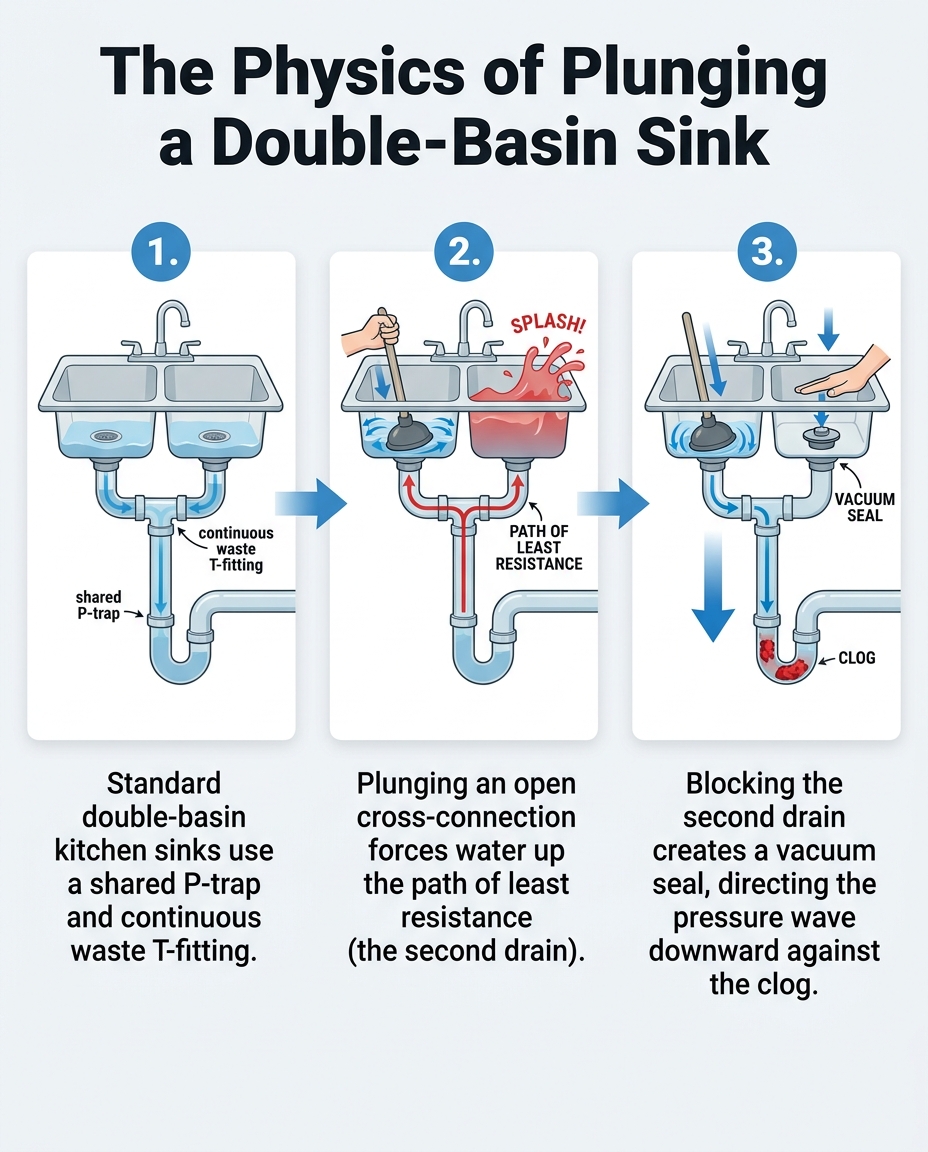
To understand why your plunging efforts are backfiring, you have to look underneath the sink. Bypassing basic drain introductions, we need to focus on the specific anatomy of a cross-connection. A standard double-basin kitchen sink with a shared P-trap and continuous waste T-fitting is designed to consolidate wastewater from two separate drains into one single exit pipe. While this design saves space and materials, it creates a unique challenge when a blockage occurs.
When a customer calls for general plumbing service, a thorough, professional, and efficient technician will always start by inspecting this under-sink anatomy. They look for the continuous waste T-fitting—a specialized piece of pipe that bridges the left and right basins. This T-fitting channels water from both sides down into a single P-trap, the curved pipe designed to hold a small amount of water to block sewer gases from entering your kitchen.
How Interconnected Plumbing Behaves
Because the continuous waste T-fitting connects both sink drains into a single pipe before reaching the P-trap, it creates a shared path of least resistance for both air and water. If a clog forms inside the P-trap or slightly beyond it, the water from either basin hits that roadblock and has nowhere to go but back up. This interconnected behavior is similar to other household fixtures; for example, understanding reasons your bathtub won't drain often involves looking at how the tub shares a vent or drain line with a nearby bathroom sink.
• Single-Basin Sink — Drainage Path: Direct line straight down into an isolated P-trap. — Plunging Behavior: Pressure is forced directly against the clog.
• Double-Basin Sink — Drainage Path: Two drains merge at a continuous waste T-fitting. — Plunging Behavior: Pressure travels across the T-fitting and escapes the second drain.
• Sink with Disposal — Drainage Path: Disposal acts as the primary drain, merging with the secondary basin. — Plunging Behavior: Pressure pushes debris backwards into the disposal or dishwasher line.
Recognizing this shared connection is the first step toward clearing the blockage. You are not dealing with two separate pipes; you are dealing with a single, U-shaped pressure system where pushing down on one side naturally forces contents up the other.
Fluid Dynamics 101: Why Plunging One Drain Shoots Water Out the Other
Plungers do not work by magically grabbing onto clogs and pulling them out. They work on the basic principles of fluid dynamics, requiring a sealed vacuum to force a pressure wave of water and air directly against a blockage. When you push down on the plunger handle, you are compressing the water inside the pipe, essentially using it as a battering ram to break apart the grease or food scraps.
The problem of the open cross-connection: When you plunge an open cross-connection in a standard double-basin kitchen sink with a shared P-trap and continuous waste T-fitting, you fail to create a closed system. Instead of the pressure wave traveling downward to hit the stubborn clog, it takes the path of least resistance. That path travels straight across the continuous waste T-fitting and immediately escapes up the secondary drain.
The cause of the splash-back: This escape route is exactly why dirty water shoots out the other side of your sink. The force you apply to the plunger simply pushes the standing water backward through the shared piping. The frustration of messy splash-back is directly connected to this lack of a proper vacuum seal. Fluid dynamics dictate that air and water will always choose an open exit over a solid blockage.
The solution to the physics problem: To defeat the physics of the T-fitting, you must eliminate the path of least resistance. By temporarily turning your double-basin sink into a single-basin system, you force the pressure wave downward into the P-trap where the clog actually lives. Once you understand this mechanic, clearing the sink becomes a matter of preparation rather than brute force.

The Proper Double-Basin Plunging Technique to Secure a Vacuum Seal
Now that you know why the standard plunging method fails on a standard double-basin kitchen sink with a shared P-trap and continuous waste T-fitting, you can apply the correct, physics-based DIY technique. If you want to successfully fix a slow drain or a complete blockage without soaking your kitchen walls, follow these precise steps.
1. Step 1: Bail out excess standing water. If both basins are filled to the brim, plunging will create a massive mess. Use a cup or small bucket to bail out the excess dirty water into a bucket. Leave just enough water in the primary basin—about one to two inches—to fully submerge the rubber cup of the plunger. Water is necessary to create the seal, but too much water will overflow.
2. Step 2: Block the second drain tightly. This is the most critical step. You must eliminate the path of least resistance to create a closed system. Take a thick, wet washcloth or a rubber sink stopper and place it over the secondary drain. If you are using a cloth, press it down firmly and hold it in place (or have a helper hold it). The wetness of the cloth helps create an airtight seal against the stainless steel or porcelain.
3. Step 3: Choose the correct plunger. Do not use a toilet flange plunger (the kind with a protruding rubber sleeve at the bottom) for a flat kitchen sink. You need a standard flat cup plunger to create a tight, flush seal over the primary drain basket. Position the plunger directly over the drain hole, ensuring the rubber lip is making full contact with the sink basin all the way around.
4. Step 4: Plunge with vigorous, straight motions. Keep the plunger handle completely vertical. If you tilt it, you will break the vacuum seal. Push down firmly and pull up sharply, maintaining the seal on the sink basin. The upward pull is just as important as the downward push, as it creates suction that helps dislodge the blockage. Repeat this vigorous up-and-down motion for 15 to 20 seconds, then pop the plunger off to see if the water drains.
If the water swirls and drains quickly, you have successfully cleared the P-trap. Flush the system with hot water for several minutes to wash away any remaining residue.
Dishwasher Backups and Garbage Disposal Complications
Your kitchen sink does not operate in isolation; it is deeply interconnected with your other kitchen appliances. Garbage disposals are integrated directly into the continuous waste T-fitting, making them part of the same shared pressure system. Because of this, plunging a sink with a disposal requires extra care.
During the busy late summer months, August back-to-school meal prep leading to heavy garbage disposal and sink usage often overloads the system. Starchy foods like pasta, rice, and potato peels expand in the pipes, creating dense clogs that affect the entire cross-connection. When you run the disposal against a clogged pipe, the motor forces the water backward, up into the secondary basin.
Protecting Your Dishwasher During Plunging
One critical component often overlooked during drain clearing is the dishwasher. The dishwasher drain hose typically connects to the side of the garbage disposal or directly into the sink's drain pipe above the P-trap. When a sink clog occurs, the dirty water has nowhere to go, which is why a kitchen sink backup can cause dirty water to pool in the bottom of your dishwasher.
At Power Pro Plumbing, Heating & Air, our drain cleaning team sees this interconnected issue frequently. One local customer reached out during the late summer back-to-school rush when their kitchen drains and dishwasher were backing up with water simultaneously. The technician provided four solution choices, performed the chosen repair, and restored the entire interconnected system. To prevent forcing dirty water into your appliance while plunging:
• Clamp the hose: Temporarily clamp the flexible dishwasher drain hose beneath the sink before you begin plunging.
• Use a C-clamp or vice grips: Gently squeeze the rubber hose shut (do not crush it) to prevent the pressure wave from forcing debris backward into the appliance.
• Check the air gap: If your sink has a cylindrical air gap on the counter, ensure water isn't shooting out of it while you plunge.
Recognizing When a Cross-Connection Clog Indicates a Deep Main Line Issue
While the wet-cloth vacuum technique is highly effective for clogs located in the shared P-trap, it has its limits. If you have perfectly executed the double-basin plunging technique—maintaining a flawless vacuum seal and bailing the excess water—and the sink still refuses to drain, the blockage is likely much deeper than the under-sink plumbing.
A standard double-basin kitchen sink with a shared P-trap and continuous waste T-fitting eventually feeds into a branch line behind the wall, which then connects to your home's main sewer line. If the clog is located deep in the branch line, the pressure wave generated by a hand plunger simply will not reach it. In these cases, you need professional plumbing repair.
Warning Signs of a Main Line Blockage
How do you know when to put the plunger down? Look for these specific symptoms that indicate a deeper systemic issue:
• Gurgling sounds: If plunging the sink causes the toilet to gurgle, or if running the dishwasher causes bubbles in the sink, air is trapped deep in the system.
• Multiple slow fixtures: If the kitchen sink, the laundry room drain, and the downstairs bathroom are all draining slowly at the same time, the main line is compromised.
• Foul odors: Persistent sewer gas smells coming from multiple drains indicate a blockage preventing proper venting and drainage.
A warning on chemical cleaners: Never pour harsh chemical drain cleaners down a double-basin sink in an attempt to clear a deep clog. These caustic chemicals sit stagnant in the continuous waste T-fitting, generating immense heat that can warp PVC pipes and damage the rubber seals. Furthermore, if the chemicals fail to clear the clog, you are left with a basin full of toxic water that makes professional intervention hazardous. Power Pro Plumbing's expert drain cleaning team is ready to step in when DIY plunging isn't enough to clear a stubborn cross-connection clog, ensuring deep main line issues are safely resolved without damaging your pipes.
Frequently Asked Questions About Double-Basin Sink Plumbing
Why does water come up the other side of my double sink?
Water comes up the other side because both drains share a single P-trap via a continuous waste T-fitting. When a clog forms below this junction, water takes the path of least resistance up the secondary drain. Plunging one side without sealing the other simply pushes the water back and forth between the two basins. To fix this, you must block the open drain to force the water downward.
How do you plunge a double kitchen sink?
To plunge a double sink, you must block one drain completely with a wet cloth or stopper to create a closed vacuum system, then plunge the other drain vigorously with a cup plunger. Start by bailing out excess standing water so the basins don't overflow. Keep the plunger handle straight up and down to maintain a tight seal, and use forceful push-and-pull motions to dislodge the blockage.
Can you plunge a sink with a garbage disposal?
Yes, but you must ensure the other basin is sealed off to prevent debris from shooting out. You may also need to clamp the dishwasher drain hose to prevent pressure from forcing water backward into the appliance. Always ensure the disposal is turned off and disconnected from power before you begin plunging to ensure absolute safety.
What is a continuous waste T-fitting?
A continuous waste T-fitting is the specific plumbing pipe configuration under a double-basin sink that connects the two separate drains into one shared line before it reaches the P-trap. It looks like a horizontal pipe bridging the two drain baskets, meeting at a T-shaped junction. This shared connection is why issues in one basin immediately affect the other.
Why is my dishwasher backing up when my sink is clogged?
The dishwasher drain hose typically connects to the garbage disposal or the sink's drain pipe above the P-trap. A clog in the shared pipe forces water backwards into the dishwasher line because the water cannot flow down the drain. Clearing the primary sink clog will usually resolve the dishwasher backup simultaneously.
Clear Your Stubborn Sink Clogs with Expert Precision
Understanding the physics of your standard double-basin kitchen sink with a shared P-trap and continuous waste T-fitting is the key to successful DIY plunging. By blocking the secondary drain and creating a closed vacuum system, you can direct the pressure wave exactly where it needs to go. However, if the wet-cloth technique fails to clear the water, the clog is simply too deep for a hand plunger to reach. When you are tired of dealing with messy backups and want a definitive fix, professional drain cleaning services will restore your plumbing safely and efficiently, leaving your kitchen clean and fully functional.