

The Myth of Maximum Heating Power in Mild Climates
A widespread misconception is that bigger, more powerful heating equipment is always better, but when comparing single-stage vs two-stage gas furnaces for Southern California homes, maximum power is rarely the right answer. National HVAC advice often pushes homeowners toward the highest-capacity systems available, assuming everyone faces the freezing temperatures of a Midwest winter. Here in Cerritos and the surrounding Southern California area, our winters are mild and short. We deal with chilly mornings and crisp evenings, not blizzards. This unique climate means that choosing a replacement system requires a completely different approach.
If you are exploring heating services this season, understanding how Daikin furnaces operate in our specific climate is the first step. Many homeowners find themselves evaluating their aging systems during the September pre-heating season. You might be wondering if upgrading to a premium two-stage system is overkill for an area where the heater only runs for a few months out of the year. The short answer is that comfort isn't just about raw heating power; it is about how that power is delivered to your living spaces.
Why National HVAC Advice Fails Local Homeowners
Most generic heating guides focus heavily on survival—keeping a house warm when it is zero degrees outside. Because our local weather rarely drops below the mid-40s, a furnace designed to blast maximum heat will actually perform poorly in a mild environment. It will heat the house too fast, shut off abruptly, and leave you with uneven temperatures. Balancing the upfront investment of a new system against the reality of our short winters means looking past raw power and focusing on precision, consistency, and daily comfort.
Understanding the Mechanics: How Do These Furnaces Differ?
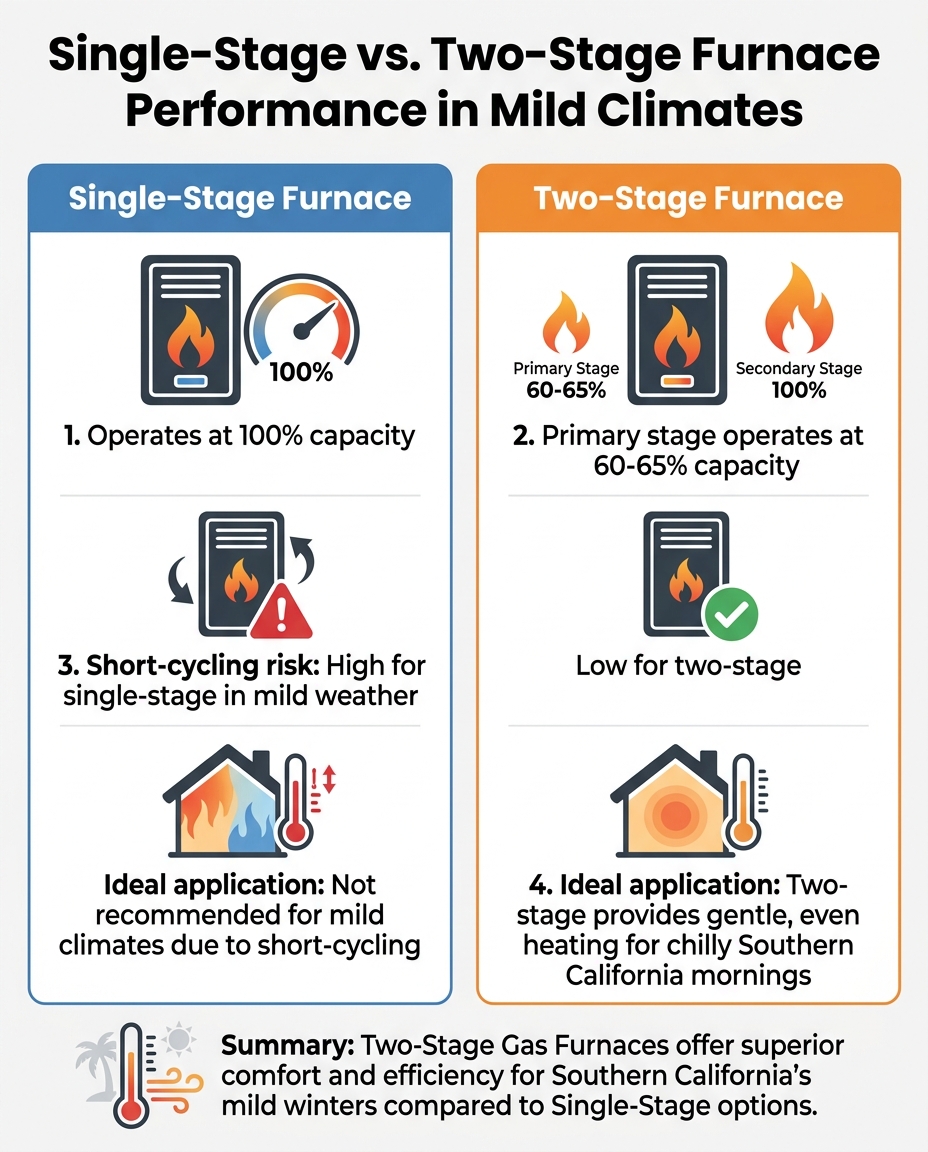
To make an informed decision, you need to understand exactly how these two types of systems operate mechanically. The primary difference lies in the gas valve and the burner inside the unit. A single-stage furnace is straightforward: it has one setting. Whenever your thermostat calls for heat, the furnace turns on at 100% capacity. It blasts hot air into your ductwork until the target temperature is reached, and then it shuts off completely. There is no middle ground. It is either fully on or fully off.
A two-stage furnace, on the other hand, operates with a specialized gas valve that provides two different levels of heat output. The first stage typically runs at about 60% to 65% of the furnace's total capacity. This lower setting is designed to handle mild weather, running quietly and steadily to maintain your desired temperature. The second stage—the full 100% capacity—is held in reserve. The system only activates this second stage during extreme cold snaps or if you bump the thermostat up several degrees all at once.
Real-World Mechanical Strain
During a recent winter, a local homeowner called for help because their heating system needed fixing. Technician Luis arrived on time and professionally explained the underlying issue—the constant mechanical strain on their aging single-stage system had finally caused a breakdown. The heating system was fixed promptly, and the customer noted they would call again, but this situation highlights why understanding your equipment's mechanics matters. A system that constantly blasts at 100% capacity experiences significantly more wear and tear than one that gently hums along at a lower stage.
These mechanical differences also impact how well your overall system distributes air. If you are troubleshooting dual-zone HVAC systems, you will often find that two-stage furnaces pair much better with zoning panels. The lower airflow of the first stage prevents excess pressure from building up in your ductwork when only one zone is calling for heat, leading to a much smoother and quieter operation throughout Cerritos and surrounding Southern California homes.
The Short-Cycling Problem During Chilly Local Mornings
One of the most frustrating issues homeowners face in mild climates is a phenomenon called "short-cycling." Short-cycling occurs when a furnace turns on, runs for just a few minutes, shuts off, and then turns back on shortly after. This rapid on-and-off sequence is highly inefficient and creates a noticeably uncomfortable environment inside the house.
In Cerritos and surrounding Southern California, our winters largely consist of chilly mornings and evenings. When you wake up to a 50-degree morning and your thermostat triggers a single-stage furnace, the system blasts 100% of its heating capacity into the home. Because the outside temperature isn't actually that cold, the house warms up incredibly fast. The thermostat reads that the target temperature is reached and shuts the system down. However, because the system didn't run long enough to thoroughly circulate the air, the heat quickly dissipates, cold spots return, and the furnace has to fire up all over again.
The Hidden Costs of Rapid Cycling
Short-cycling doesn't just cause annoying temperature swings; it actively damages your equipment. Think of it like driving a car: stop-and-go city traffic puts far more wear on your engine and brakes than smooth highway driving. The same principle applies to your heating system.
• Heat Exchanger Stress: Constant heating and rapid cooling cycle forces the metal heat exchanger to expand and contract excessively, increasing the risk of cracks.
• Ignition Wear: The igniter and gas valve are forced to engage dozens of extra times per day, leading to premature failure.
• Energy Waste: Furnaces consume the most energy during the startup phase. Turning on and off repeatedly spikes your utility bills.
• Poor Air Mixing: Short run cycles fail to push air to the furthest rooms in your house, leaving bedrooms cold while the hallway is sweltering.
A two-stage unit solves this specific regional issue. By running at 60% capacity, it provides a gentle, even stream of heat that takes longer to satisfy the thermostat. This longer cycle thoroughly mixes the air in your home, prevents cold spots, and eliminates the damaging start-and-stop behavior entirely.
Side-by-Side Comparison: Performance in Mild Winters
When weighing your options, seeing a direct comparison helps clarify which system aligns with your household needs. The table below outlines how single-stage and two-stage units perform under the specific conditions of a mild Southern California winter.
• Operational Capacity — Single-Stage Furnace: Always runs at 100% power, regardless of outside temperature. — Two-Stage Furnace: Runs at 60-65% for mild days; uses 100% only for extreme cold.
• Temperature Consistency — Single-Stage Furnace: Prone to temperature swings of 3 to 4 degrees between cycles. — Two-Stage Furnace: Maintains temperature within 1 to 2 degrees of the thermostat setting.
• Energy Efficiency (AFUE) — Single-Stage Furnace: Standard efficiency; wastes energy through frequent on/off cycling. — Two-Stage Furnace: Higher efficiency; lower stage consumes less fuel and electricity.
• Operational Noise — Single-Stage Furnace: Noticeable "whoosh" of air every time the system kicks on. — Two-Stage Furnace: Quiet operation; the lower stage produces a soft, barely noticeable hum.
• Upfront Investment — Single-Stage Furnace: Lower initial purchase and installation cost. — Two-Stage Furnace: Higher initial cost, offset by better comfort and longevity.
As the comparison shows, the differences extend far beyond just heating the air. For residents in Cerritos and surrounding Southern California, the true value of a two-stage system is found in its ability to adapt to our shifting daily temperatures, providing exactly the right amount of heat without the disruptive noise or energy waste of a single-stage blast.

Year-Round Indoor Air Quality and Comfort Benefits
While we primarily focus on temperature when discussing furnaces, the heating system plays a massive role in your home's indoor air quality. Competitors often miss this secondary benefit, but it is one of the most compelling reasons to consider a two-stage system. The secret lies in the blower fan and how long it operates during a heating cycle.
Because a two-stage furnace runs at a lower capacity, the heating cycles take longer to complete. This means the blower fan is moving air through your home for a longer continuous period. Every time air moves through your return ducts, it passes through your HVAC filter. Longer run times equal more filtration. In Cerritos and surrounding Southern California, we frequently deal with dry, dusty local conditions, seasonal wildfires, and regional allergy seasons. Having a system that filters your air for 20 minutes at a time rather than just 5 minutes makes a remarkable difference in the amount of airborne particulate matter floating in your living space.
Eliminating Stagnant Air Pockets
Better air circulation also prevents stagnant air pockets from forming in the home during transitional weather. Have you ever noticed that a back bedroom always feels stuffy, or that the air in your living room feels heavy on a mild afternoon? That happens when the HVAC system isn't running long enough to mix the air.
• Continuous Filtration: Longer, slower blower cycles capture more pet dander, dust, and pollen.
• Humidity Control: While more prominent in cooling mode, steady air movement helps balance indoor moisture levels year-round.
• Even Distribution: Slow, steady airflow pushes conditioned air out to the furthest vents in the house, eliminating hot and cold spots.
By keeping the air moving gently and consistently, a two-stage system improves your overall comfort even when it isn't actively generating massive amounts of heat. It transforms your furnace from a simple heater into a comprehensive climate control system.
Balancing the Upfront Investment: Is a Two-Stage Upgrade Worth It?
The most common hurdle homeowners face when considering this upgrade is the price tag. We absolutely acknowledge that two-stage systems come with a higher initial equipment cost. The decision point always comes down to whether that higher upfront cost is justified by the enhanced comfort, reduced wear and tear, and potential energy savings.
While extreme winter climates demand high-efficiency systems purely for survival and massive fuel savings, our mild climate benefits from nuanced comfort control. The value here isn't just in shaving a fraction off your gas bill; it is in extending the lifespan of the equipment by eliminating short-cycling, enjoying whisper-quiet operation, and breathing cleaner air. Our expertise in high-efficiency Daikin furnaces allows us to match the exact right system to your home's square footage and ductwork, ensuring you don't overpay for capacity you will never use.
Making Premium Comfort Accessible
During the September pre-heating season, many homeowners realize their old system won't make it through another year, but they haven't budgeted for a premium replacement. We believe that stepping up to a two-stage system shouldn't drain your savings. That is why we offer flexible HVAC financing options designed to help you manage the upfront investment. By spreading the cost over time, the monthly difference between a basic single-stage unit and a premium two-stage Daikin system becomes incredibly manageable. You get to enjoy the immediate benefits of superior comfort and quiet operation while paying for the system on a timeline that works for your household budget.
Why Early Fall is the Ideal Time to Upgrade Your Furnace
Timing your furnace replacement is just as critical as choosing the right equipment. The strategic advantage of scheduling a replacement during the September pre-heating season cannot be overstated. Once the late-fall rush hits and the first major temperature drop arrives, installation schedules book up rapidly. Waiting for an aging system to fail puts you in a vulnerable position where you might have to settle for whatever equipment is currently in stock, rather than the ideal two-stage system you actually want.
Another local homeowner faced a busted heater right in the middle of winter. Technician Niko was friendly, professional, and honest about the necessary repairs. The heater was fixed, and the customer highly recommends the service, but dealing with an emergency breakdown when temperatures drop is incredibly stressful. You can avoid that stress entirely by being proactive.
Your Fall Upgrade Timeline
1. Assess System Health: Note if your current furnace is over 10-15 years old, making strange noises, or failing to heat the house evenly.
2. Schedule an Evaluation: Have a professional technician inspect the heat exchanger, blower motor, and overall safety of the unit before the cold weather sets in.
3. Review Your Options: Compare the benefits of single-stage and two-stage systems based on your specific home layout and comfort goals.
4. Secure Installation: Book your replacement during the slower early fall weeks to ensure you get the exact equipment you want installed at your convenience.
Taking action now provides the ultimate peace of mind. You will know your home is fully prepared for winter, and you won't have to worry about shivering through a chilly morning while waiting for an emergency repair. If your system is showing its age, now is the time to schedule HVAC service and explore your replacement options.
Frequently Asked Questions
Is a 2-stage furnace worth it in a mild climate?
Yes, a two-stage furnace is highly beneficial in a mild climate because it provides precise comfort control. Instead of blasting 100% heat on a moderately chilly day, it runs on a lower, quieter setting. This prevents the house from overheating quickly, eliminates annoying temperature swings, and reduces wear and tear on the system.
What is the difference between a single-stage and two-stage gas furnace?
The primary difference lies in their operational capacity. A single-stage furnace only has one setting—it runs at full blast whenever it is turned on. A two-stage furnace has a low setting (usually 60-65% capacity) for mild weather and a high setting (100% capacity) reserved strictly for extreme cold drops.
Do two-stage furnaces really save energy in Southern California?
Two-stage furnaces can offer noticeable energy savings by running primarily on their lower setting. Because the system doesn't have to consume maximum fuel every time it cycles on, it operates more efficiently. Additionally, the variable-speed blower motors commonly found in these units use significantly less electricity than standard motors.
Which furnace is best for Southern California homes?
The best furnace for a Southern California home is typically a two-stage system paired with a variable-speed blower. This combination perfectly handles our chilly mornings without overpowering the house with excessive heat. It provides superior air filtration, quieter operation, and consistent temperatures throughout the short winter season.
How does a two-stage furnace prevent short-cycling?
A two-stage furnace prevents short-cycling by operating at a lower capacity for longer periods. Because it outputs less heat during its first stage, it takes longer to reach the thermostat's target temperature. This steady, gradual heating process stops the system from rapidly turning on and off, protecting the internal components from premature failure.
Evaluating single-stage vs two-stage gas furnaces for Southern California homes doesn't have to be overwhelming. By focusing on how a two-stage system provides gentle, even heating tailored perfectly to our mild climate, you can make a choice that guarantees long-term comfort. Reach out today to discuss which system will keep your home consistently comfortable all winter long.