

Preparing for the Dust: The Arrival of Santa Ana Winds
As September approaches, our team at Power Pro Plumbing, Heating & Air frequently reminds homeowners that upgrading to a MERV 13 filter for Santa Ana wind season in LA County becomes one of the most impactful decisions you can make for your home's indoor environment. The shift in weather is unmistakable. The familiar, comfortable coastal moisture evaporates, replaced almost overnight by dry, high-velocity offshore winds that sweep through the canyons and valleys. These powerful gusts carry an immense volume of fine particulate matter, turning a normal autumn day into a significant air quality event.
Whether you are optimizing your air conditioning systems for the lingering heat or exploring comprehensive indoor air quality solutions for the months ahead, preparing your home for this seasonal shift requires more than just keeping the windows closed. The autumn Santa Ana wind season, with its typical September onset, introduces a concrete problem our technicians see every year: severe dust, ash, and allergen infiltration that easily bypasses standard fiberglass filters. Those basic, see-through filters are designed only to catch large debris like pet hair, leaving your family's lungs vulnerable to microscopic irritants.
The critical decision point: Homeowners must choose whether to upgrade their filtration to combat this specific environmental dust, and more importantly, how to do so without suffocating their HVAC system. The drastic drop in humidity, often plummeting into the single digits, combined with intense fine particulate matter kicked up during early fall wind events, creates a unique challenge. You need a robust defense mechanism that purifies the air without causing your blower motor to overwork and fail when you need it most.
The Unique Air Quality Threat in LA County and Cerritos CA
The geography of Southern California creates a perfect storm for poor air quality during the autumn months. High-pressure systems over the Great Basin force air down through the narrow mountain passes of the San Gabriel and San Bernardino ranges. As this air compresses and accelerates, it funnels high-speed winds directly into LA County and Cerritos CA. In our years of servicing local ductwork and HVAC units, we've seen firsthand the massive amounts of debris these winds pick up and deposit directly into residential systems.
The Double-Threat: Dry Heat and Ultra-Fine Ash
During these events, the South Coast Air Quality Management District (SCAQMD) frequently issues wind and dust advisories, warning residents of hazardous breathing conditions. The extreme dry heat of early autumn combined with heavy particulate matter creates a double-threat. First, there is a severe risk to human respiratory health. The combination of dry heat and ever-present wildfire risk introduces ultra-fine ash into residential neighborhoods, even if the fires are miles away. Second, there is a significant threat to your HVAC equipment, which must cycle this abrasive, dust-laden air continuously.
Standard 1-inch MERV 4 to MERV 8 filters are fundamentally inadequate for this specific regional threat. These basic filters are essentially "boulder catchers." They do an excellent job of stopping large lint particles and dog hair from coating your blower wheel, but they are completely porous to the microscopic ash and fine silica dust brought in by the Santa Ana winds. Relying on a low-grade filter during a high-wind advisory means that the vast majority of these irritants will pass straight through your ductwork and circulate back into your living space, settling on your furniture and entering your lungs.
Why the MERV 13 Filtration Standard is the Recommended Solution
To effectively combat the microscopic debris carried by offshore winds, you need a filter designed to capture ultra-fine particles. The MERV (Minimum Efficiency Reporting Value) rating scale is the industry standard for measuring a filter's ability to trap specific sizes of particulate matter. Rather than getting bogged down in dense technical jargon, we find it is easiest for our customers to understand MERV by focusing on particle capture size.
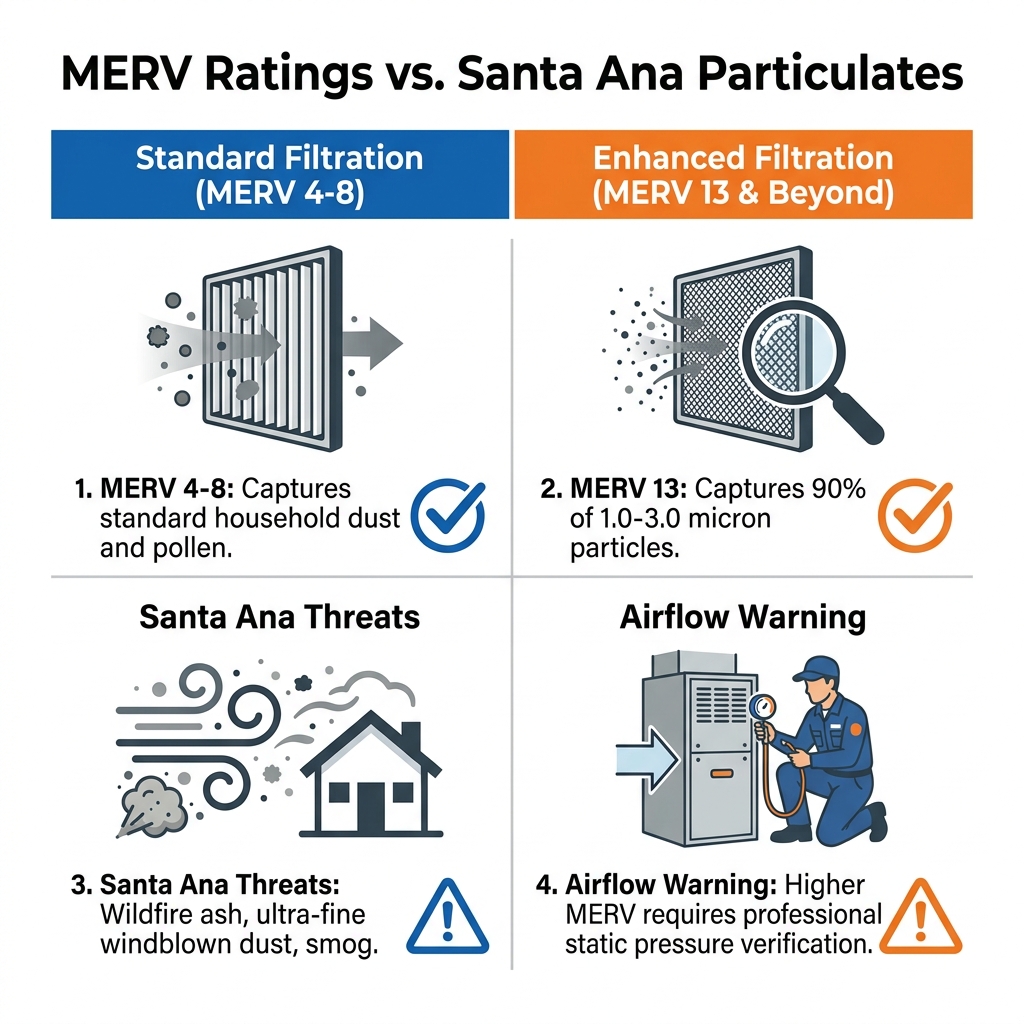
The MERV 13 filtration standard is highly recommended because it captures up to 90% of particles between 1.0 and 3.0 microns. To put that in perspective, a single strand of human hair is about 70 microns thick. The ultra-fine wildfire ash and fine windblown dust that plague LA County during the fall sit squarely in that 1.0 to 3.0-micron range.
Comparing Filtration Capabilities
Both the EPA and ASHRAE (American Society of Heating, Refrigerating and Air-Conditioning Engineers) guidelines recommend a MERV 13 rating for reducing indoor fine particle concentrations during smoke and high-dust events.
• MERV 4 - 8 — Particle Capture Size: 10.0 microns and larger — Primary Targets Captured: Pollen, dust mites, carpet fibers, pet hair — Best Use Case: Basic equipment protection in mild climates
• MERV 11 — Particle Capture Size: 3.0 to 10.0 microns — Primary Targets Captured: Lead dust, larger milled flour, auto emissions — Best Use Case: Moderate allergy relief and pet owner homes
• MERV 13 — Particle Capture Size: 1.0 to 3.0 microns — Primary Targets Captured: Wildfire ash, smog, ultra-fine windblown dust — Best Use Case: High-wind events, smoke advisories, severe allergies
The respiratory benefits of this upgrade are immediate. Contrast the daily struggle of dusting your home every evening and battling morning allergy symptoms with the passive, continuous air purification of a properly fitted high-efficiency filter. When the winds howl outside, your indoor air remains clean, clear, and breathable.

The Hidden Mechanical Danger: Blower Motor Strain
The Problem: Increased Airflow Resistance
While upgrading your filtration is essential for your health, there is a crucial mechanical relationship we always explain to our customers before they buy a new filter. High-efficiency filtration relies on smaller pores in the filter media to trap microscopic particles. However, pushing air through those tiny pores creates significantly more airflow resistance, known in the HVAC industry as static pressure.
The Cause: Dense Filters in Older Systems
In our experience, the most common mistake homeowners make at the start of the autumn Santa Ana wind season is heading to a big-box store, purchasing the densest 1-inch MERV 13 filter they can find, and dropping it into an older system. Older residential blowers were often designed to push air through highly porous, low-resistance fiberglass filters. When you suddenly block that airflow with a dense, restrictive 1-inch pleated filter, the system begins to suffocate. If you need AC services in Los Angeles because your system suddenly stopped blowing cold air during a fall heatwave, a restrictive filter is a culprit our team uncovers frequently.
The Solution: Balancing Health and Mechanics
The consequences of suffocating the blower motor are severe. Because the system cannot pull enough warm air across the indoor evaporator coil, the coil can literally freeze into a block of solid ice. Meanwhile, the blower motor works overtime trying to pull air through the dense filter, leading to overheating and premature system failure. As mechanical experts at Power Pro Plumbing, Heating & Air, we prioritize both your family's respiratory health and your HVAC system's longevity. Protecting your lungs should never come at the cost of destroying your home's cooling and heating equipment. The key is achieving high filtration without restricting the volume of air your system needs to survive.
Professional System Assessment: Ensuring Compatibility
Before you make a drastic change to your home's filtration setup, a professional assessment is highly recommended to ensure your ductwork and blower motor are fully compatible with higher MERV ratings. Our technicians use specialized tools, such as a manometer, to measure the static pressure inside your ductwork. This reading tells us exactly how much resistance your specific blower motor can safely handle without sustaining damage.
During a recent pre-heating-season tune-up in LA County and Cerritos CA, a homeowner requested our expert advice on preparing their system for the incoming fall winds. Our technician arrived on time, thoroughly explained the static pressure testing process, and provided clear, actionable information so the customer could make informed decisions about their ongoing filtration needs. This level of professional guidance is exactly what prevents costly breakdowns during critical weather transitions.
The Advantage of Deep Media Cabinets
If your system's static pressure is too high to accommodate a restrictive 1-inch MERV 13 filter, the most effective solution we install is a 4-to-5-inch deep media cabinet.
• Expanded surface area: Deep media filters use an accordion-style folding technique that provides massive surface area compared to a flat 1-inch filter.
• Lower airflow resistance: Because the air has so much more space to pass through, a 5-inch MERV 13 filter actually offers less airflow resistance than a 1-inch MERV 8 filter.
• Longer lifespan: The increased capacity allows the filter to hold significantly more dust and ash before clogging.
Expert advice is invaluable when making these modifications. By scheduling comprehensive heating maintenance and having a professional verify your system's capabilities, you can safely achieve hospital-grade air purification without risking an expensive blower motor burnout.
Filter Maintenance Strategy During Active Wind Advisories
Even with the right filter properly installed, your maintenance routine must adapt to the weather. The standard advice of replacing your filter every 90 days completely goes out the window during active high-wind and wildfire events. We constantly remind our local customers that the lifespan of any filter drastically decreases when it is subjected to the rapid loading of particulate matter brought on by Santa Ana winds.
Proactive Steps for High-Wind Events
1. Monitor the Air Quality Index (AQI): When local advisories indicate a significant drop in air quality due to wind or smoke, increase your vigilance. Check your filter weekly rather than monthly.
2. Inspect for Rapid Loading: Pull the filter out and hold it up to a light source. If no light passes through the media, the filter is fully loaded and must be replaced immediately, regardless of how new it is.
3. Watch for Performance Drops: Pay attention to how your HVAC system behaves. Restricted airflow, unusually long cooling cycles, or a lack of air pressure at the vents are strong indicators of a clogged filter.
4. Address Unusual Odors: If you notice strange smells when the system kicks on, it may be time for a change. Understanding why your furnace smells like burning dust can often be traced back to a filter that is no longer trapping debris effectively.
Staying proactive with your filter changes prevents fine dust from bypassing a clogged filter media and settling deep within your ductwork. By maintaining a strict replacement schedule during the MERV 13 filtration standard's toughest tests, you ensure your home remains a safe, clean haven from the harsh autumn winds.
Frequently Asked Questions
Can my older HVAC system use a MERV 13 filter?
It depends entirely on the static pressure capabilities of your specific blower motor. Many older systems were designed for low-resistance fiberglass filters and will suffocate if a dense 1-inch MERV 13 filter is installed. A professional must measure your ductwork's static pressure to determine if an upgrade is safe or if a deep media cabinet is required.
What MERV rating is necessary to capture wildfire ash?
A MERV 13 rating is the minimum recommended standard for effectively capturing wildfire ash. This rating is capable of trapping up to 90% of particles in the 1.0 to 3.0-micron range, which includes ultra-fine ash, smog, and fine windblown dust. Lower-rated filters will allow these microscopic irritants to pass through into your living space.
How do Santa Ana winds affect my home's indoor air quality?
Santa Ana winds drastically reduce humidity while blowing massive amounts of dust, pollen, and ash into residential areas. These high-velocity winds force fine particulate matter through tiny gaps in windows and doors, severely degrading your indoor air quality. Without proper high-efficiency filtration, these contaminants circulate continuously through your HVAC system.
How often should I change my filter during high wind events?
During active wind advisories or nearby wildfires, you may need to change your filter every two to four weeks. The heavy volume of airborne debris causes the filter media to load and clog much faster than during normal weather conditions. You should inspect the filter weekly when the outdoor air quality is poor.
What is the difference between a 1-inch and a 4-inch MERV 13 filter?
The primary difference is the total surface area of the filter media. A 4-inch or 5-inch deep filter has significantly more pleated material, allowing it to capture the same microscopic particles with far less resistance to airflow. This means a thicker filter protects your air quality without putting dangerous strain on your blower motor.
Will a high MERV filter cause my air conditioner to freeze up?
Yes, if the filter restricts too much airflow, it can cause the indoor evaporator coil to drop below freezing. When the system cannot pull enough warm air across the coil, condensation freezes into solid ice, halting the cooling process entirely. This is why verifying system compatibility before upgrading to a dense 1-inch filter is so important.
Upgrading your filtration strategy is the best defense against the harsh autumn weather, but it must be done carefully. If you are ready to improve your indoor air quality and want to ensure your system can safely handle the upgrade, our team at Power Pro Plumbing, Heating & Air is here to help. Schedule a professional assessment today to find the perfect balance of respiratory protection and mechanical reliability.