

September Shifts: Why Your Condenser Needs Immediate Attention
The September early fall transition is already stirring up the winds across Southern California, sending dry leaves and yard debris scattering across your property. If your cooling system has been running hard all summer, preparing your outdoor AC unit for the mild winter months is the next step in protecting your investment. You might be tempted to simply turn off the thermostat and forget about the outdoor condenser until spring. However, leaving autumn leaves trapped against the delicate metal fins creates a severe moisture trap once the winter rains arrive.
Whether you are looking for comprehensive Air Conditioning maintenance from our team at Power Pro Plumbing, Heating & Air or just a quick seasonal check, taking action before the damp weather sets in is always the smartest move.
The core decision for homeowners: You have a choice right now. You can ignore the outdoor unit as your daily cooling demand drops, or you can proactively clear away the debris to prevent long-term damage. When organic matter breaks down against your system, it holds water like a sponge. This constant contact with moisture leads to rust, corrosion, and restricted airflow. Evaluating your unit's exterior condition today ensures it remains healthy, efficient, and ready to perform whenever you need it.
The Mechanics of Moisture Traps and Fin Corrosion
Understanding how your outdoor unit operates helps explain why trapped debris is so destructive. The large metal box outside your house is called the condenser, and its walls are lined with hundreds of thin aluminum fins. These fins are designed to release heat from your home into the outdoor air. Because they need to transfer heat efficiently, they are entirely exposed to the elements. In our years of servicing HVAC systems across Cerritos and surrounding Southern California areas, our technicians consistently see how falling leaves, grass clippings, and dirt naturally blow against these fins during the September early fall transition.
The chemical reaction of trapped moisture: When dry leaves accumulate, they might not seem like a threat. But as occasional winter rain in Southern California arrives, that organic matter gets wet. It begins to decompose, turning into a heavy, wet sludge that clings directly to the aluminum fins. Instead of evaporating, the moisture is held tightly against the metal. Prolonged exposure to this damp, acidic organic matter causes a chemical reaction known as oxidation. Over time, the aluminum fins begin to corrode, pit, and rust, permanently damaging the unit's ability to release heat.
A unique regional threat: In colder climates, homeowners worry about deep freezes cracking internal components. In our region, freeze damage is rare. Instead, our biggest threat is this slow, corrosive moisture trap. Preventing this rust extends the lifespan of your entire system and keeps your energy bills low by maintaining peak efficiency.
How Debris Accelerates Wear
In our combined decades of experience repairing outdoor units, we've learned that this damage does not happen overnight. It follows a predictable timeline that you can interrupt if you know what to look for:
• Dry accumulation: Loose leaves and twigs blow against the base of the unit, partially blocking the lower fins.
• Compaction: Wind and gravity press the debris tighter against the metal, forming a dense mat.
• Moisture retention: Winter rains soak the compacted debris. Because the mat is so dense, the sun and wind cannot dry it out.
• Airflow restriction: If you turn the system on, the unit has to work twice as hard to pull air through the blocked, wet fins, straining the compressor motor and accelerating mechanical wear.
The 'Winterizing' Myth: Why Covering Your Unit Causes Harm
If you search online for end-of-season HVAC tips, you will almost certainly find advice telling you to wrap or cover your outdoor unit tightly with a tarp. This is a classic example of national advice that does not apply to mild climates. As a local authority on HVAC systems in Cerritos and surrounding Southern California areas, our team constantly protects homeowners from this damaging, generic "winterizing" myth.
Why manufacturers say no: The vast majority of HVAC manufacturers explicitly advise against fully covering heat pumps and AC units. These outdoor condensers are engineered to withstand rain, wind, and sun. They are built for the outdoors. However, they are also built to breathe. When they get wet from a rainstorm, normal airflow quickly dries out the internal components.
The dangers of a tight cover: When you wrap a unit in a plastic tarp or a heavy canvas cover, you trap ground moisture inside the cabinet. The sun hits the cover, evaporating moisture from the soil below, which then condenses on the internal electrical components and motors. Furthermore, a dark, dry, protected space is incredibly inviting to rodents seeking shelter during the cooler months. Mice and rats love to nest inside covered units, where they often chew through critical wiring.
• Moisture Control — Tightly Covered Unit: Traps condensation inside, leading to internal rust and electrical shorts. — Uncovered, Breathable Unit: Allows rain to wash over the unit and dry naturally with the breeze.
• Rodent Risk — Tightly Covered Unit: Creates a dark, warm shelter perfect for nesting and chewing wires. — Uncovered, Breathable Unit: Remains exposed, making it an unappealing habitat for pests.
• Airflow — Tightly Covered Unit: Completely choked off. Running the unit with a cover on will destroy the compressor. — Uncovered, Breathable Unit: Unrestricted. The system can be turned on safely at a moment's notice.
• Rust Risk — Tightly Covered Unit: High. Trapped humidity accelerates the oxidation of internal parts. — Uncovered, Breathable Unit: Low. As long as organic debris is cleared from the base, the metal stays dry.
Safe Exterior Clearing: Creating a Breathable Perimeter
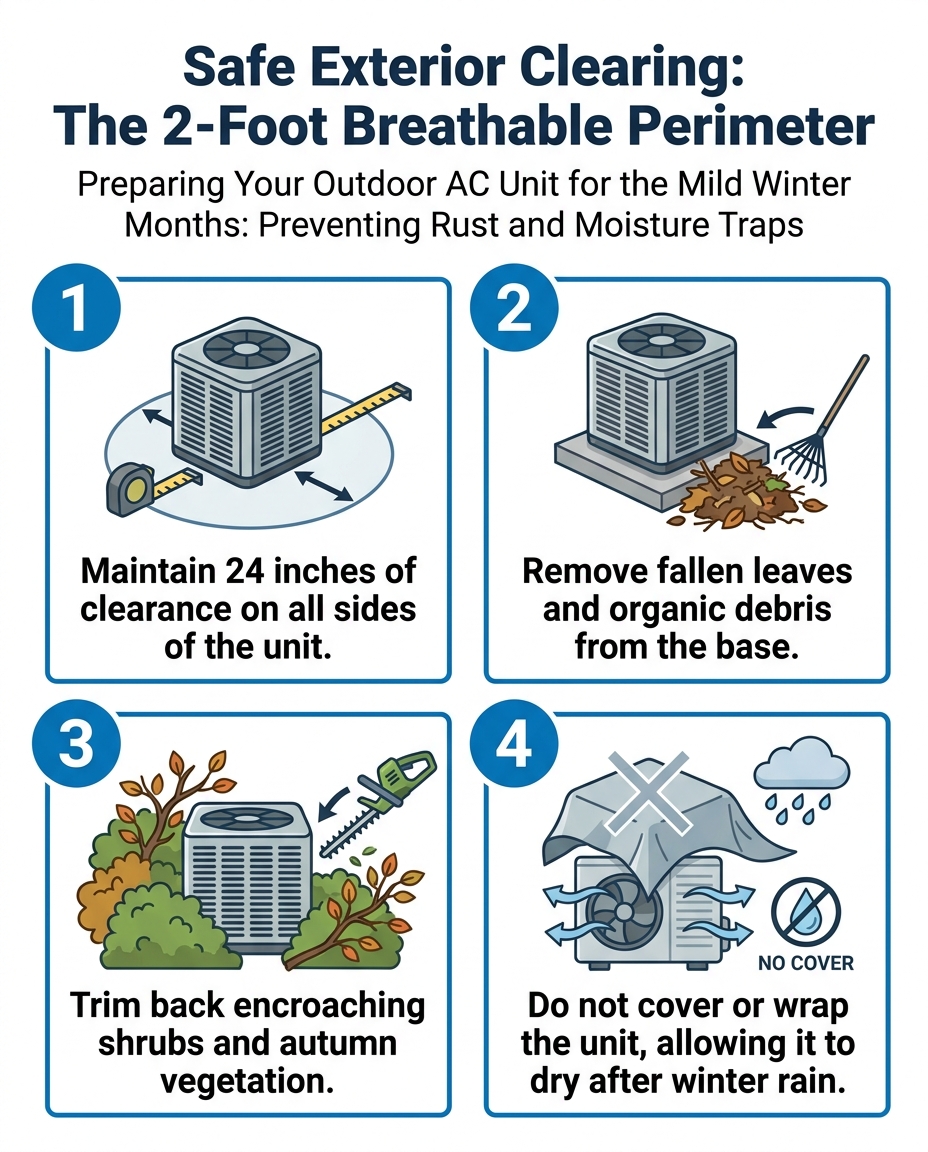
Protecting your system during the September early fall transition does not require complex tools or technical knowledge. It simply requires a bit of yard work. The golden rule of outdoor HVAC care that we teach our customers is maintaining a strict 2-foot clearance zone around the entire unit. This breathable perimeter ensures that air can flow freely through the fins and that moisture can evaporate rapidly after a rainstorm.
Choosing the right tools: When clearing the exterior, gentleness is key. The aluminum fins are incredibly fragile and bend easily. Use soft tools like a standard push broom, gloved hands, or a garden hose on a gentle shower setting. Never use a pressure washer, a stiff wire brush, or a high-powered water jet. These aggressive tools will flatten the fins, instantly suffocating your system.
Managing the landscape: Look at the vegetation growing near your unit. Autumn is the perfect time to trim back encroaching shrubs, low-hanging tree branches, and tall ornamental grasses. Ensure that nothing is growing within that 24-inch boundary.
The hard line on DIY: While clearing the outside is perfectly safe, you must explicitly avoid opening the condenser cabinet. Never attempt to remove the metal casing to clean internal electrical components or the fan motor. That level of maintenance involves high-voltage electricity and requires a licensed professional.
Step-by-Step Perimeter Check
1. Perform a visual inspection: Walk around the entire unit and identify any encroaching branches, tall weeds, or vines that have grown too close during the summer.
2. Trim back vegetation: Use pruning shears to cut back any plants so there is a clear 2-foot radius of empty space around all four sides.
3. Remove base debris: Put on gardening gloves and gently pull away any compacted wet leaves, pine needles, or dirt from the base of the unit.
4. Rinse gently: If the fins look dusty, use a garden hose with a standard spray nozzle (not a high-pressure attachment) to gently rinse the outside of the fins, aiming straight down.
5. Check the drainage: Ensure that the ground around the concrete pad slopes away from the unit so that winter rain does not pool around the base.

Remaining Ready for Unexpected Winter Warm Spells
One of the unique challenges we navigate living in Cerritos and surrounding Southern California areas is the volatility of our winter weather. While January might bring chilly rain, it is equally likely to deliver a sudden, unseasonable heatwave. Your system must remain operational and breathable throughout the mild winter to handle these rapid shifts in temperature.
The danger of choking the system: If you have improperly covered your unit or allowed a thick wall of debris to choke the fins, turning the system on during a sudden 85-degree December day can be disastrous. The mechanical strain of running a suffocated system causes the compressor to overheat rapidly, leading to major breakdowns right when you need relief.
Dual-use systems and heating demands: Many modern homes utilize heat pumps, which provide both cooling and heating from the exact same outdoor unit. A heat pump works by extracting ambient heat from the outdoor air and transferring it inside. To do this efficiently, the outdoor unit must be completely unobstructed. For example, one local family called us during the winter due to a busted heater when temperatures suddenly dropped. Our very own technician Niko arrived, clearly explained the necessary repairs, and got their system back online. This highlights why your outdoor unit must be well-maintained year-round; a neglected exterior directly impacts your ability to stay warm.
Ensuring seamless transitions between heating and cooling demands during volatile weather weeks requires professional oversight. If you rely on a heat pump or a furnace, scheduling Heating Repair and Maintenance ensures that every component is prepared for the unpredictable season ahead.
Transitioning Your Indoor Components for the Damp Season
While clearing the exterior condenser is vital for preventing rust, we always remind our customers that outdoor maintenance should connect to your indoor air quality and whole-home comfort. The changing seasons outside directly impact the environment inside your living spaces.
The moisture connection: As the September early fall transition brings damp, cooler air into the region, indoor humidity levels begin to shift. If your outdoor unit is struggling to breathe due to debris, it cannot effectively dehumidify the air when running in cooling mode during warm afternoons. This leaves your home feeling sticky and allows fall allergens to circulate freely.
To keep your home comfortable and healthy, follow this indoor transition checklist:
• Change your indoor air filters: This is your primary defense against fall allergens, dust, and pet dander. A fresh filter ensures unrestricted airflow to the blower motor.
• Check vents and registers: Walk through your home and make sure no heavy furniture, rugs, or curtains are blocking your supply and return vents.
• Monitor indoor humidity: Aim to keep your indoor humidity between 30% and 50% to prevent mold growth and maintain comfort.
• Consider air quality upgrades: If your family suffers from seasonal allergies, upgrading your Indoor Air Quality with whole-home purifiers or advanced filtration can make a massive difference during the damp season.
Knowing Where Homeowner Care Ends and Professional Maintenance Begins
There is a hard line between the safe, DIY debris clearing you can handle and the necessary internal maintenance that requires an expert. As a homeowner in Cerritos and surrounding Southern California areas, your job is to manage the exterior 2-foot perimeter. Everything inside the metal cabinet belongs in the hands of a licensed professional.
The depth of a professional tune-up: When a technician performs an end-of-season evaluation, they are looking at critical safety and performance metrics that a homeowner simply cannot assess. We check the exact refrigerant levels to ensure the system isn't leaking, tighten high-voltage electrical connections that vibrate loose over the summer, and test the health of the compressor motor.
Standard rinsing vs. deep cleaning: There is a critical difference between a homeowner gently rinsing the outside of the fins with a garden hose and a professional performing internal coil cleaning. Over time, microscopic dirt and grime bake onto the inner coils, requiring specialized chemical treatments to safely dissolve the buildup without damaging the aluminum. You can read more about this exact process in our guide on Chemical Coil Cleaning vs Standard Rinsing for Outdoor AC Units.
The value of peace of mind: When a system isn't maintained, small issues escalate quickly. In one recent case, a customer called us to handle an unexpected performance issue right as the weather changed. Our Power Pro technician Miguel made the process easy, bringing a professional and passionate approach to the repair. That thorough, educational approach to maintenance is what ensures you understand exactly what is being done to protect your investment before the holiday weather hits.
Common Questions About Mild Winter AC Preparation
Should I cover my AC unit in the winter?
The short answer is no, you should not cover your AC unit in a mild climate. Covering the unit traps ground moisture inside the cabinet, which accelerates rust and corrosion on internal parts. It also creates a dark, dry shelter that attracts mice and other rodents looking for a place to nest. Your unit is engineered to withstand rain and weather, provided it can properly breathe and dry out naturally.
How do I protect my outside AC unit in the winter?
The best way to protect your outside unit is to maintain a clean, 2-foot perimeter around it. Gently remove any accumulated autumn leaves, dirt, or twigs from the base of the unit to prevent moisture from getting trapped against the fins. Additionally, trim back any overgrown shrubs or bushes that are encroaching on the system, ensuring unrestricted airflow.
Do you need to winterize your AC in a mild climate?
You do not need to perform heavy "winterizing" like wrapping the unit or building a shelter, which is common in deep-freeze climates. However, you do need to perform a seasonal transition during the September early fall transition. This includes clearing away organic debris, changing your indoor air filters, and scheduling a professional tune-up to ensure the system is ready for unexpected winter warm spells.
What happens if you don't clear debris from your AC unit in fall?
If you leave debris piled against your unit, winter rains will turn those dry leaves into a wet, compacted sponge. This trapped moisture rests directly against the aluminum fins, causing a chemical reaction that leads to rust and corrosion. Over time, this restricts airflow, forces the system to work harder, and significantly shortens the lifespan of the equipment.
Can I run my AC in the winter if there is a sudden heatwave?
Yes, you can safely run your AC during a winter heatwave, provided the unit is completely uncovered and free of debris. If you have a heat pump, the system will naturally switch back and forth between heating and cooling as needed. Just ensure that the exterior fins are not choked by leaves, as running a suffocated system will cause the compressor to overheat.
Secure Your Comfort Before the Rainy Season Arrives
Clearing autumn leaves and maintaining a breathable perimeter around your outdoor unit is the most effective way to prevent rust and moisture traps this season. By taking a few minutes to manage the exterior of your system in Cerritos and surrounding Southern California areas, you protect the delicate aluminum fins from corrosive winter rains and ensure the unit remains ready for sudden temperature spikes.
Proper exterior care combined with professional internal maintenance ensures year-round reliability and peace of mind. Don't wait until the damp weather settles in to find out if your system is struggling. Take action today and Schedule HVAC Service to book a professional tune-up with our team before the winter weather truly sets in, keeping your home comfortable and your equipment safe.