

Navigating the Extremes of the Early Fall Transition
September is officially here, and at Power Pro Plumbing, Heating & Air, our team sees firsthand how managing thermostat settings during unpredictable September temperature swings is a frustrating reality for many homeowners across the region. You go to sleep bundled in blankets and wake up to a chilly house, only to find yourself sweating by mid-afternoon as the sun beats down. Trying to handle these wild fluctuations by manually bumping the temperature up and down is not only exhausting, but it also forces your equipment to work much harder than necessary.
To ensure your HVAC system can handle the stress of the season, you need to optimize your air conditioning performance before the weather patterns shift again.
The reality of the "second summer"
Here in Cerritos, we frequently experience a specific regional phenomenon known as Southern California's "second summer." During this time, the weather rapidly shifts within a single 24-hour cycle. You cannot rely on a generic summer cooling schedule, because leaving the AC blasting overnight will turn your home into an icebox by morning. Conversely, switching entirely to a winter heating schedule will leave your living room unbearably hot by 3:00 PM.
Why manual adjustments fail
Most homeowners try to solve this by acting as a human thermostat. You walk past the hallway, feel a draft, and bump the heat up. A few hours later, the house feels stuffy, so you switch the system back to cool. This constant toggling places excessive strain on the entire system. Every time you manually force the system to switch gears, you are demanding a massive surge of electricity to start the compressor or ignite the burners. Over the course of the September early fall transition, this erratic behavior can lead to premature wear and tear on your expensive internal components.
Protecting your equipment while staying comfortable
The good news is that modern technology has already solved this problem. By optimizing your smart thermostat settings, you can protect your equipment, reduce unnecessary energy waste, and maintain a perfectly comfortable home. The secret lies in understanding how to program your system to react to the environment automatically, rather than waiting for you to intervene.
The 30-Degree Daily Swing: Why Your HVAC System Gets Confused
The Problem: Extreme daily temperature variations
The core challenge of the early fall transition is the sheer volume of the temperature shift. In our years of servicing HVAC systems across Cerritos, we've noticed that a typical September weather pattern in our area features rapidly climbing daytime temperatures followed by steep evening drops. It is incredibly common to see 90-degree afternoon highs plummet to much cooler temperatures as soon as the sun dips below the horizon. This 30-degree daily swing creates a thermal whiplash effect inside your home. The building materials absorb the intense afternoon heat and radiate it indoors, but a few hours later, the cold night air begins stripping that heat away through the windows and roof.
The Cause: System confusion and short-cycling
When faced with this temperature whiplash, heating systems and cooling systems can essentially end up fighting each other if the thermostat isn't programmed for wide variations. If you set a rigid target of 72 degrees, the heater might kick on at 6:00 AM to warm the house. By 11:00 AM, the sun is heating the house naturally, pushing the indoor temperature past 72. The AC then kicks on to cool it back down.
Our technicians frequently get call-outs for this exact issue: a constant back-and-forth that triggers a damaging process called short-cycling. Short-cycling occurs when your system turns on, runs for a brief period, and shuts off rapidly, only to turn right back on a few minutes later. It happens because the thermostat is trying to hold a single, impossibly tight temperature target while the outdoor weather is swinging wildly.
The Solution: Adapting to the swing
This system confusion causes unnecessary energy waste and massive equipment wear. The motors, capacitors, and contactors in your HVAC unit take the most damage during the startup phase. If your system is starting and stopping twenty times a day to fight a 30-degree swing, you are aging your equipment rapidly. The solution is to stop using single-point temperature targets and start using intelligent ranges that allow the home to breathe with the natural weather cycle.
Activating Auto-Changeover Mode for Seamless Transitions
To stop the daily battle between your furnace and your air conditioner, you need to utilize a feature designed specifically for the September early fall transition. Auto-changeover mode is the most powerful tool in your smart thermostat's arsenal, yet we find it is the one homeowners use the least.
Here is exactly how our team configures auto-changeover mode and how you can implement it in your home:
1. Understand the difference from standard modes: Standard "Heat" mode will only ever turn on the furnace. Standard "Cool" mode will only ever turn on the AC. Auto-changeover mode allows the thermostat to decide which system to use based on the current indoor temperature, eliminating the need for you to manually flip a switch on the wall.
2. Verify your system prerequisites: Before you can use this feature, you must have a compatible smart thermostat and a properly wired two-way HVAC setup. Your system must have both functional heating and cooling equipment tied to the same central control board.
3. Set your dual target temperatures: Instead of choosing a single fixed setpoint (like 72 degrees), auto-changeover requires you to set a heating target and a cooling target. For example, you tell the thermostat to heat the house if it drops below 68 degrees, and cool the house if it rises above 75 degrees.
4. Let the algorithm take over: Once activated, the thermostat constantly monitors the ambient room temperature. If the morning chill drops the house to 67 degrees, the algorithm triggers the furnace. As the afternoon sun warms the house to 76 degrees, the algorithm shuts off the furnace, waits for a safety delay, and triggers the AC.
5. Monitor the transition delays: A properly functioning auto-changeover mode includes a built-in time delay. The system will never instantly switch from heating to cooling. It will enforce a waiting period (usually 5 to 10 minutes) to allow the refrigerant pressures to equalize and the heat exchanger to cool down, protecting the internal components from thermal shock.
Mastering the Deadband: Preventing the AC and Furnace from Fighting
While auto-changeover is a fantastic feature, it only works safely if you understand a highly technical concept known as the "deadband." In our experience performing pre-heating-season tune-ups, we find that understanding the deadband is the key to surviving 60-degree night lows without destroying your energy bill.
What is a thermostat deadband?
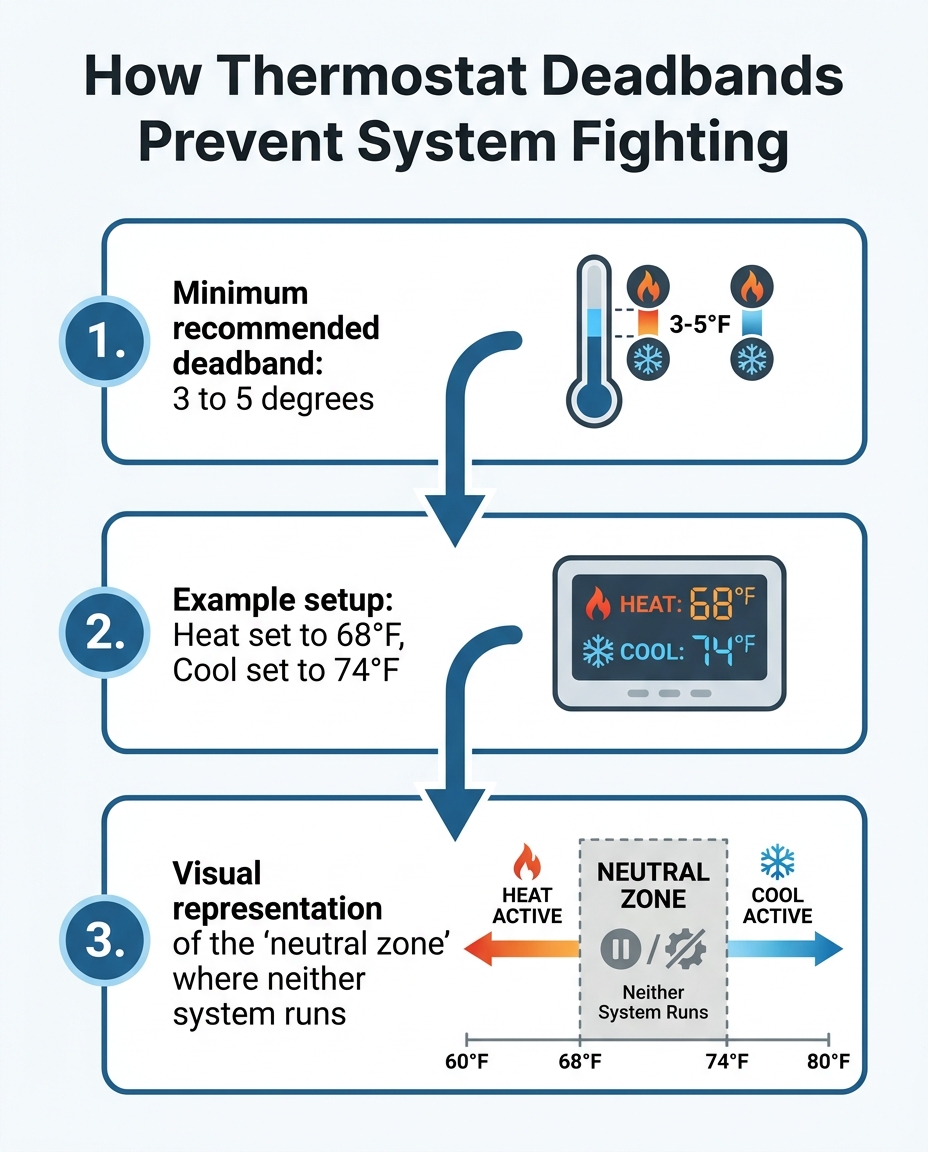
The deadband is the temperature range where neither heating nor cooling is active. It is the "neutral zone" or "coasting zone" between your heating setpoint and your cooling setpoint. If your heat is set to 68 degrees and your AC is set to 74 degrees, you have a 6-degree deadband. As long as the indoor temperature is sitting anywhere between 69 and 73 degrees, your HVAC system does absolutely nothing. It stays completely off.
Why a wider deadband is essential
Energy guidelines strongly recommend a minimum deadband of 3 to 5 degrees. If you set your deadband too narrow—for instance, setting the heat to 71 and the AC to 73—you are going to cause a disaster. As the sun rises, the house hits 74, and the AC kicks on. It cools the house rapidly. But because the deadband is so tight, the AC might overshoot slightly, dropping the house to 70. Instantly, the furnace kicks on to warm it back up to 71. Your systems will literally fight each other all day long.
Comparing Deadband Strategies
• 1 to 2 Degrees (Too Narrow) — Example Settings (Heat / Cool): Heat at 71°F / Cool at 73°F — System Impact during 30-Degree Swings: Severe short-cycling. AC and furnace fight each other constantly. High energy waste.
• 3 to 4 Degrees (Minimum) — Example Settings (Heat / Cool): Heat at 69°F / Cool at 73°F — System Impact during 30-Degree Swings: Acceptable for mild days, but may still trigger unnecessary switching during rapid afternoon warm-ups.
• 5 to 7 Degrees (Optimal for Fall) — Example Settings (Heat / Cool): Heat at 68°F / Cool at 74°F — System Impact during 30-Degree Swings: Maximum efficiency. Allows the home to naturally absorb heat and cool down without forcing the HVAC to intervene.
By utilizing a wide deadband, you allow the home to naturally cool as outdoor temperatures plummet in the evening. You aren't paying to heat or cool the house; you are simply letting the natural environment do the work while the thermostat stands guard at the extreme edges.

Structuring Your Daily Schedule Blocks for 'Second Summer'
Once you understand auto-changeover and deadbands, the next step is to apply them to a time-based schedule. Generic summer and winter schedules do not work when you are dealing with 90-degree afternoon highs. You need a highly specific strategy tailored for extreme late-summer temperature swings.
Optimizing these schedule blocks also supports better indoor air quality by reducing stagnant air periods. When the system runs in longer, more controlled cycles, the air filter has time to actually capture dust, pollen, and pet dander.
Based on the patterns we see most often in Southern California homes, here is how our team recommends structuring your daily checklist:
• Morning Block (6 AM - 10 AM): Focus on managing the lingering chill without over-heating the house before the sun peaks.
• Afternoon Block (12 PM - 5 PM): Implement pre-cooling strategies to handle peak solar heat gain.
• Evening Block (6 PM - 10 PM): Utilize wide deadbands to let the home naturally cool as outdoor temperatures plummet.
• Overnight Block (10 PM - 6 AM): Allow the temperature to drop slightly to promote better sleep while preventing the furnace from running unnecessarily.
Morning Adjustments for Swift Warm-Ups
During the morning block, your goal is comfort without commitment. The house is cold from the night before, but the sun is already rising.
• Set the heating setpoint just high enough: Aim for 67 or 68 degrees to remove the morning chill from the air.
• Avoid aggressive heating: Do not set the heat to 72 degrees. Aggressive heating will trap warmth in the house. As the day heats up, that trapped warmth will force your AC to turn on much earlier in the afternoon, wasting energy.
Afternoon Cooling Protocols
When the "second summer" heat hits its peak, your house will absorb a massive amount of solar radiation.
• Rely on the cooling setpoint: Set your cooling target to 74 or 75 degrees to manage the sudden spike in outdoor temperatures.
• Use ceiling fans: Supplement the AC with ceiling fans during the hottest hours. Fans create a wind-chill effect on your skin, making a 75-degree room feel like 71 degrees without forcing the compressor to run.
When to Consult a Local Expert for Thermostat Configuration
While adjusting a deadband or setting up a schedule is something most homeowners can handle, there is a distinct bridge between DIY programming and the need for professional HVAC assessment. The September early fall transition often reveals underlying issues that generic troubleshooting cannot fix.
Signs of miswiring or incompatibility
If you attempt to activate auto-changeover mode and notice that the system blows hot air when it should be cooling, or if the thermostat constantly reboots, you likely have a miswired system. Smart thermostats require a "C-wire" (common wire) to maintain constant power. Without it, the thermostat "steals" power from the furnace circuit, which can cause erratic behavior during rapid temperature swings.
The complexity of advanced systems
Furthermore, complex dual-fuel systems or multi-stage equipment require professional calibration. If you have a two-stage furnace or a variable-speed compressor, a standard smart thermostat might not be configured to utilize those lower speeds. It will just blast the system on high constantly, completely negating the efficiency benefits you paid for.
Our team at Power Pro Plumbing provides expert, localized HVAC solutions and smart thermostat programming tailored specifically to Southern California's volatile late-summer climate. We see the impact of these temperature swings every day. In fact, one local homeowner recently reached out when their system began experiencing confusing operational issues during a rapid temperature swing. Technician Emiliano visited the home, patiently explained the underlying problems with their setup, and provided clear, actionable solutions, ensuring the customer completely understood how to optimize their home's needs without stress.
Having a technician provide a patient explanation of your system's capabilities and optimal settings is invaluable. We highly recommend scheduling a fall heating tune-up to ensure the furnace is ready to handle the nighttime drops safely, and to verify that your thermostat is communicating flawlessly with the control board.
Frequently Asked Questions About Transitional Thermostat Settings
How do I set my thermostat for hot days and cold nights?
The most effective strategy is to use your thermostat's auto-changeover mode paired with a wide temperature range. Set your cooling target to around 74 degrees and your heating target to around 68 degrees. This allows the home to naturally absorb heat during the day and shed it at night without forcing the HVAC system to run constantly. Avoid making drastic manual adjustments, as this wastes energy.
What is a thermostat deadband?
A thermostat deadband is the specific temperature range between your heating setpoint and your cooling setpoint where the HVAC system remains completely off. For example, if you set your heat to 68 and cool to 73, the 5-degree gap between them is the deadband. It acts as a buffer zone, preventing the air conditioner and the furnace from rapidly switching back and forth.
How does auto changeover work on a smart thermostat?
Auto changeover is an advanced setting that allows the thermostat to automatically switch between heating and cooling modes based on the indoor temperature. You program a dual setpoint (one for heat, one for cool). The thermostat continuously monitors the room; if the temperature drops below the heat setting, the furnace activates, and if it rises above the cool setting, the AC turns on automatically.
Can my AC and heater run on the same day?
Yes, your AC and heater can absolutely run on the same day, and this is very common during the early fall in Cerritos. When afternoon highs reach 90 degrees and nighttime lows drop to 60 degrees, your home will likely require both systems within a 24-hour period. Using auto-changeover ensures they run efficiently without fighting each other.
Why does my house feel humid when the temperature drops at night?
When the outdoor temperature drops rapidly at night, your air conditioner stops running because the indoor temperature has naturally cooled down. However, because the AC is no longer running, it is no longer pulling moisture out of the indoor air. This lack of dehumidification, combined with cooler indoor air holding less moisture, makes the home feel noticeably more humid and clammy.
Is it bad for my HVAC system to switch from heat to cool daily?
Switching from heat to cool daily is not inherently bad for your HVAC system, provided the system is given enough time to rest between cycles. The danger comes from "short-cycling," where the system switches back and forth every few minutes. As long as you have a proper deadband (at least 3 to 5 degrees) programmed into your thermostat, daily switching is perfectly safe.
Ensure Your System is Ready for the Seasonal Shift
Proper thermostat management is the first and most important step in preventing premature equipment strain. When you master your schedule blocks and deadbands during the September early fall transition, you save money, improve your comfort, and extend the lifespan of your system.
However, if your system still struggles to keep up with the temperature swings, or if your thermostat is behaving erratically, it is time to get a professional assessment of your air conditioning performance and heating readiness. Reach out to the local experts at Power Pro Plumbing, Heating & Air to ensure your home is perfectly calibrated and ready for whatever the season brings.