

The Clock is Ticking: Stopping an Active Water Leak
Water is rapidly pooling across your hallway floor, and you realize that locating and shutting off your main water valve during a plumbing panic is the only thing standing between a minor cleanup and catastrophic home damage. At Power Pro Plumbing, Heating & Air, our dispatchers field frantic calls just like this every week. A sudden pipe burst or an overflowing fixture creates an immediate, stressful race against time. Every second that pressurized water continues to flow indoors multiplies the structural damage to your drywall, flooring, and personal belongings. Our team sees this precarious situation escalate often during the intense August late-summer heat, right as families are transitioning back to school and residential plumbing systems are already heavily stressed by high irrigation demands, peak water usage, and continuously running air conditioning condensate lines.
If you are dealing with an active indoor leak and need immediate professional assistance, contact our rapid response team for emergency plumbing repair, or learn more about our comprehensive residential plumbing services.
Before calling for professional help, a homeowner's first critical action is stopping the flow of water directly at the source. Most property damage occurs in the frantic window between the moment a leak starts and the moment the water is finally turned off. At Power Pro Plumbing, our commitment to customer education means we want to empower you to take immediate control of the situation. By knowing exactly where to go and what to do, you can safely stop the damage while our rapid response team is en route.
Locating and Shutting Off Your Main Water Valve During a Plumbing Panic
The psychology of an emergency: It is entirely normal to feel overwhelmed when water is actively flooding your living space. The sound of rushing water triggers a fight-or-flight response. However, running around the house grabbing towels will not solve the underlying issue. The single most effective action you can take is to bypass the immediate symptoms of the leak and head straight for the main water shutoff. Cutting off the supply depressurizes the entire residential system, instantly stopping the flow to the broken pipe or overflowing fixture. Once the water is off, the panic subsides, allowing you to assess the situation clearly and wait for our professional repair team without watching the damage multiply.
Why Southern California Homes Hide Their Shutoff Valves
If you search online for emergency plumbing advice, most national guides will tell you to frantically check your basement or crawlspace. In our years serving residents in our area, we've found that following this generic advice wastes precious time. Understanding the unique architectural layout of Cerritos CA and surrounding Southern California residential tracts is a pattern we see often as the first step to bypassing panic and going straight to the right location.
Because the climate in Southern California does not require digging below a deep winter frost line, the vast majority of homes in this region are built on concrete slab foundations. Our technicians know firsthand that this architectural standard fundamentally changes the plumbing layout of the house. Instead of a main water line entering through a subterranean basement wall, the primary supply line typically runs underground from the street meter, travels across your front yard, and rises above the ground just before entering the physical structure of your home.
What this means for you:
• Exterior placement: The main water shutoff valve is almost always located on the exterior perimeter of the house, not hidden indoors under a staircase.
• Stucco entry points: The supply pipe will visibly emerge from the soil and enter the stucco or siding of the exterior wall.
• No basement hunting: You will never need to search a basement, and we rarely see homeowners needing to navigate a dark attic to stop an active whole-house leak.
Knowing that your home's plumbing architecture is designed around a slab foundation allows you to ignore generic national advice. When an emergency strikes, you already know that the solution lies just outside your front door or inside your garage, saving you vital minutes when every second counts.
Step-by-Step: Where to Find Your Main Water Shutoff
When water is actively damaging your home, you need a precise, actionable search pattern. For homes in Cerritos CA and surrounding Southern California residential tracts, we recommend following these exact steps to locate your main water shutoff valve quickly—the same search pattern our own emergency plumbers use when arriving on scene.
1. Check the exterior front wall: Start your search on the exterior front wall of your house, facing the street. Walk the perimeter near your garden hose bib or front outdoor faucet. Look for a vertical pipe protruding from the ground and entering the wall. The main shutoff valve will be attached directly to this pipe, usually about one to two feet above the soil line.
2. Inspect the side yards: If the valve is not on the immediate front wall, check the side of the house closest to the street. In some local tracts, builders placed the main line entry point just around the corner from the front door to keep it hidden behind landscaping or gate enclosures.
3. Look inside the garage: If you cannot find an exterior valve, move your search to the garage. The main shutoff is frequently located near the water heater setup, especially if the water heater is elevated on a platform. Alternatively, check any garage wall that is shared with an interior kitchen or laundry room.
4. Locate recessed utility boxes: In certain newer developments, the valve may be housed inside a recessed utility box mounted flush against the stucco on the side of the house. These boxes usually have a metal or plastic access panel that swings open.
5. Do not confuse the house valve with the street meter: The city's street meter is located underground near the curb, usually under a heavy concrete lid. While it does control water to your property, it often requires a specialized tool (a water meter key) to operate and belongs to the municipal utility. Always aim for your home's dedicated shutoff valve first.
One homeowner reached out to us last fall when their main water line was leaking on the front lawn. Because they knew exactly where their exterior shutoff was located based on our guidance, they quickly stopped the flow before the yard completely flooded, turning a potential disaster into a manageable weekend emergency plumbing in Cerritos.
Identifying Your Equipment: Gate Valve vs. Ball Valve
Once you have located the main water line, you must identify the type of valve installed on the pipe. Our plumbing specialists constantly see that operating the valve correctly is crucial; using the wrong motion or applying too much force can cause the valve to break, escalating the emergency. In residential plumbing, you will encounter one of two primary designs: the gate valve or the ball valve.
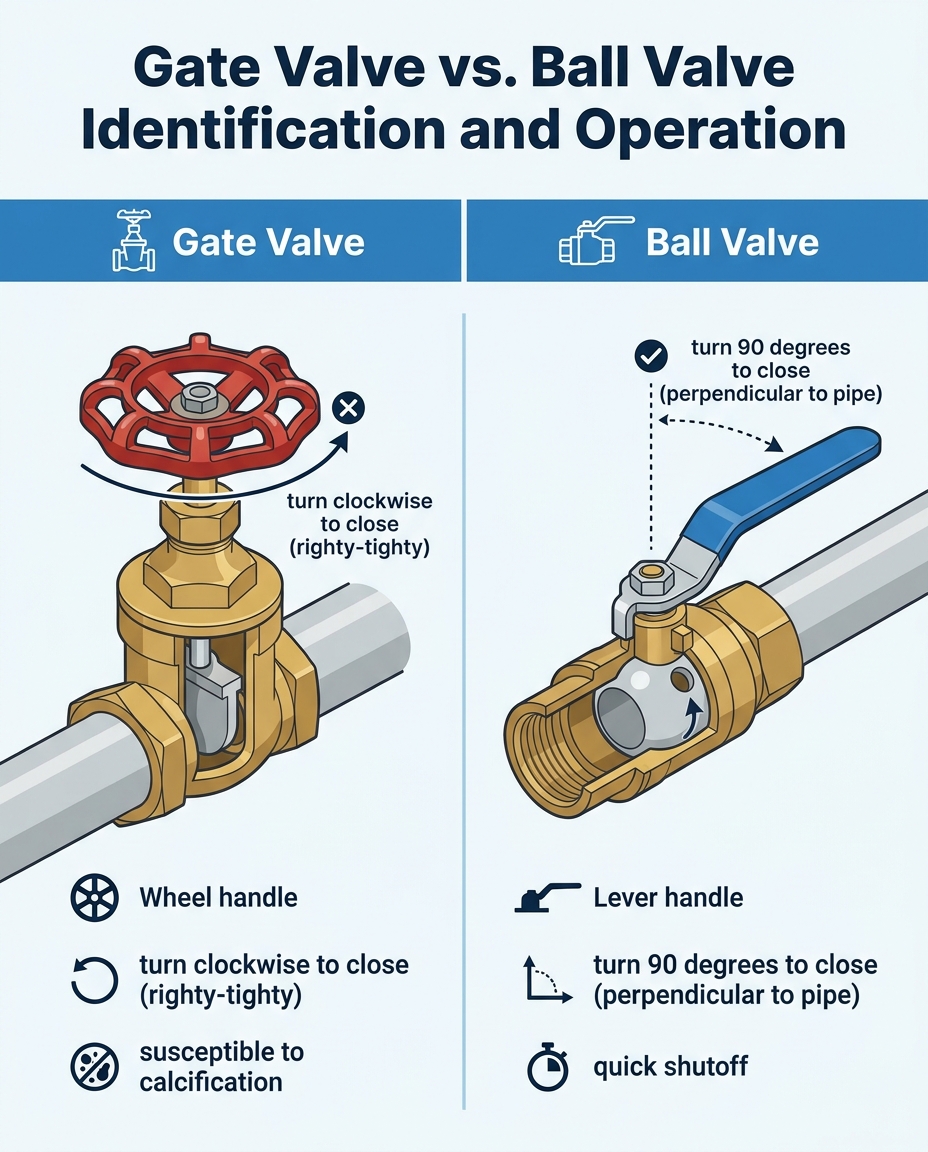
Understanding Gate valve (wheel) vs. Ball valve (lever) identification allows you to shut off the water safely and effectively.
• Handle Appearance — Gate Valve: Round, wheel-like handle (similar to a garden hose spigot) — Ball Valve: Straight, flat lever handle
• Operation Motion — Gate Valve: Turn clockwise repeatedly (righty-tighty) — Ball Valve: Turn exactly 90 degrees
• Internal Mechanism — Gate Valve: Lowers a brass gate to block water flow — Ball Valve: Rotates a sphere with a hole in the center
• Shutoff Speed — Gate Valve: Slow (requires multiple full rotations) — Ball Valve: Instant (a simple quarter-turn)
• Visual Status — Gate Valve: Difficult to tell if fully closed by looking — Ball Valve: Lever perpendicular to pipe = OFF
Operating a Ball Valve: If your home is equipped with a ball valve, stopping the water is incredibly straightforward. The lever handle runs parallel to the pipe when the water is turned on. To shut off the water, grasp the lever and make a simple 90-degree turn so that the handle sits completely perpendicular (forming a cross) to the pipe. This action immediately halts the flow of water into the home.
Operating a Gate Valve: If you have an older gate valve, you will need to turn the wheel handle clockwise. Remember the rule "righty-tighty" to close the valve. You must rotate the wheel repeatedly until it is fully seated and cannot turn any further. Do not stop at the first sign of resistance; the internal gate must lower completely to block the water pressure.

The Hard Water Hazard: Dealing with Stubborn or Stuck Valves
Because our team at Power Pro Plumbing regularly deals with Southern California's municipal water supply, we know firsthand the toll its high mineral content—commonly referred to as hard water—takes on fixtures. Over years of constant exposure, the calcium and magnesium in the water accelerate scale buildup inside your plumbing. This creates a severe regional complication for homeowners in Cerritos CA and surrounding Southern California residential tracts, particularly those with older homes.
Older gate valves are notoriously susceptible to this mineral buildup. The threaded brass stem inside the valve can become heavily calcified, essentially locking the wheel handle in the open position. When a plumbing panic strikes, a homeowner's first instinct is often to grab the stuck wheel and force it to turn.
The danger of excessive force: We constantly warn our customers: if the wheel handle feels stiff, gritty, or completely stuck, do not use excessive force, and absolutely never use heavy tools like a pipe wrench or a hammer to wrench it free. Forcing a severely calcified gate valve can easily snap the internal brass stem. If the stem snaps while the gate is raised, the valve will be permanently stuck in the open position. Worse, applying extreme torque can crack the valve body itself, creating a second, massive leak right at the main entry point of your home.
What to do if the main valve is stuck:
• Stop turning: If you cannot turn the wheel by hand with moderate effort, stop immediately.
• Do not use tools: Pliers and wrenches provide too much leverage and will shear older brass components.
• Pivot your strategy: If the main valve refuses to cooperate safely, immediately shift your focus to isolating the specific leaking fixture or waiting for our professional emergency assistance to address the main line safely.
Isolating the Issue: When to Shut Off Local Fixture Valves Instead
We always advise our local clients that not every plumbing panic requires shutting down the water supply to the entire house. If your main valve is stuck, or if you simply want to keep the water running to the rest of your home while dealing with a single overflowing sink, you can use localized shutoff valves. These are commonly known as "angle stops."
These smaller valves operate on the same mechanical principles as the main line. Applying your knowledge of Gate valve (wheel) vs. Ball valve (lever) identification works here as well. Older angle stops feature small oval handles that require multiple clockwise turns (righty-tighty), while modern angle stops are often quarter-turn ball valves that shut off instantly.
Common Localized Shutoff Locations
Knowing where to find these localized valves can save your flooring without interrupting your family's access to fresh water in other rooms.
• Underneath sinks: Look inside the cabinet beneath your bathroom or kitchen sink. You will typically find two angle stops against the back wall—one for the hot water supply (usually on the left) and one for the cold water supply (usually on the right). Turn both clockwise to isolate the faucet.
• Behind the toilet: Toilets only require a cold water supply. Look near the base of the toilet, close to the wall on the left side. You will see a single small valve connected to a flexible supply line. Turning this off stops an overflowing tank in seconds.
• At the water heater: If you are experiencing a water heater leak, look directly above or adjacent to the tank. You will find a dedicated shutoff valve on the cold water inlet pipe. Shutting this valve stops new water from entering the leaking tank.
• Behind the washing machine: Washing machines are connected to dedicated hot and cold valves, often housed in a recessed plastic box in the laundry room wall. If a washer hose bursts, pull the machine forward slightly and turn off both valves immediately.
Earthquake Preparedness: A Year-Round Reason to Know Your Valves
As local plumbing professionals, we know that locating your main water valve isn't just a reaction to a sudden pipe burst; it is a critical component of regional safety and homeownership. Southern California's frequent seismic activity makes knowing exactly how to shut off your main water and gas supplies a mandatory safety measure.
Following a significant earthquake, the shifting ground can easily compromise underground pipes. Even if you do not see water inside the house immediately, a fractured main line can lead to severe structural flooding, soil erosion under your slab foundation, or contamination of your fresh water supply. It can also overwhelm your drainage system, leading to unexpected drain and sewer issues.
For homeowners in Cerritos CA and surrounding Southern California residential tracts, our team recommends taking these proactive steps today for earthquake preparedness:
• Clear the path: Ensure the path to your exterior or garage shutoff valve remains completely clear of debris, overgrown landscaping, or stored boxes year-round. In an emergency, you do not have time to move heavy objects out of the way.
• Test the valve annually: Once a year, gently test your main water valve to ensure it moves smoothly. If it feels stiff or shows signs of heavy corrosion, schedule a professional replacement with our team before a crisis strikes.
• Educate the family: Make sure every responsible adult and teenager in the household knows exactly where the valve is and how to operate it.
Frequently Asked Questions About Water Shutoff Valves
Where is the main water shutoff valve in a house without a basement?
In homes built on slab foundations, the main water shutoff valve is typically located on the exterior front wall or inside the garage. You will usually find it connected to a vertical pipe emerging from the ground near the front garden hose bib. If it is not on the exterior perimeter, check the interior garage walls near the water heater setup.
Which way do you turn a main water valve to shut it off?
To shut off a main water valve, you must turn it clockwise, following the "righty-tighty" rule. If you have a gate valve with a round wheel, turn it to the right repeatedly until it stops completely. If you have a ball valve with a lever handle, turn it 90 degrees so the lever sits perpendicular to the water pipe.
How do you unstick a main water shutoff valve safely?
You should never use heavy tools or excessive force to unstick a main water valve, as this can snap the internal stem. If a valve is mildly stiff, you can try applying a penetrating oil to the stem threads and gently working it back and forth by hand. If the valve remains completely stuck due to heavy calcification, we recommend relying on localized fixture valves and calling a professional plumber to replace the main unit.
Can I shut off my water at the street meter?
While shutting off water at the street meter will stop flow to the house, our experts generally discourage it during an immediate panic. Street meters are often covered by heavy concrete lids, require a specialized meter key to turn, and technically belong to the municipal utility company. It is much faster and safer to use your home's dedicated exterior shutoff valve.
What is the visual difference between a gate valve and a ball valve?
A gate valve features a round, wheel-like handle, whereas a ball valve features a straight, flat lever handle. Applying Gate valve (wheel) vs. Ball valve (lever) identification is simple: the wheel requires multiple clockwise rotations to lower an internal gate, while the lever requires only a single quarter-turn to rotate an internal sphere, providing a much faster shutoff.
Next Steps After the Water is Off
Once the water flow has completely stopped, take a deep breath. The immediate panic is over, and the focus now shifts from damage mitigation to permanent repairs. We strongly advise you not to attempt to dismantle the broken pipes, cut into wet drywall, or force a stuck main valve to move once the pressure is off.
For homeowners in Cerritos CA and surrounding Southern California residential tracts, the safest next step is to bring in the experts at Power Pro Plumbing. Contact our local professionals to thoroughly assess the damage, repair the underlying plumbing issue, and restore full functionality to your home safely. Now that you have successfully handled locating and shutting off your main water valve during a plumbing panic, our highly trained technicians will handle the rest. We will dispatch quickly to ensure your home's plumbing is repaired correctly, giving you back your peace of mind and protecting your property from further water damage.