

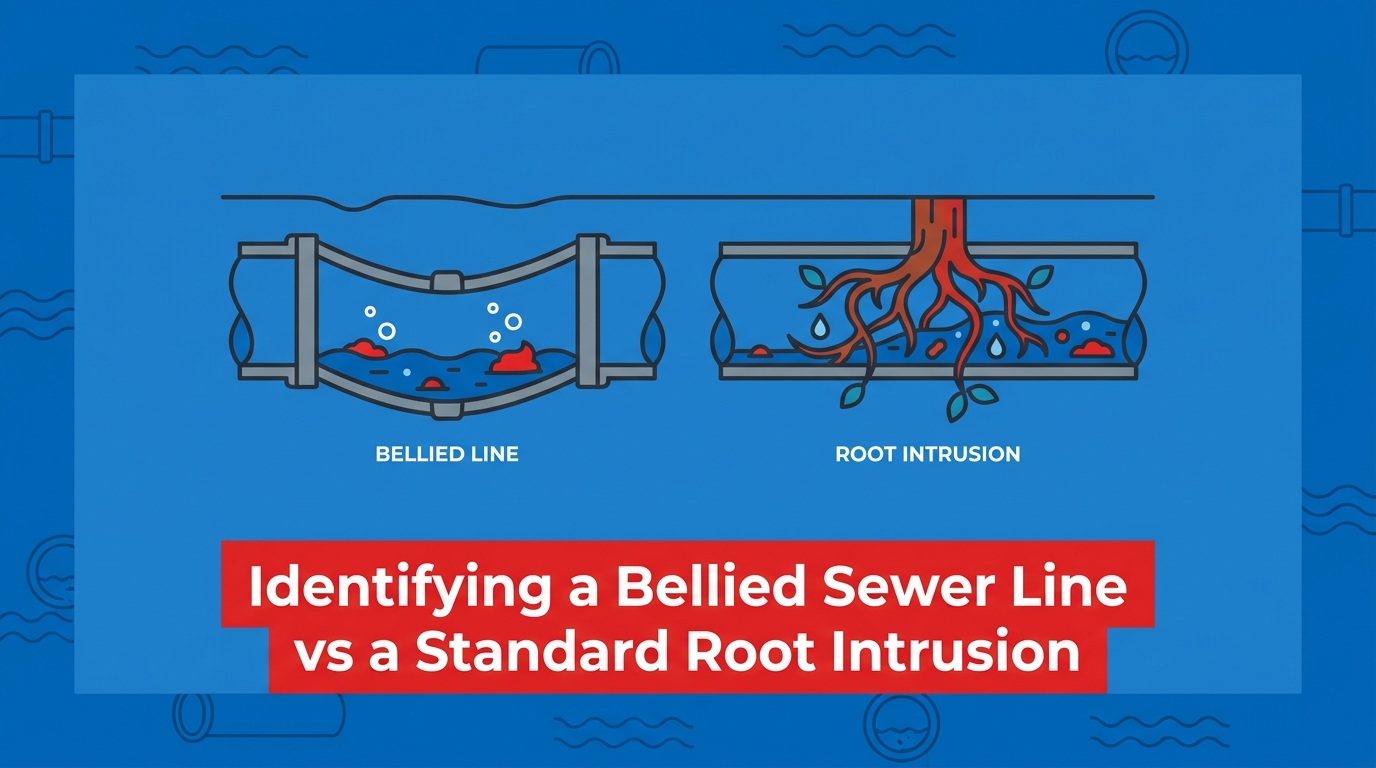
When Routine Drain Clearing Stops Working
When your toilets are gurgling and wastewater threatens to back up into your ground-floor tubs, identifying a bellied sewer line vs a standard root intrusion is the first step toward a permanent solution. If you recently paid to have your main line snaked, experiencing these same symptoms just a few months later is incredibly frustrating. You are left wondering if the plumber missed something, or if there is a much larger issue lurking beneath your lawn. Our team at Power Pro Plumbing, Heating & Air often sees homeowners stuck in this cycle of repeated backups, especially in older Cerritos neighborhoods.
For more information on how to break this cycle, you can explore our drain and sewer services.
Homeowners eventually face a crucial decision point: continue paying for routine snaking every few months to clear suspected blockages, or investigate the underlying structural integrity of the pipe. Taking action during early fall 2026—our recommended pre-rainy season preparation window—is highly recommended. Diagnosing the exact cause of the restriction before heavy winter rains saturate the ground can save you from catastrophic overflows inside your home. The two most common culprits for these recurring nightmares are physical root barriers and structural pipe sags, but they require entirely different approaches to fix.
The Physical Barrier: How Tree Roots Infiltrate Pipes
Underneath your yard, a silent battle is constantly taking place. The dry climate in Southern California drives thirsty tree roots deep underground, making them aggressively seek out any available moisture. Unfortunately, the most consistent source of water and nutrients in your yard is the wastewater flowing through your sewer lines. Older vitrified clay or cast iron pipes—especially those installed in homes built prior to 1980—are particularly vulnerable to this organic invasion.
Mature tree roots exert immense pressure on the soil and surrounding structures. If there is even a microscopic hairline crack or a slightly loose joint in your plumbing, roots will find it. While a mechanical auger can temporarily tear through these roots, it does not stop them from growing back. It is essentially giving the roots a haircut, leaving the core problem unresolved. If you want to know what to look for above ground, checking for signs of tree roots in sewer lines is a great place to start.
The Anatomy of a Root Clog
Understanding how roots completely choke off a standard 3-inch or 4-inch residential pipe requires looking at the biological process of infiltration. It happens in three distinct stages:
1. Moisture vapor escaping: Warm water vapor escapes from loose pipe joints or tiny cracks, creating a condensation trail in the soil that attracts nearby roots.
2. Penetration and expansion: Hair-like roots slip into the pipe. Once inside, they feast on the continuous supply of water and fertilizer, rapidly expanding into a dense, net-like mass that catches solid waste and toilet paper.
3. Total line failure: As the root mass thickens, it exerts outward pressure on the interior walls. The pipe eventually cracks further or collapses entirely under the organic stress.
The Structural Sag: Understanding a Bellied Sewer Line
While root intrusions are a biological problem, a bellied sewer line is a purely structural failure. A "belly" is a low spot or sag in the underground pipe where the natural downward slope has been compromised. Residential sewer systems do not use pumps to move waste away from your home; they rely entirely on gravity and precise angling. When that angle is lost, gravity stops working in your favor.
In Cerritos and surrounding Southern California communities, our technicians frequently see local geology playing a massive role in this issue. Seismic activity and expansive clay soils that are prone to shifting contribute directly to ground settling. When the earth beneath the pipe sinks or washes away, the pipe loses its supportive bedding and sags under its own weight. Because this is a structural deformity rather than an organic intrusion, chemical root killers and traditional clearing methods are completely useless.
Why Gravity Fails in a Sagging Pipe
The precision of slope: Normal sewer lines use a precise, continuous downward slope—usually a standard quarter-inch drop per foot of pipe—to carry wastewater into the municipal system.
The artificial valley: A sag creates an artificial valley or bowl in the middle of the run. Water cannot flow uphill, so it rests permanently in this low spot, creating a stagnant pool.
The accumulation of solids: As wastewater flows into the belly, the water might eventually spill over the other side, but solid waste and paper drop out of the flow. They accumulate in the valley, quickly building a sludge dam that blocks the entire line.
Why Both Issues Share the Same Warning Signs
One of the most challenging aspects of residential plumbing is that completely different underlying causes often produce the exact same symptoms inside the house. Whether your pipe is choked by a web of roots down to a half-inch opening, or sagging into a subterranean valley holding 10 gallons of stagnant water, the flow of wastewater is severely restricted. This leads to the identical visible outcomes that frustrate homeowners.
You will likely notice gurgling toilets when the washing machine drains, slow emptying across multiple sinks, and the terrifying sight of raw sewage backing up into the lowest tubs or showers. Furthermore, foul odors are prevalent with both issues. A root net traps organic matter that slowly decays inside the pipe, while a pipe belly holds a stagnant, rotting pool of pooling waste. Because the symptoms mirror each other so closely, symptom analysis alone is insufficient for a proper diagnosis.
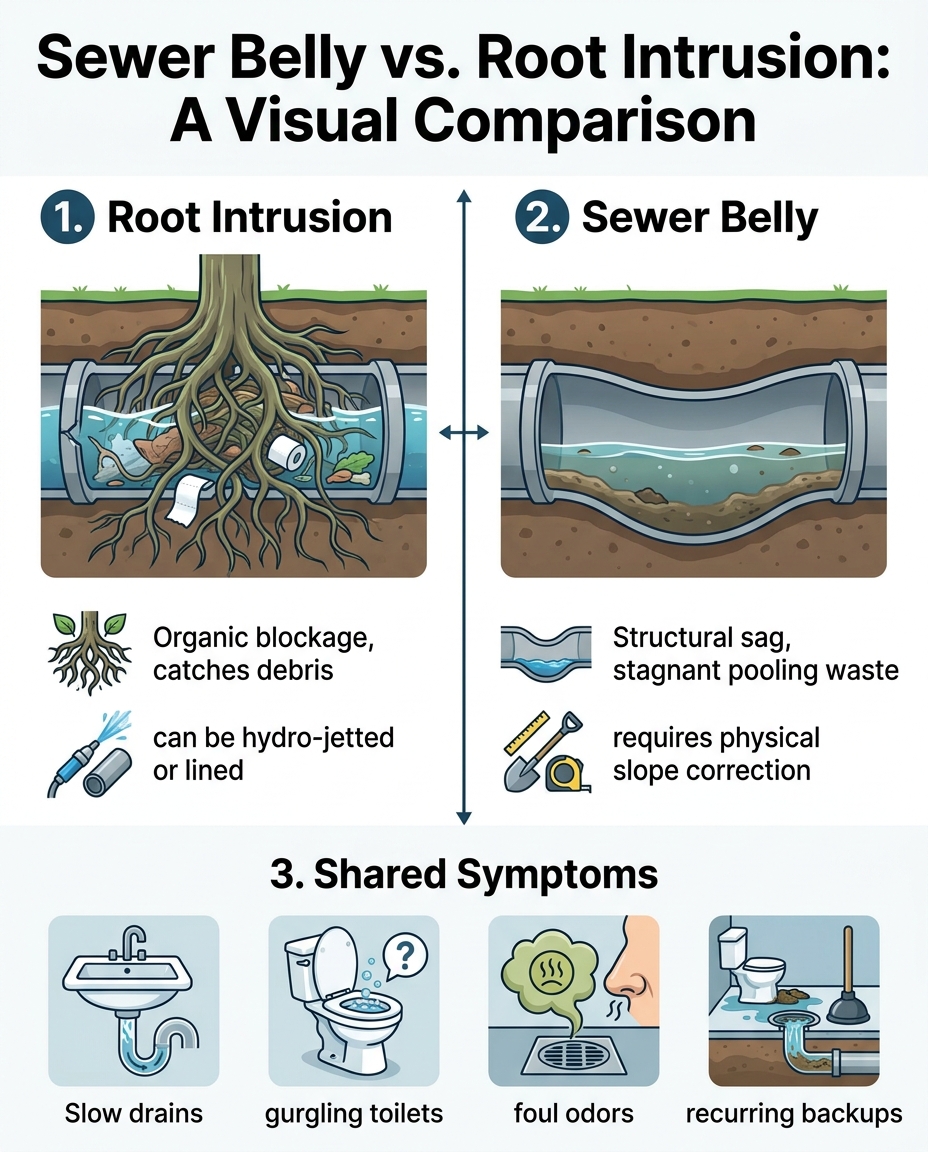
• Drain Speed — Root Intrusion: Progressively slower as roots grow thicker. — Bellied Sewer Line: Consistently slow; stops completely when valley fills.
• Odor Source — Root Intrusion: Decaying waste trapped in the fibrous root net. — Bellied Sewer Line: Stagnant pooling waste sitting in the low spot.
• Snaking Result — Root Intrusion: Temporary relief until roots grow back (months). — Bellied Sewer Line: Immediate recurrence as soon as solids fill the sag (days).
• Primary Cause — Root Intrusion: Organic growth seeking moisture. — Bellied Sewer Line: Structural settling and soil shifting.

The Hidden Reason Snaking Won't Fix a Sagging Pipe
If you have ever hired a plumber to clear a main line, you are likely familiar with a plumbing snake or auger. This tool consists of a heavy-duty, spinning metal cable with a cutting head attached to the end. It is specifically designed to punch a hole through a solid physical barrier, such as a localized clump of paper, grease, or a dense wall of tree roots.
The mechanics of failure: When our technicians run a rapidly spinning snake and it hits a bellied line, the cable simply passes through the stagnant pool of water and sludge. It might stir up the waste enough to let some water drain temporarily, but it does absolutely nothing to change the physical structure of the pipe. The cable pulls back out, the technician assumes the line is clear, and the artificial valley remains.
The inevitable return: Because the low spot was never corrected, the line will inevitably back up again as soon as the valley fills with new solid waste—often within just 48 to 72 hours. This realization is often the turning point for homeowners who are tired of being stuck in a cycle of repeated, ineffective service calls. A mechanical auger cannot fix a gravity problem.
Eliminating Guesswork with High-Definition Diagnostics
The only way to definitively tell the difference between these two major issues is to look inside the pipe. A CCTV sewer camera inspection removes all the mystery from the equation. By feeding a 1080p high-definition camera through your property's cleanout, a technician can provide a real-time, visual assessment of the pipe's interior condition.
During the inspection, the technician is looking for specific visual cues. If roots are the issue, the camera will clearly show fibrous masses protruding through joints or cracks. If a belly is the problem, the camera head will physically submerge underwater as it enters the sagging section, only emerging once it reaches the other side of the valley. Utilizing professional, high-definition sewer camera inspection technology ensures that the exact cause is accurately diagnosed without any destructive guesswork.
One local homeowner reached out during a recent fall service call regarding a recurring plumbing issue that required a thorough explanation. Our Power Pro Plumbing technician utilized diagnostic tools to explain everything being done during the prompt, efficient visit, ensuring the homeowner saw the exact problem on screen. This level of transparent communication prevents you from wasting money on the wrong repair method. For a comprehensive approach to your home's infrastructure, turning to professional plumbing solutions guarantees you get the full picture before any digging begins.
Mapping Out the Right Repair Path for Your Home
Once you have a clear visual diagnosis, the path forward diverges entirely based on what the camera revealed. Treating a belly like a root intrusion will just drain your wallet, and vice versa. Here is how the two different diagnoses dictate entirely different repair strategies:
1. Assessing structural integrity: If the camera reveals roots but the pipe itself is still round and structurally sound, the repair path is less invasive.
2. Clearing organic barriers: Root intrusions can often be managed with high-pressure hydro jetting operating at 3,000 to 4,000 PSI to obliterate the organic matter. If the pipe has minor cracks, trenchless pipelining can be installed to seal off the entry points and prevent future growth without digging up your yard.
3. Correcting structural sags: A severe belly almost always requires physical excavation. There is no trenchless shortcut to fix a pipe that has sunk into the earth. The sagging section must be dug up, the soil must be re-compacted with proper bedding, and a new section of pipe must be installed at the correct downward slope.
4. Ensuring long-term success: Accurate diagnostics dictate the success of the repair. Working with licensed professionals who can explain the long-term implications of each repair path ensures you make the right investment for your property.
Take the Guesswork Out of Your Home's Plumbing
Recurring backups are a symptom, not the root cause. Continuing to snake a line that backs up every few months is treating the symptom while ignoring the disease. Whether you are dealing with aggressive tree roots or a structural sag caused by shifting soil, symptom analysis alone will not solve the problem.
Stop wasting resources on temporary fixes and get a definitive visual diagnosis. By scheduling a camera inspection this September, you can clearly see the physical difference between a root clog and a bellied pipe. Address these vulnerabilities now before the late fall seasonal changes exacerbate the issue, and explore your options for professional sewer line repair to restore reliable flow to your home.
Frequently Asked Questions
What is the difference between a sewer belly and a root intrusion?
A sewer belly is a structural defect where the pipe sags into a low spot, creating a stagnant pool of waste that disrupts gravity flow. A root intrusion is a biological blockage where tree roots penetrate cracks in the pipe to seek moisture, creating a physical net that catches debris. One is caused by shifting soil, while the other is caused by organic growth.
Why does my sewer line keep backing up after snaking?
If your line backs up shortly after snaking, the auger likely just punched a temporary hole through a root mass or passed harmlessly through a bellied pool of water. Snaking does not stop roots from growing back, nor does it correct the slope of a sagging pipe. A recurring backup is a strong indicator of a deeper structural or severe infiltration issue.
Can a bellied sewer line be fixed without digging?
No, a severe belly almost always requires excavation to fix properly. Because the issue is caused by the pipe sinking into the ground and losing its downward slope, trenchless methods like pipelining cannot correct the angle. The earth must be dug up to install proper bedding and realign the pipe.
How do you know if you have roots in your sewer line?
Common indicators include gurgling toilets, slow drains, foul odors in the yard, and patches of unusually lush, green grass above the sewer line. However, because these symptoms overlap with other plumbing failures, a camera inspection is the only way to confirm the presence of roots definitively.
How much does a sewer camera inspection typically reveal?
A high-definition camera inspection reveals the exact interior condition of your entire main line in real-time. It will show the precise location of root masses, the depth and severity of any bellied sections, cracked joints, and overall pipe degradation, removing all guesswork from the diagnostic process.
Does homeowners insurance cover a sagging sewer line?
Insurance coverage for a sagging sewer line depends heavily on your specific policy and the cause of the damage. Standard policies often exclude damage caused by natural earth movement, soil settlement, or general wear and tear. You should review your policy details or speak with your insurance agent to understand your specific underground utility coverage.