

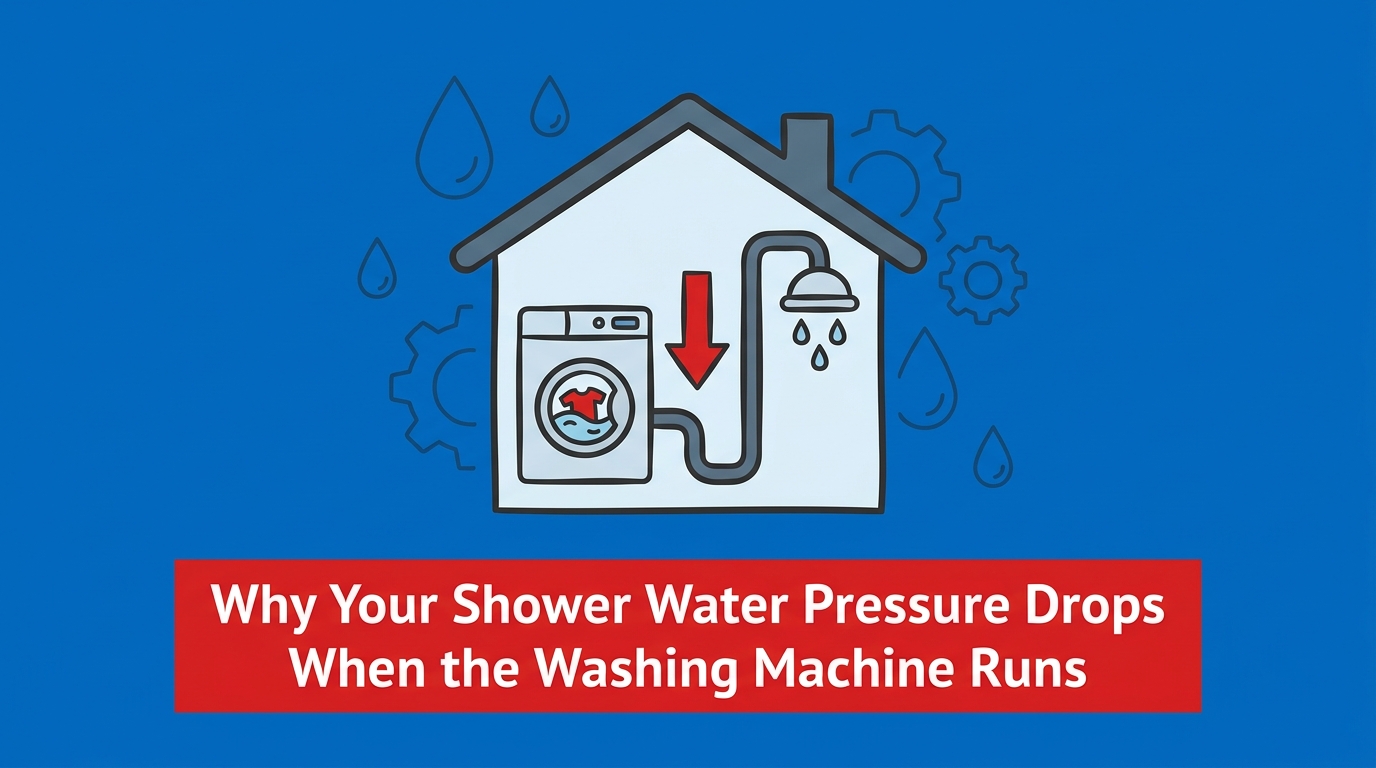
Why Does the Shower Go Weak When the Washing Machine Fills?
Have you ever wondered why your shower water pressure drops when the washing machine runs? You step in for a warm, relaxing rinse, but the moment that washer fills, your strong showerhead turns into a weak, freezing trickle. This frustrating daily interruption is a concrete problem that forces families to schedule their routines around laundry day. While it is incredibly tempting to blame a clogged showerhead or a bad cartridge, simultaneous fixture use actually exposes hidden bottlenecks deeply rooted in your plumbing system. Most of the time, the root cause is a failing main water Pressure Reducing Valve (PRV) struggling to keep up with the demand of multiple appliances. Identifying the true cause requires professional diagnostic testing rather than guesswork.
If you are tired of dealing with sudden temperature swings and weak flow, our team at Power Pro Plumbing, Heating & Air provides professional plumbing services to locate and resolve the exact bottleneck in your Cerritos home's system.
Understanding the Physics: Water Pressure vs. Water Volume
To understand why your plumbing system chokes under demand, you have to look at the critical difference between static pressure and dynamic volume. Many homeowners assume that if water sprays hard out of one faucet, their "pressure" is fine. However, pressure and volume are two completely different physical properties of your plumbing system. When multiple fixtures run simultaneously, the system relies on volume to keep everything flowing smoothly.
What is Static Water Pressure (PSI)?
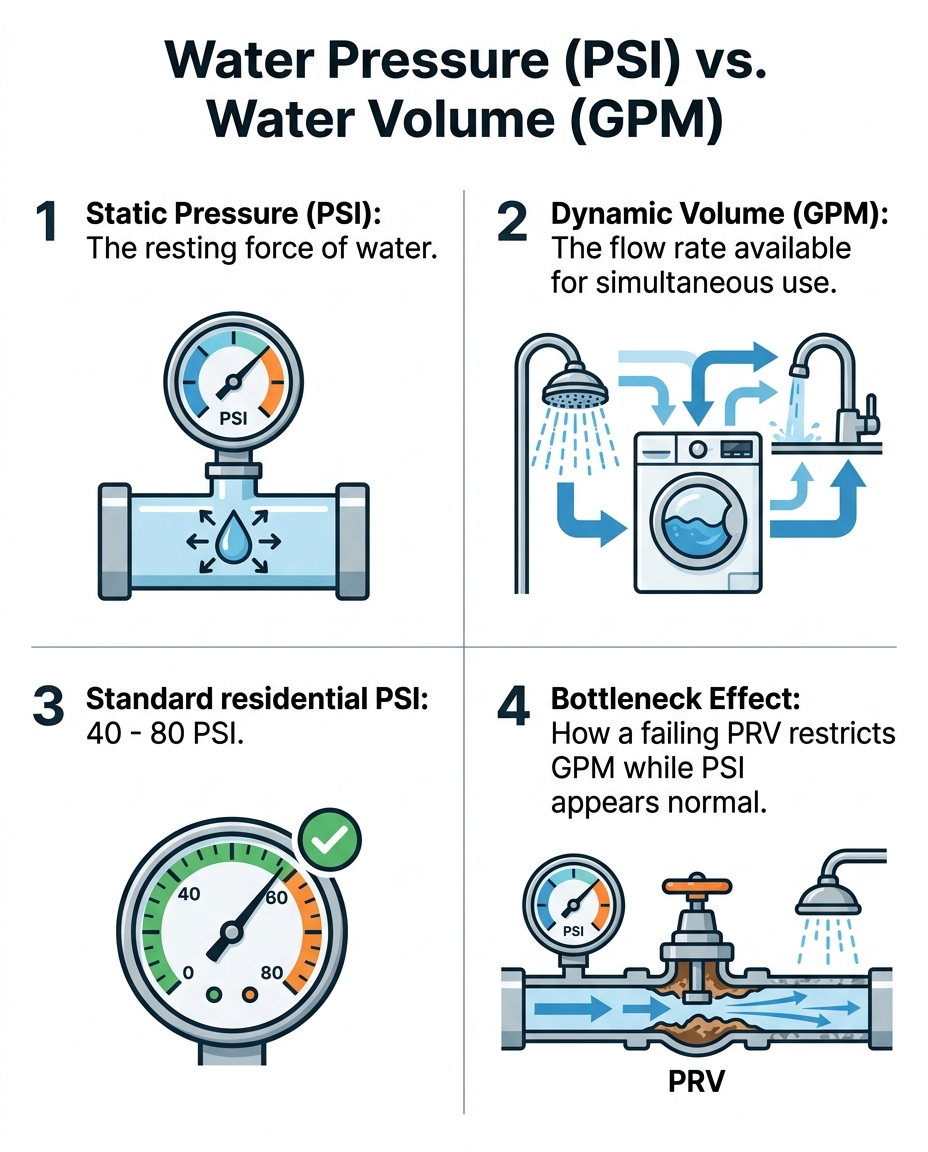
Static water pressure is the resting force of water in your system when absolutely no fixtures are running. It is measured in Pounds per Square Inch (PSI). According to the Uniform Plumbing Code (UPC), standard residential water pressure should be between 40 and 80 PSI.
• The resting force: PSI is simply how hard the water pushes against the inside of your pipes when the valves are closed.
• The gauge illusion: Static pressure can read perfectly normal on a gauge even if there is a severe, restrictive blockage in the main line. This is because the water has time to build up force behind the closed faucet.
• High pressure dangers: If PSI exceeds 80, it puts immense strain on pipe joints, appliance hoses, and fixture seals, leading to premature leaks.
What is Dynamic Water Volume (GPM)?
Dynamic water volume is the actual flow rate of water moving through the pipes when fixtures are open. It is measured in Gallons Per Minute (GPM). This is the true measure of how much water is available for simultaneous use.
• The flow rate: GPM dictates whether you have enough water physically entering the home to supply a shower and a washing machine at the exact same time.
• The real culprit: Restricted volume is the true culprit when multiple appliances run. A home can have a normal static PSI of 60, but if the volume is severely restricted, the pressure will immediately plummet the second a second fixture draws water.
• Meeting demand: A standard showerhead uses about 2.5 GPM, while a washing machine might demand 3 to 5 GPM while filling. If your system can only deliver 4 GPM total due to a bottleneck, one of those fixtures is going to be starved of water.

The Role of the Main Water Pressure Reducing Valve (PRV)
Your home's plumbing system is directly connected to the municipal city water supply. Often, city water is pumped at incredibly high pressures—sometimes well over 100 PSI—to ensure it reaches every home, fire hydrant, and commercial building in the neighborhood. To protect your home's internal pipes from this destructive force, a main water Pressure Reducing Valve (PRV) is installed where the water line enters your house.
The PRV is a bell-shaped mechanical device containing a heavy-duty spring and a flexible rubber diaphragm. As municipal water enters the valve, the diaphragm restricts the opening, stepping the pressure down to a safe 40 to 80 PSI. However, as a PRV ages or fails, its internal components degrade. The rubber diaphragm can become stiff, brittle, or stuck in a partially closed position.
When this mechanical failure occurs, the valve severely restricts the flow (volume) of water entering the home. Because the PRV controls the water supply for the entire house, a failing valve means the total GPM available to your plumbing system drops dramatically. That is exactly why a high-demand appliance like a washing machine starves the shower of water. The system simply cannot pull enough water through the broken PRV to satisfy both fixtures at once. Diagnosing and replacing a main PRV is a highly complex task that requires specialized tools and the expertise of a licensed professional. If you suspect your main valve is failing, it is time to look into comprehensive plumbing repair services.
How Hard Water Accelerates Plumbing Bottlenecks
In our years of servicing residential plumbing throughout Cerritos and Southern California, our team at Power Pro Plumbing, Heating & Air has seen firsthand how local municipal water sources play a massive role in plumbing wear and tear. Our local water often exceeds 10 to 15 grains per gallon (gpg) of hardness. We frequently find that this high mineral content specifically targets mechanical valves and accelerates the bottlenecks that ruin your shower experience.
Mineral Scale and the PRV Mechanism
Hard water is packed with dissolved calcium and magnesium. As water flows through your main line, these minerals precipitate out and stick to the brass and copper surfaces inside your plumbing. Over time, this creates a thick, chalky buildup known as mineral scale.
• Coating internal parts: Scale coats the internal springs, strainer screens, and diaphragm of the main PRV.
• Loss of movement: This calcification prevents the valve from opening fully or adjusting to sudden demands for water. When the washing machine turns on, a scaled-up PRV cannot flex to allow more volume through, resulting in an immediate pressure drop in the bathroom.
Reduced Pipe Diameter
The main valve is not the only component affected by hard water scale. The pipes themselves suffer from this invisible buildup, which drastically cuts your system's overall capacity.
• Clogged arteries: Years of hard water scale act exactly like clogged arteries in a home's plumbing system. The scale builds inward, layer by layer.
• Physical restriction: This reduces the physical space water has to travel through. A pipe that was originally three-quarters of an inch in diameter might be reduced to half an inch, drastically lowering the maximum GPM the pipe can carry.
This mineral accumulation creates immense system strain, affecting everything from basic showerheads to complex water heating appliances. If you live in an older home, understanding how scale affects flow is a critical part of diagnosing pressure drops in older homes.
Fixture-Specific Issues vs. Whole-House Failures
When you experience a sudden drop in flow, it is important to differentiate between a localized problem and a systemic, whole-house failure. If the pressure drop only happens in one specific bathroom, the issue might be localized. For example, a clogged showerhead or a faulty pressure-balancing shower cartridge might be the culprit. These shower cartridges are designed to prevent scalding by balancing hot and cold water; if they fail, they can severely restrict flow to that one shower.
Contrast this with systemic drops. If flushing a toilet, running the dishwasher, or using the washing machine affects water flow everywhere in the house, the bottleneck is located at the main line or the PRV. Sudden volume drops can also negatively impact sensitive appliances. For instance, a tankless water heater requires a minimum flow rate (usually around 0.5 GPM) to activate its burners. If the washing machine steals all the volume, the water heater might shut down entirely, turning your shower ice cold.
• Pressure drops only in the master bathroom shower. — Likely Cause: Clogged showerhead or faulty pressure-balancing cartridge. — Scope of the Problem: Localized to one specific fixture.
• Shower goes weak when the washing machine or dishwasher runs. — Likely Cause: Failing main PRV or severe main line volume bottleneck. — Scope of the Problem: Systemic (Whole-House).
• Hot water suddenly turns freezing cold when a toilet is flushed. — Likely Cause: Pressure-balancing valve reacting to a drop in cold water volume. — Scope of the Problem: Systemic volume restriction affecting the water heater.
• Water flow is weak at every faucet, regardless of simultaneous use. — Likely Cause: Main PRV is stuck closed or municipal supply is severely restricted. — Scope of the Problem: Systemic (Whole-House).
Why Professional Diagnostic Testing is Essential
Guessing at plumbing issues often leads to wasted time and unnecessary expenses. Replacing showerheads and swapping out bathroom cartridges will not solve a volume bottleneck located at the front of your house. This is why thorough root-cause diagnostic testing is the only way to effectively resolve the problem.
The Dangers of DIY Pressure Adjustments
It is crucial to warn homeowners against attempting DIY PRV adjustments. Many people find the bell-shaped valve and attempt to tighten the adjustment bolt to increase their water pressure.
• Dangerous pressure spikes: Adjusting a PRV without proper commercial gauges can easily exceed safe PSI limits, sending 100+ PSI into your home.
• Catastrophic damage: This high pressure carries a massive risk of blowing out appliance seals, bursting older pipes, and voiding warranties on water heaters and washing machines.
Comprehensive System Testing
Our commitment to thorough diagnostic testing ensures the actual root cause is resolved, rather than just patching symptoms. Professionals test both static and dynamic pressure using specialized gauges attached to multiple points in the home. By measuring the resting PSI and then watching how the gauge reacts when a high-demand fixture is opened, a licensed technician can isolate the exact location of the bottleneck.
At Power Pro Plumbing, Heating & Air, our team sees the value of patient diagnostics every day. Just recently, during an early fall service call here in Cerritos, a homeowner was dealing with mysterious flow issues that were ruining their morning routine. Our technician arrived, provided a patient explanation of the pressure versus volume problems, and laid out probable solutions. Because we always prioritize educating our customers on the diagnostic results, they felt completely informed and confident in the repair plan. Thorough testing ensures the correct repair is implemented the very first time.
Timing Your Plumbing Diagnostics for the Season
Ignoring volume bottlenecks only leads to worse performance over time as scale continues to build and mechanical valves degrade further. What starts as a minor annoyance when the washing machine runs will eventually turn into a complete lack of usable water flow across the entire house.
As we move into September, this early fall transition before holiday guest plumbing demand hits is the absolute best time to address whole-house plumbing issues. During the holidays, your plumbing system faces maximum stress. You have extra guests taking back-to-back showers, the washing machine running constantly to clean guest linens, and the dishwasher working overtime. If your main PRV is already struggling to supply a single shower and a washing machine today, it will completely fail when your home is full of visitors.
Resolving PRV issues proactively ensures your plumbing system can handle increased simultaneous demand. Taking care of main line bottlenecks in the fall guarantees that your system will perform flawlessly when you need it most. Additionally, if your pressure issues are tied to an aging, scale-filled water heater, early fall is a great time to upgrade, as generic federal tax credits and utility incentive programs may apply to qualifying high-efficiency installations—just be sure to verify current programs with your utility provider or tax professional.
Frequently Asked Questions About Simultaneous Water Demand
Why does water pressure drop when two things are running?
It indicates a volume bottleneck in the main supply line or a failing PRV. When two fixtures run, the system cannot supply enough Gallons Per Minute (GPM) to satisfy multiple fixtures at once. The static pressure drops rapidly because the pipes are being drained faster than the main line can refill them. Resolving this requires locating the exact point of restriction in the main water supply.
How do I know if my pressure reducing valve is bad?
Symptoms include sudden pressure drops when multiple taps are on, hammering noises in the pipes, or abnormally high static pressure. You might also notice a vibrating or humming sound coming from the walls when water is running. Because these symptoms can overlap with other plumbing issues, a professional gauge test is required to confirm whether the PRV has failed.
How do you fix a water pressure drop when multiple taps are on?
The fix depends on the diagnostic results; it usually involves replacing the main PRV or clearing a blockage in the main line. If the valve's internal diaphragm is stiff or covered in mineral scale, the entire unit must be cut out and replaced with a new one. This process requires professional plumbing services to execute safely and ensure the new valve is calibrated correctly.
Why does my shower go cold when the washing machine fills?
Washing machines draw a large volume of cold water very quickly. If the system has a volume bottleneck, the cold water supply to the shower drops significantly, leaving mostly hot water flowing. However, modern pressure-balancing shower valves sense this drop in cold water and automatically restrict the hot water to prevent you from being scalded, which results in a weak, cold shower.
Can hard water destroy a Pressure Reducing Valve?
Yes, excessive mineral scale can heavily coat the internal components of a PRV. The calcium and magnesium in hard water precipitate out and stick to the brass and rubber parts inside the valve. This calcification prevents the valve from moving freely, leading to a permanent restriction in water volume and eventual mechanical failure.
Will replacing my showerhead fix the pressure drop when the washer runs?
No, a new showerhead will not fix a systemic volume issue. If the pressure drops specifically when another appliance runs, the issue is systemic (a lack of available volume), not localized to the showerhead itself. While a low-flow showerhead might mask the symptom slightly, it does not repair the failing main valve causing the bottleneck.
Get to the Bottom of Your Water Pressure Problems Today
Living with frustrating pressure drops and scheduling your showers around the washing machine is completely unnecessary. As we have seen, a clear explanation of volume versus pressure physics points directly to a mechanical issue that requires professional attention, not a quick DIY fix.
If your shower flow vanishes the moment a major appliance turns on, it is time to stop guessing. Reach out to Power Pro Plumbing, Heating & Air to schedule a comprehensive diagnostic inspection with our team. We will pinpoint the main PRV bottleneck safely and provide the expert plumbing repair services you need to restore strong, reliable water flow to your entire home.