

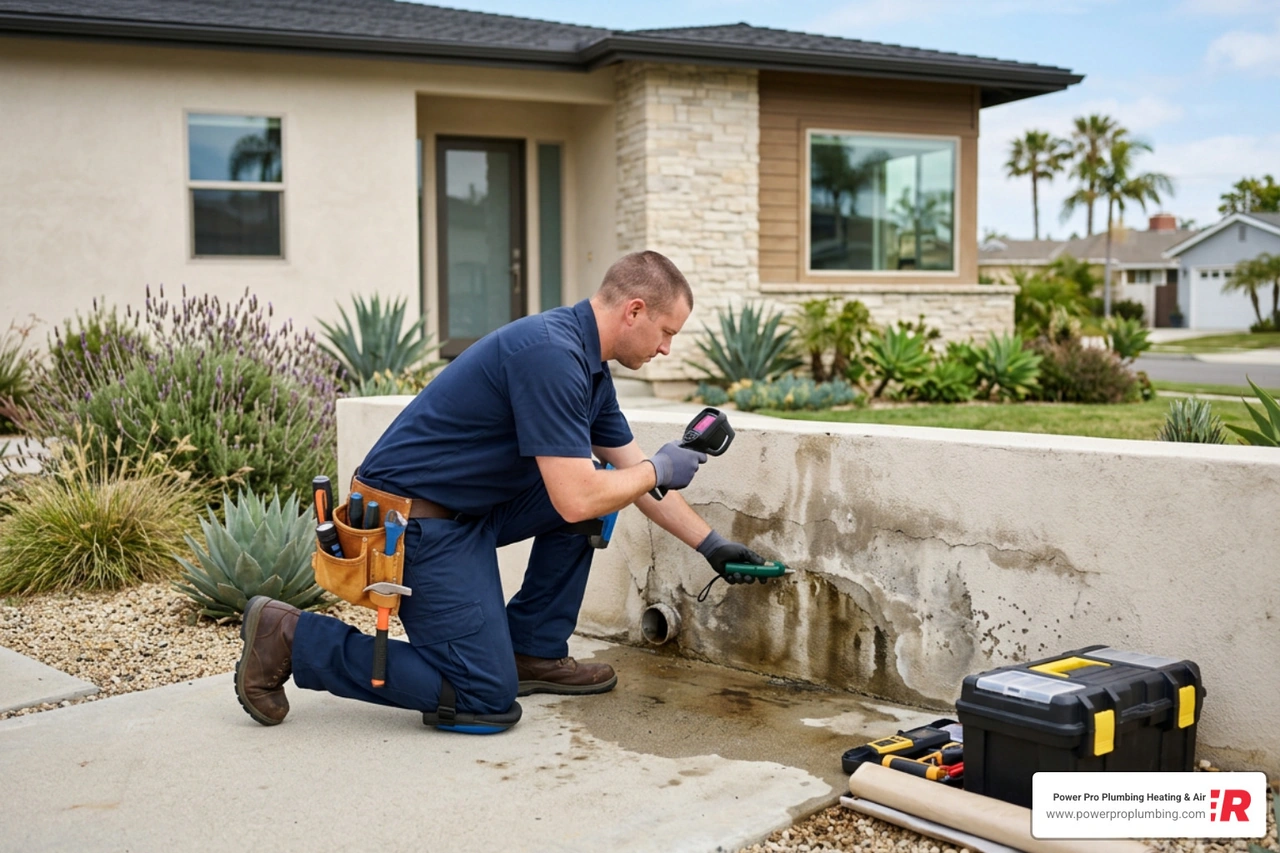
What Are the Hidden Plumbing Problems That Cost Los Angeles and Orange County Homeowners the Most?
The hidden plumbing problems that cost los angeles and orange county homeowners the most fall into a handful of categories that quietly drain your wallet long before you ever see visible damage:
- Slab leaks - Pinhole leaks in copper pipes beneath your concrete foundation, worsened by hard water corrosion and seismic activity
- Hard water pipe corrosion - Orange County's water averages 13+ grains per gallon, accelerating scale buildup and premature pipe failure
- Root intrusion in sewer lines - Tree roots seeking moisture can crack and block underground clay pipes
- Galvanized pipe deterioration - Common in pre-1970 homes, corroding from the inside out and restricting flow
- Running toilets and silent fixture leaks - A running toilet alone can waste up to 200 gallons of water per day
- Underground irrigation leaks - Outdoor leaks that never surface visibly but show up on your water bill every month
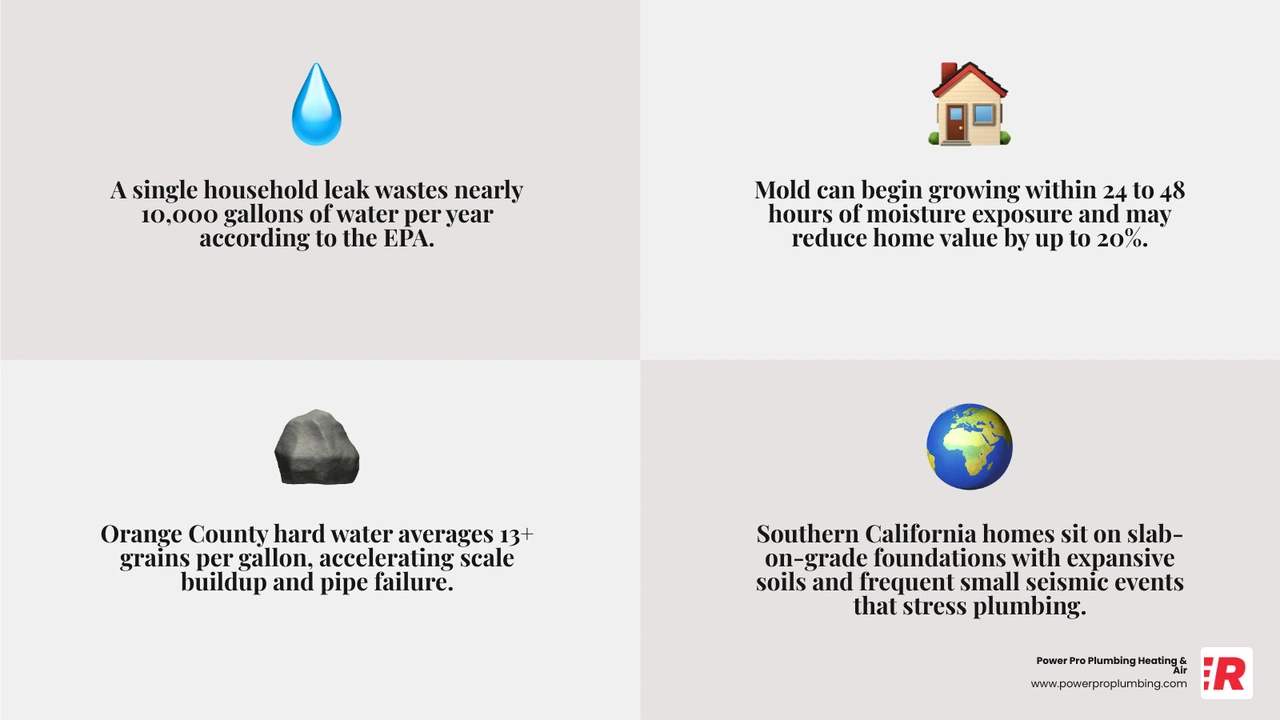
Most Southern California homeowners don't find out they have a plumbing leak until it has already done real damage. By then, what started as a slow drip beneath a concrete slab or a corroding joint inside a wall has turned into a mold problem, a foundation issue, or a water bill that doesn't make sense. According to the EPA, a single household leak can waste nearly 10,000 gallons of water per year — and in a region where water costs are already high and homes sit on slab-on-grade foundations, the stakes are even higher than the national average.
In Greater Los Angeles and Orange County, the combination of aging housing stock, hard municipal water, expansive soils, and thousands of small seismic events each year creates conditions that are uniquely harsh on residential plumbing systems. A slow leak behind drywall in a Cerritos ranch home or a pinhole leak under the slab of an Anaheim bungalow can go undetected for months — silently wasting water, feeding mold colonies, and weakening the structure around it. Mold can begin to grow within just 24 to 48 hours of moisture exposure, and left unchecked, it can reduce a home's market value by up to 20%.
I'm Daniel Rodriguez, a second-generation tradesman with C36 and C20 licenses in plumbing and HVAC, and I've spent years working inside Southern California homes where the same hidden plumbing problems that cost los angeles and orange county homeowners the most repeat themselves across neighborhoods and decades. In this guide, I'll walk you through exactly what to look for, how to catch these issues early, and when it's time to stop guessing and call a licensed professional.
Hidden Plumbing Problems That Cost Los Angeles and Orange County Homeowners the Most
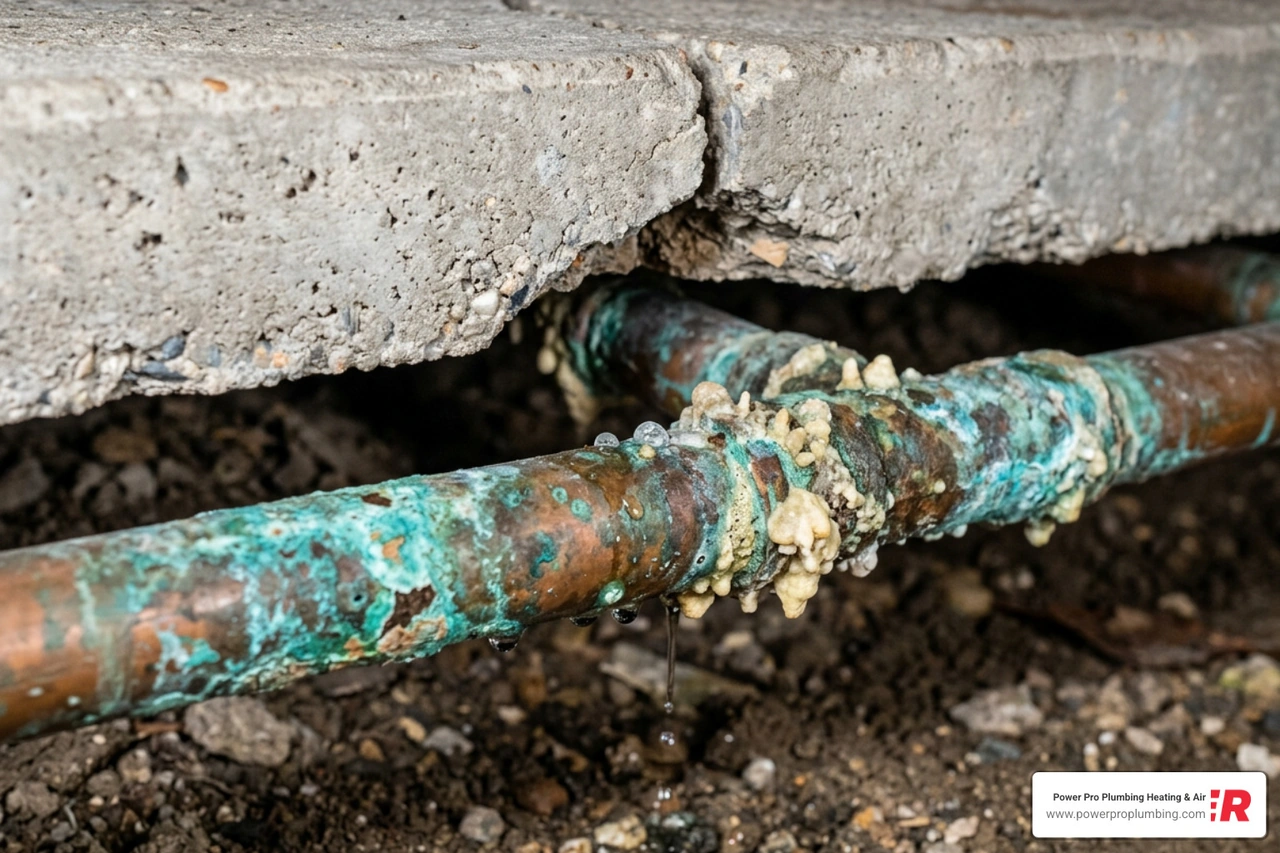
When we talk about the hidden plumbing problems that cost los angeles and orange county homeowners the most, we are looking at issues that develop completely out of sight. Unlike a burst washing machine hose that floods your hallway in minutes, these silent threats can simmer behind your walls, deep in your yard, or under your concrete foundation for months—or even years—before making their presence known.
Every neighborhood has its own structural patterns. If you walk through a 1960s ranch home in Garden Grove or a mid-century bungalow in Long Beach, you are looking at different piping materials and foundational vulnerabilities than a newer development in Irvine or Mission Viejo. However, regardless of the age of your home, certain Plumbing Red Flags You Should Not Ignore consistently lead to major property damage and financial strain.
Among the 10 Common Plumbing Issues we resolve daily, underground sewer line root intrusion is a major culprit. Southern California’s warm, dry climate means local trees—especially thirsty species like ficus, eucalyptus, and willow—will aggressively seek out moisture. Your sewer line, particularly if it is older clay pipe, carries warm, nutrient-rich water. Over time, tiny hairline cracks allow moisture to escape, drawing roots that force their way through the joints. This leads to stubborn, recurring clogs, structural pipe collapses, and raw sewage backups that require extensive excavation or trenchless restoration.
Slab Leaks: The Most Destructive Hidden Plumbing Problems That Cost Los Angeles and Orange County Homeowners the Most
Because Southern California basements are virtually non-existent, the vast majority of homes in Los Angeles and Orange County are built on slab-on-grade foundations. This means your home's concrete foundation is poured directly onto the soil, with your main water supply lines running directly underneath or through that concrete slab.
Slab leaks develop when these underground copper pipes experience pinhole leaks. There are three primary forces driving this phenomenon in our area:
- Seismic Activity: Southern California experiences thousands of minor, unfelt seismic events every year. While they rarely cause visible structural damage, these tiny ground shifts create friction, causing copper pipes to rub continuously against the rough concrete and rocks surrounding them until the pipe wall wears thin.
- Expansive Soils: The clay-rich soil common in areas like the South Bay and Orange County swells when wet and shrinks when dry, putting immense physical stress on buried plumbing joints.
- Chemical Reaction (Electrolysis): A chemical reaction between the minerals in the soil and the copper piping can corrode the metal from the outside in, while hard water eats away at it from the inside.
Once a pinhole leak forms, water escapes under high municipal pressure. It doesn't take long for that water to find its way upward. It saturates the concrete, rots the wooden floor joists, warps expensive hardwood floors, and ruins carpets.
Even worse, the constant presence of moisture beneath your home creates the perfect breeding ground for mold, which thrives in dark, humid environments. Because mold can begin colonizing within 24 to 48 hours of moisture exposure, a slab leak that goes undetected for months can quickly lead to a massive mold remediation project.
Furthermore, the escaping water can wash away the supporting soil beneath your foundation, leading to foundation settlement, drywall cracks, sticking doors, and uneven floors. To prevent these catastrophic structural failures, it is vital to understand Why Hire Professional Leak Detection Specialists for Plumbing Leaks and how early Leak Detection Prevents Major Issues.
Hard Water and Pipe Corrosion: Why These Are Hidden Plumbing Problems That Cost Los Angeles and Orange County Homeowners the Most
If you live in Orange County, you are dealing with some of the hardest water in the nation, often averaging 13 grains per gallon or higher. This high mineral concentration is primarily made up of calcium and magnesium. While completely safe to drink, hard water is incredibly tough on your pipes, fixtures, and water heaters.
Over time, these minerals precipitate out of the water, forming a rock-hard scale inside your plumbing system. This scale acts as an insulator inside your water heater, meaning the system has to work twice as hard to heat the water through a thick layer of sediment. This leads to premature water heater failure, often in as little as 8 to 12 years.
Additionally, older homes built before 1970 throughout Los Angeles and Orange County often still rely on galvanized steel pipes. As galvanized pipes age, their protective zinc coating wears away, exposing the raw iron to oxygen and minerals. This leads to severe internal corrosion, which restricts water flow and causes pinhole leaks at the joints.
To help you visualize the difference, here is a comparison of how hard water accelerates damage compared to normal wear and tear:
| Plumbing Component | Normal Wear & Tear Over Time | Hard Water Accelerated Damage |
|---|---|---|
| Copper & Galvanized Pipes | Gradual thinning of walls over 40–50 years | Rapid pinhole leak formation, internal scale buildup, and restricted flow |
| Water Heater Tanks | Minor sediment accumulation flushed during annual maintenance | Pounds of mineral sediment solidifying at the bottom, causing overheating and tank cracking |
| Faucet Aerators & Showerheads | Minor aesthetic wear, easily cleaned | Thick white or greenish crust blocking water flow, destroying internal cartridges |
| Appliance Valves (Washers/Dishwashers) | Slow, predictable seal degradation | Mineral deposits locking valves open or closed, leading to sudden indoor floods |
Understanding the Common Causes of Plumbing Leaks and Recognizing 10 Subtle Indicators of a Significant Plumbing Issue in Your Home can save you from a complete whole-house repipe.
Early Warning Signs of Hidden Leaks Homeowners Often Miss
Many homeowners assume that a plumbing leak will make itself obvious with a dramatic spray of water or a ceiling that is actively dripping. In reality, the vast majority of costly leaks are incredibly subtle. If you don't know what to look, listen, and smell for, you could be living right on top of an active leak for months.
Here are the primary early warning signs of hidden leaks that are frequently overlooked:
- Unexplained Water Bill Spikes: If your water usage habits haven't changed, but your monthly bill has jumped by 15% or more, there is a strong chance water is escaping somewhere in your system. A hidden leak can waste 90 gallons of water a day without ever showing its face on your living room ceiling.
- Persistent Low Water Pressure: If you notice a gradual drop in water pressure across all your faucets, or if you can no longer run the shower and the washing machine at the same time, you aren't just dealing with a minor annoyance. This is a classic sign of internal pipe corrosion or an active leak diverting water away from your fixtures.
- Musty, Earthy Odors: If you open the cabinet under your kitchen sink or walk into your guest bathroom and notice a damp, musty smell that never goes away—even after a thorough cleaning—moisture is accumulating nearby.
- Warm Spots on the Floor: If you walk barefoot across your kitchen tile or laminate flooring and notice a spot that feels unusually warm, you are likely standing directly over a hot-water slab leak. (In fact, we often hear stories of family dogs finding these warm spots and claiming them as their favorite new napping places!)
- Gurgling Drains: If your toilet bubbles or your sink gurgles when you run the washing machine or take a shower, it indicates air is trapped in your drainage system. This points to a blocked sewer line or a compromised vent pipe.
Paying close attention to these signs is critical. Learning about Detecting Water Leaks Home and realizing that an Unexplained High Water Bill Could Be a Leak are your first lines of defense. If you suspect an issue behind your drywall, knowing How to Detect a Water Leak Behind Walls can prevent extensive structural damage.
How to Detect Hidden Leaks Before They Cause Major Damage
You don't have to wait for a disaster to find out if your plumbing system is compromised. There are several simple, non-destructive tests you can perform yourself, alongside advanced diagnostic tools that professional plumbers use to pinpoint issues with absolute precision.
The most effective DIY test is the Water Meter Test:
- Turn off every water-consuming appliance and fixture inside and outside your home (washing machine, dishwasher, faucets, sprinklers, and ice makers).
- Locate your water meter, which is typically found in a concrete box near the street or sidewalk.
- Open the cover and look at the meter dial. Many meters have a small, triangular "low-flow indicator" (often red or blue) that spins even with the slightest water movement.
- If that indicator is spinning, or if the digital numbers are climbing while all water is shut off, you have an active leak.
- If you don't see an immediate change, write down the exact reading, wait 30 minutes without using any water, and check it again. Any change in the numbers confirms a hidden leak.
If you live in a specific community, such as Cerritos, understanding the unique soil and construction challenges of your area is highly beneficial; read more about Hidden Water Leaks in Cerritos Homes to see how local factors play a role. Additionally, you should regularly Detect Hidden Water Leaks in Your Bathroom by checking around the base of your toilet, shower pan, and vanity.
If your water meter test confirms a leak, or if you are noticing any of the warning signs mentioned above, it is highly recommended to schedule a professional inspection. Modern leak detection specialists use non-invasive technology—such as thermal imaging cameras that detect temperature differences caused by hidden moisture, and acoustic listening devices that can hear the sound of escaping water through feet of concrete—to locate the exact source of the problem without tearing up your home. If you aren't sure where to start, review these 5 Signs You Need a Plumbing Inspection.
When to Call a Professional Plumber vs. DIY Fixes
As a homeowner, it is satisfying to tackle home improvement projects yourself. Many minor plumbing tasks are perfectly safe and cost-effective for a handy homeowner to handle over a weekend:
- Replacing a worn toilet flapper: If your toilet is constantly running, a quick trip to the hardware store for a new flapper valve can stop you from wasting up to 200 gallons of water per day.
- Cleaning faucet aerators: If a single faucet has low pressure, unscrewing the aerator at the tip and soaking it in vinegar will quickly clear out hard water mineral scale.
- Clearing simple sink clogs: Using a standard plunger or a hand-cranked drain snake to clear hair out of a bathroom P-trap is a great DIY fix.
However, attempting to DIY complex plumbing issues can quickly lead to disastrous consequences. Some of the most common plumbing mistakes include using harsh chemical drain cleaners (which can eat through older cast iron and copper pipes) or accidentally overtightening fittings, which can crack pipes and cause massive indoor floods.
You should always leave the following situations to licensed, professional plumbers:
- Slab Leaks: Locating and repairing a leak under concrete requires specialized acoustic equipment, thermal imaging, and advanced repair methods like pipe rerouting or trenchless pipe bursting.
- Sewer Line Issues: Recurring backups require a professional sewer line camera inspection to see exactly what is happening underground, followed by hydro-jetting or trenchless pipe lining.
- Gas Line Work: Any issue involving gas lines, gas water heaters, or suspected gas leaks is a major safety hazard that requires immediate professional intervention.
- Water Heater Failures: Replacing or repairing a water heater involves high pressure, electrical wiring, or natural gas connections that must comply with strict local building codes.
To protect your home and family, make sure you understand which Plumbing Problems Homeowners Should Never Ignore and which Plumbing Problems That Need a Professional. If you are dealing with a sudden, uncontrollable leak or a sewer backup, you need to know When a Plumbing Problem Is an Emergency so you can act immediately.
Frequently Asked Questions about Southern California Plumbing Issues
Plumbing systems in Southern California face unique challenges due to our climate, geology, and local water quality. Here are answers to some of the most common questions we receive from local homeowners.
How can a simple water meter test detect a hidden leak?
A water meter test works by isolating your home's plumbing system. By shutting off all water fixtures and appliances, no water should be moving through your main water line. If the low-flow indicator on your water meter continues to spin, or if the digital reading changes after 30 minutes of zero water usage, it proves that water is escaping from your pipes. This is an incredibly reliable, non-invasive way to confirm an active leak. For a step-by-step walkthrough, check out our guide on Detecting Water Leaks Home.
What are the specific signs of a slab leak in Southern California homes?
Because slab leaks occur beneath a thick layer of concrete, they can be difficult to spot. The most common signs include unexplained warm spots on your floor, the sound of running water when all faucets are turned off, cracks appearing in your foundation or drywall, damp carpet or warped flooring, and a sudden, unexplained jump in your water bill. If you notice any of these symptoms, it is crucial to consult a professional; learn more about Why Hire Professional Leak Detection Specialists for Plumbing Leaks.
Why do my drains gurgle when I use other fixtures?
If your drains gurgle when you flush the toilet or run the washing machine, it means your plumbing system is struggling to vent air properly. When water flows down your drains, it needs to pull air behind it to keep things moving smoothly. If your roof vent pipes are blocked (often by bird nests or leaves) or if your main sewer line is partially clogged by tree roots, air gets trapped and bubbles back up through your sink or shower P-traps, causing that distinct gurgling sound. This is one of the 10 Common Plumbing Issues that requires professional diagnostics.
Conclusion
Ignoring a plumbing issue to save time or money is a risky gamble that rarely pays off. What starts as a tiny pinhole leak or a slow-draining pipe can quickly escalate into a catastrophic emergency, resulting in extensive structural damage, mold growth, and astronomical repair bills.
Taking a proactive approach to your plumbing maintenance is the single best way to protect your home and your budget. By scheduling routine professional inspections, installing water softeners to combat Southern California's notoriously hard water, and addressing minor leaks immediately, you can reduce your long-term plumbing repair costs by up to 30%.
At Power Pro Plumbing Heating & Air, we have spent years helping homeowners across Greater Los Angeles, Orange County, and the South Bay keep their plumbing systems running safely and efficiently. With over 28,573 online reviews and a dedicated team of highly trained, licensed technicians, we are committed to providing the honest, reliable service your family deserves. Whether you suspect a hidden slab leak, are dealing with a stubborn clog, or want to protect your home with our Power Pro Club maintenance program, we are here when you need us.
If you have noticed any of the warning signs you have a hidden plumbing problem, don't wait for a costly flood—reach out to our friendly team today to schedule an inspection.